Hull’s MCAS results show students’ growth as well as areas for improvement

By Carol Britton Meyer

School administrators recently presented an overview of Hull students’ scores on this past spring’s Massachusetts Comprehensive Assessment System (MCAS) exams to the school committee, naming two critical areas of focus – student attendance and low participation in the exams as compared to statewide numbers.

“Overall, we did very well,” Superintendent of Schools Judith Kuehn told The Hull Times in a follow-up telephone interview.

While some results were praiseworthy, there are areas of concern.

“We have such high expectations,” she said.

Director of Curriculum and Assessment Christine Cappadona explained the latest MCAS test results, with Hull High School Principal Michael Knybel, Memorial School Principal Tony Hrivnak, and Jacobs Elementary School Principal Kyle Shaw providing details for their individual schools.

* Math achievement was at or above the statewide results in grades 3 to 7 and grade 10.

“Overall, we saw typical student growth, but our expectation is high growth,” Cappadona said. Student growth percentiles complement the MCAS year-by-year test scores, measuring change in achievement over time rather than grade-level achievement results in any one year, according to the Massachusetts Department of Elementary and Secondary Education website.

“We want to ensure that our students are really learning the content [of the subjects they are studying] as well as achieving high scores,” Cappadona told The Hull Times. “We want to see our students grow and exceed their expectations,” including students who are already good test-takers.

* The Hull Public Schools ranked number one in both 10th-grade English language arts and mathematics when compared with similar districts and schools with regard to size, demographics, and other considerations. “This provides a level playing field, comparing apples with apples, so to speak,” Kuehn said. “In this comparison, we are always at the top, and we’re proud of that.”

This year Cappadona and Kuehn compared Hull’s MCAS results with those of students in the neighboring communities of Hingham, Cohasset, and Norwell, and Hull students fared “pretty well,” Kuehn said.

* HHS students’ average was above the state in ELA, math, and science,” Cappadona reported, “and they are in the top 20% in ELA and math.”

* Memorial Middle School results were mixed. “However, we saw significant growth in the sixth-grade math results,” Cappadona said. “They were 19% above the state average in meeting and exceeding expectations.”

* Jacobs School had strong reading and language scores, while the writing scores declined, consistent with the statewide results. Math and science scores were above the state average.

As was the case nationwide, student learning in Hull was impacted by the COVID19 pandemic.

Two critical areas of focus in the Hull Public Schools accountability results were attendance and the MCAS participation rate.

According to Cappadona, 28.9% of HPS students missed 18 days (10 percent) of school last year, and 4.9% of the students missed 36 days, or 20 percent. The average number of days missed was 13.

This is not surprising since students who exhibited potential COVID19 symptoms were encouraged to stay home from school, which resulted in “a loss of critical instruction time,” along with COVID-restricted in-person learning, according to Kuehn.

The Class of 2026 as middle-schoolers was particularly hard hit, entering sixth grade followed by a shutdown of in-person learning halfway through, and then in seventh and eighth grade, implementation of COVID-related restrictions that cut back on the usual in-person learning opportunities and face-to-face instruction, Kuehn explained.

Steps are being taken to help students at all levels make up for the lost learning, “but this is challenging and takes time,” she said.

HPS used money from the COVID-related Elementary and Secondary School Emergency Relief fund (ESSER) in part to pay for summer scholarships for some children to participate in the Hull Parks & Recreation Program and benefit from socialization, and to start an intramural track program for students in grades 6 and 7, and an eSports program for students who enjoy participating in electronic sports, a form of competition using video games.

In addition to attendance issues, the HPS MCAS participation rate was low compared to the statewide numbers, according to Cappadona.

“Our rate is low compared to the state, meaning we did not have 100% of our students in each grade take the test,” Kuehn explained. “We are a small district, which means that a small number of students not taking the test has a significant impact. There are a small group of elementary and middle school parents who choose to opt-out [their children].”

Visit www.hulltimes.com for a link that shows how each of the Hull Public Schools’ participation rates compares to other schools within the Commonwealth.

Each school district is expected to maintain a participation rate of 95% or higher for each subject-area test. Any school or district with a participation rate below 95% is considered to have low assessment participation.

“Hull participation rates differ at each grade level,” Kuehn noted. “Overall, this is an area of improvement for the district.”

Cappadona called the overall MCAS process as it relates to Hull Public Schools a collaborative effort.

“There are tests everywhere [at all different levels of students’ time in school and beyond], and we want them to learn the strategies for test-taking,” Cappadona said.

While keeping up with the overall state MCAS results is not the only consideration, helping students achieve higher scores is considered to be a priority.

A number of action steps are in place to help students who need assistance at different levels for various reasons.

Districtwide strategies for improvement include comprehensive curriculum reviews, curriculum mapping, deeper learning, more enrichment time, a focus on writing skills, benchmark and formative assessments, data meetings, and a consistent K-12 student-intervention process.

 Curriculum maps encourage teachers to discuss best practices and share resources, improving the overall level of teaching across a school district. Parents benefit from structured curriculum maps because they make them aware of learning targets for their children. Students are given coherent curriculum throughout the class, with a constant flow of knowledge from term to term and year to year.

Cappadona and Kuehn praised the school system’s leadership team and teachers for their hard work during the pandemic and now.

“They remain dedicated, and we want to acknowledge them so that they know they are valued and appreciated,” Kuehn said.

Board pledges support for diversity, sets Nov. 30 date to fill HRA, planning board vacancies

By Carol Britton Meyer

Following a previous presentation to the select board by the No Place for Hate Committee about the possibility joining the Metropolitan Area Planning Council’s Massachusetts Municipal Diversity, Equity, and Inclusion Coalition and developing a DEI policy for the town, the committee asked the select board to adopt a related pledge at its meeting last week.

The following wording was approved: “The Hull Select Board believes in the strength and vitality of an inclusive, equitable, and diverse community. We will work to support and promote these qualities in Hull through the town’s policies and operations.”

“We fully support the work of the committee,” select board Chair Jennifer Constable said.

The town joining this coalition is among the committee’s key goals. DEI is based on the premise that diversity, equity, and inclusion are three distinct values “that municipal leaders should actively seek to understand, define, and incorporate into their daily practice.”

The committee is planning to do research on DEI and to prepare, with the select board’s support, an application to MAPC for a technical assistance grant to support facilitation, training and planning for communitywide engagement about this program.

The board asked the committee to draft a grant application to present to board members at an upcoming meeting.

In other business last week, planning board Chair Harry Hibbard notified the board that due to the election of Irwin Nesoff to the select board during the last town election, there is currently a vacancy on the planning board. The term of the current open seat ends in 2025.

HRA Chair Bartley Kelly also submitted a letter to the select board informing them of the recent resignation of Vice Chair Robert DeCoste, effective Oct. 17.

Kelly asked the board to schedule a time for a joint meeting with the HRA “to consider candidates to temporarily fill [this] seat until the next town election,” when the position will be filled for the remainder of DeCoste’s term, which expires in May 2026.

The select board will meet in joint session with the HRA and the planning board on Nov. 30 to discuss these vacancies.

Town Manager Philip Lemnios encouraged citizens interested in filling these positions to contact the select board office.

Veterans Day ceremonies include street-naming honor for late General Butch Neal

Veterans Day ceremonies at Monument Square on Friday, Nov. 11 included the dedication of a small section of street to the late Gen. Richard ‘Butch’ Neal. Among those performing during the ceremony were piper Bob Cameron and Robert Corcoran. The Rotary Club of Nantasket-Hull recognized dozens of veterans with a dinner at the Parrot restaurant earlier in the week;  Attending Friday’s ceremony were veterans Tommy Emanuello, George Anastos, and Jack W. Morse; speakers included War Memorial Commissioners Paul Dunphy, left, and Edward Burke, right, and Veterans Agent Paul Sordillo, center; attending the street dedication ceremony were Neal family members Patricia McCann and her daughter, Joanna Frazier.

Click here for Hull Community TV’s Video-on-Demand coverage of the full ceremony.

The Hull Police Department Honor Guard – Detective Andrew Reilly, Officer John Mercer, Sgt. Stephen Glavin, and Officer Leanne Marshalsea – offered a salute to Hull veterans during Friday’s Veterans Day ceremonies at Monument Square. 

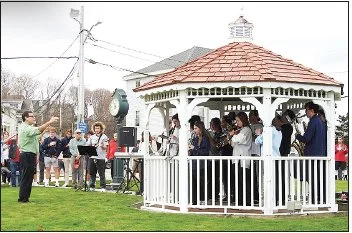
Also during Friday’s ceremonies at Hull’s war memorial, Director Ian Barkon led the Hull High Band as they provided musical accompaniment. Veterans of Foreign Wars Post 1787 Commander Kevin Beck presented awards to the annual essay contest winners: third place, sixth-grader Luisa Rizzo; second place, eighth-grader Libby Harper; and first place, seventh-grader Colin English.

[All Skip Tull photos, except the veterans dinner, which was taken by Karen Pitrolo]

Hull Garden Club’s ‘Daffodil Lady’ honored for decades of dedication to beautifying town

By Carol Britton Meyer

Longtime resident Anne Musmeci, known around town as “Hull’s Daffodil Lady,” was honored by the select board last week with a resolution from the “grateful Town of Hull” for her many years of service with the Hull Garden Club.

GRATEFUL GROWTH. The select board presented Anne Musmeci, shown here with some of her fellow members of the Hull Garden Club, with a resolution honoring her years of service to the club and the community. She was a founding member of the club and is known as the ‘Daffodil Lady’ for her work in planting bulbs throughout town. [Skip Tull photo]

Musmeci attended the meeting, and following presentation of the resolution by Chair Jennifer Constable and a round of applause, she posed for photos with the select board and members of the Garden Club who came to the meeting to show their support for efforts over the years.

Musmeci was a founding member in 1966 and served as president from 1997 to 1999, when the Daffodil Trail program was created as an ongoing campaign to sell and distribute daffodil bulbs as part of a continuous planting effort throughout town.

This avid gardener has sold more than 180,000 daffodil bulbs during her time with the club – hence her nickname – and was responsible for having the daffodil named as the town flower because it “represents a sign of spring that makes everyone smile,” according to one club member.

Throughout the years, Musmeci has dedicated her “time, talent, and effort to beautify our surroundings and enhance our quality of life by sharing her gardening skills with our community” through the ‘Adopt a Garden’ program,” the resolution states.

This program, which Musmeci chairs, gives club members and others in the community the opportunity to “adopt” small areas of town property to maintain and beautify, including traffic islands.

When the Veterans’ Council and the DPW had containers added to the Hull Village Cemetery markers for streets named in honor of Hull residents who were killed in action during wartime, Musmeci included them in the program.

The 14 containers were all adopted by members of the club, who are responsible for the plant material, design, and watering.

A smiling Musmeci expressed appreciation for the recognition and offered a special thank you to fellow Garden Club members for their assistance in planting the daffodils and with other projects.

“It looks so nice when they start to bloom throughout the town,” she said.

Sandbar’s expanded entertainment request approved; owner pledges to control noise

By Carol Britton Meyer

With the end-of-year license expirations approaching, the select board voted this week to renew six annual alcohol and five package store licenses, along with three common victualler and a number of livery, lodging house, and auto sales licenses.

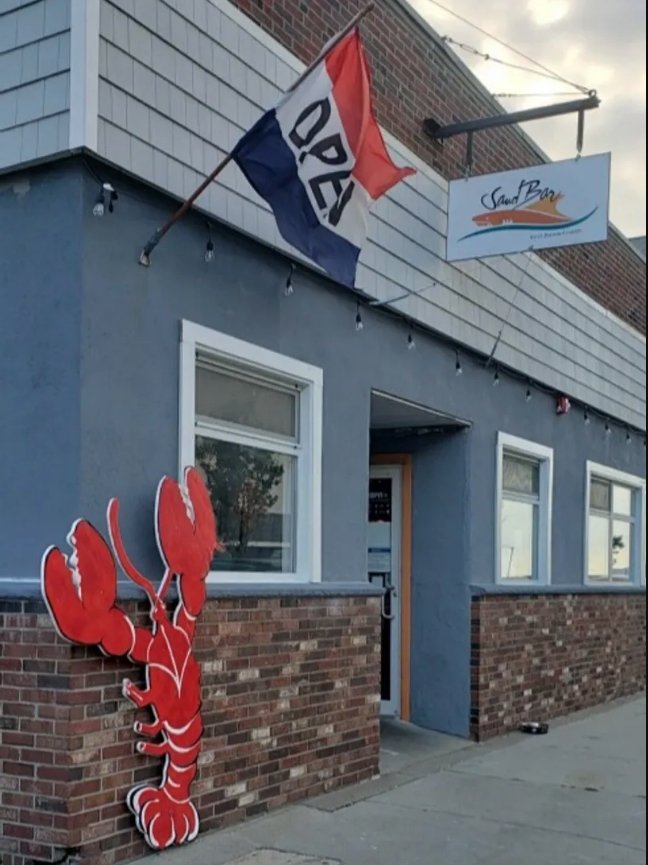
THE SANDBAR IS LOCATED AT 297 NANTASKET AVE., IN THE SURFSIDE BUSINESS DISTRICT.

The board also agreed to expand the Sandbar’s entertainment license after a public hearing was requested by restaurant owner Lillian Parker.

In response to concerns expressed by neighbors about noise from the music affecting their quality of life, restaurant patrons who gather outside the restaurant in the late evening hours being disruptive, and potential parking issues, the select board approved the following: live music Monday through Thursday from 2 p.m. to 11 p.m., including three-piece bands without amplification according to the existing license but not including televisions, which can remain turned on until 1 a.m.

In accordance with the request to expand the restaurant’s entertainment license, live music with amplification for up to five-piece bands and floor shows will be allowed Friday, Saturday, Sunday, and all holidays up until 1 a.m., with live music and floor shows to begin no earlier than 2 p.m. on Sundays. The Sandbar, at 297 Nantasket Ave., will also be open seven days a week moving forward.

Town Manager Philip Lemnios said it’s a balancing act to accommodate commercial enterprises that are close to residential properties, because the residences in that area are in a business district.

Parker said every effort is made to be considerate of residents living near the restaurant.

“It’s hard to control people, but if we hear loud noise on the sidewalk, we ask them to quiet down. We have respect for our neighbors and [will continue to] do everything we can to manage [the noise],” she said.

Board member Donna Pursel called Hull “a unique place to live for both residents and businesses. It’s necessary to communicate in order to survive, and we have found businesses to be willing to work with the neighbors [overall].”

Annual alcohol license renewals were approved for The C Note, Daddy’s Dry Dock, California Underground, Schooners, Nantasket Flatts, and Jo’s Nautical Bar.

Common victualler licenses were renewed for Dylan’s Pizza, Nantasket Seafood, and Breadbasket Bakery and Cafe.

Package store renewals were granted to West Corner Liquors, Smart Save Variety Store, Nantasket Liquors, the EZ Smoke Shop, and Quick Pick, Inc.

Chair Jennifer Constable and Select Board member Domenico Sestito were not present at Wednesday’s meeting.

Board adopts FY23 tax rate; average bill for single-family set to jump 3.6% to $6,983.15

By Carol Britton Meyer

While the proposed tax rate for FY23 is 3% lower than the FY22 rate, the value of single-family homes in Hull has increased, meaning that homeowners will pay an average of $241.65 more, or 3.6%, in real estate taxes this year.

Because the value of commercial properties increased by far less of a percentage than single-family homes, the average tax bill will decrease by $2, or .02%, based on the tax rate approved by the select board at the annual public hearing this week.

CLICK HERE FOR THE FULL PRESENTATION FROM THE TAX RATE HEARING.

The proposed FY23 tax rate is $12.17, down from $12.54 per $1,000 of assessed value for the previous fiscal year, subject to Massachusetts Department of Revenue certification.

“That’s the good news,” Town Accountant Michael Buckley said Wednesday. At the same time, “residential property values have gone up by 7% and commercial property values by 3%.”

The average annual tax bill for a single-family dwelling for the last fiscal year was $6,741.50, based on an average home value of $537,600. In the current year, the average value has increased to $573,800, and the average tax bill will be $6,983.15.

The average commercial property valuation is $666,300, up from $646,800 in FY22. The average commercial property tax bill will decrease from $8,110.87 to $8,108.87.

In accordance with tradition, the select board voted to maintain a single tax rate for residential and commercial properties during this year’s tax classification hearing upon the recommendation of Buckley and the board of assessors.

Because 95% of the properties in town are residential, with a very small commercial base, maintaining the single tax rate means that most of the tax burden falls on residential property owners.

While a split tax rate would shift some of the tax burden from residential to commercial properties, they comprise only 3% of the town’s total valuation. This means that any shift of the tax burden in that direction would “just crush” commercial businesses, according to Buckley.

Hull ranks 16th among the 27 communities in Plymouth County when comparing the average single-family tax bill, according to the assessors’ presentation to the select board.

A small portion of the property tax – 2% -- applies to personal property. This tax is levied by the jurisdiction in which the property is located and includes tangible property that is not real property, such as furniture in second homes or business equipment.

If the tax rate were split, homeowners would save relatively little, while the average commercial property owner would see his or her tax burden greatly increase, depending on the percentage of the split, Buckley explained.

For example, at 10%, the average homeowner would save $28.69, with an increased tax burden of $812.89 for the average business. At 50%, the average homeowner would save $149.19, while the average business would face an increased tax burden of $4,057.77.

The select board also voted not to adopt residential or small-business exemptions, which would shift some of the tax burden toward higher-valued properties.

There are 5,187 residential parcels in Hull with a total value of $2.8 billion, zero open space parcels, 126 commercial parcels with a total value of $72.7 million, zero industrial, and 797 in the personal category, which is worth $45.6 million.

Buckley provided a chart listing the range of values for Hull’s single-family homes. Out of those, as a few examples, none are valued at below $100,000 and only 120 are valued between $200,000 and $300,000. There are 1,001 homes in the $400,000 to $500,000 category. Fourteen are valued at more than $2 million.

“There are a lot fewer starter homes in town than there used to be,” Buckley said. “Hull is a desirable place to live.”

Town Manager Philip Lemnios and select board Chair Jennifer Constable expressed appreciation for Buckley’s and the board of assessors’ hard work leading up to this presentation.

“It’s a complicated process,” Constable said.

The hearing was continued until the proposed FY23 tax rate is certified by the state.

Council on Aging’s goals include reducing seniors’ fiscal burden, potential new building

By Carol Britton Meyer

Exploring options for lessening the tax burden on Hull’s older population is among the many recommendations in the recently completed needs assessment report to help longtime residents remain in their homes if they wish to do so.

That said, Hull Council on Aging member Robert Goldstein told the select board recently, “We have programs!” He added that many seniors “love this town and are concerned about the high costs associated with being able to stay in their homes, including water and other utility bills, and taxes.”

This is where the town’s tax-relief programs can benefit qualifying older residents.

These include:

- A personal exemption of $1,000 for seniors ages 65 and older who meet income/asset, home ownership, and other criteria;

- An “elderly tax-credit program” established in 2013 offering 13 slots that provide a maximum tax credit of up to $1,700 per person, based on certain qualifications determined by the assessor’s office. (Currently, the spots are not filled). This program requires participants to complete up to 125 hours of service to earn a tax-credit voucher, the value of which is based on the minimum wage ($14.25 in 2022), less Medicaid taxes.

While Goldstein said potential program alterations could provide more of a benefit to seniors and older residents who are caregivers to people in their homes, including decreasing the number of hours required to participate in the tax-credit program and increasing the maximum income for personal exemptions, it would take time to make these potential changes.

Also, it would need to be determined how much discretion the town has in changing the programs in the first place.

Select Board Chair Jennifer Constable said it’s “good to know the resources that are out there for seniors,” noting that “getting the word out to them” could be improved. Questions include, “Where did these numbers come from, how did the town adopt these programs, and what might we be able to do to [make them better]?” she said.

Despite the fact that “these programs aren’t perfect,” efforts to promote them will continue, Goldstein said.

Goldstein also discussed long- and short-term goals for the Anne M. Scully Senior Center at 197A Samoset Ave., including expanding capacity by adding a permanent satellite location dedicated to programming needs or “building a new space capable of meeting the increased demand of an aging population.”

Goldstein said that next steps could include creating a subcommittee of the COA to conduct a feasibility study of both options.

Although he said the value of the senior center to older residents “isn’t just about a new building, but rather about the [sense of] community offered there,” Goldstein does believe that “a new building is needed.”

As Hampton Circle playground rehab project advances, town studies climate-change risks

By Carol Britton Meyer

THE FORMAL NAME OF THE HAMPTON CIRCLE PLAYGROUND IS LT. JOSEPH D. MCLAUGHLIN PARK. IT WAS NAMED AFTER A US NAVY LIEUTENANT WHO WAS KILLED IN ACTION IN WORLD WAR II. [C.J. HARADEN PHOTO]

The Hull Community Development and Planning Department is working with Hampton Circle residents to reconstruct the neighborhood playground, subject to an environmental review conducted by the state and other considerations.

"The current proposal calls for a new play structure with an Americans with Disabilities Act-compliant pour-in-place surface and walkway, parking, a new swing set, benches, plantings, and a rain garden-type feature to manage stormwater better and to attempt to improve ocean flooding drainage," Director of Community Development & Planning Director Chris DiIorio told The Hull Times.

CLICK HERE TO READ THE FULL ENVIRONMENTAL NOTIFICATION FORM FOR THIS PROJECT.

As part of the process, the planning department submitted an Environmental Notification Form to the Secretary of Energy and Environmental Affairs on Oct. 31 to initiate review of this project.

“The land where the playground existed is in an Area of Critical Environmental Concern,” DiIorio explained. It is also an area that floods during abnormally high tides.

In addition, because the town plans to use some federal funding for this project, a Massachusetts Environmental Policy Act review was triggered, resulting in the ENF.

The community preservation committee, with town meeting's approval, has allocated some funding toward Hampton Circle playground improvements in the past.

The playground was dedicated to US Navy Lt. Joseph D. McLaughlin, who died in World War II, in the 1950s. McLaughlin’s family lived on nearby Lincoln Avenue for decades. The playground is the beginning and ending point of the neighborhood’s annual Fourth of July parade.

A site visit and remote consultation session with town officials may be scheduled relating to the ENF.

At the same time, the town is conducting a climate change risk assessment of the Hampton Circle area that includes the playground, according to Director of Climate Adaptation and Conservation Chris Krahforst. A public outreach meeting is planned for early December, with more details at a later date.

Residents who wish to comment on, or express concerns about environmental issues, the proposed project or to be notified of a site visit or remote consultation may email MEPA@mass.gov or write to Secretary of Energy & Environmental Affairs, 100 Cambridge St., Suite 900, Boston, MA  02114, Attn: MEPA Office, referencing the project.

MEPA will make the determination as to whether an environmental impact report is required for the project.