
Opinion: The questions Hull ratepayers were not asked
/Op/Ed by Jake Vaillancourt, Clerk
Hull Municipal light board
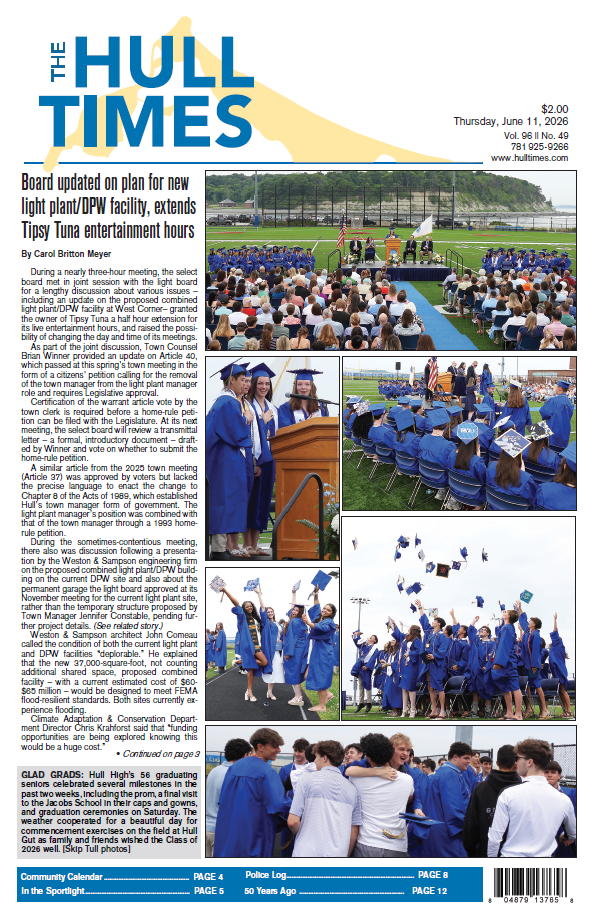
On June 10, the light board and the select board sat together for a presentation on a proposed building that would move the Hull Municipal Light Plant out of 15 Edgewater Road and into a shared facility with the Department of Public Works at West Corner.
The boards were told, near the outset, that no one was proposing to move the light plant into a joint facility. The cover of the slide deck handed to us that evening reads, in large type: Design of Resilient Joint HMLP and DPW Facility. Residents can hold both of those statements in mind as they read what follows.
Start with what the study never examined. After roughly four years of planning, exactly one option was presented: a combined building of approximately 37,000 square feet, rising to 44,000 with mezzanines, on the DPW site at 9 Nantasket Avenue. The deck’s site screening slide tells residents two things its presenters did not dwell on. First, the top-ranked site, the one that is actually out of the flood zone, is privately owned and the owner will not sell; the DPW site is the fallback. Second, 15 Edgewater Road was screened only for whether a brand-new, full-sized replacement light plant facility would fit there. Whether the existing facility could be renovated and a garage added, the path the light board has actually voted for, was never screened, never costed, and appears on no slide.
When the question was asked at the meeting, the project’s lead acknowledged it plainly: that wasn’t the scope. Select board member Jerry Taverna pressed the point, asking exactly where these buildings are failing and why, noting that the DPW building has extremely good bones, and asking whether the buildings the town already owns can be salvaged. No one had an answer, because in four years, no one was ever paid to find one. A feasibility study that examines one outcome is not a comparison. It is a recommendation in search of a ratification.
Next, the cost. The schematic design is with an estimator now; the town has no estimate. The only dollar figure shown to two elected boards on June 10, after four years of study, appears on a closing slide that reads, in full: $60 million plus $5 million, followed by a question mark. The presenter, to his credit, cautioned that no one should hold him to it. Fine. But notice what even that framing conceals. The light plant’s dedicated program is roughly 12,000 of the 37,000 square feet, about one-third of the building. So who pays what? If ratepayers are assessed a proportional share, that approaches or exceeds $20 million. If ratepayers pay only the $5-million increment, then Hull’s taxpayers are subsidizing the light plant’s housing. Nobody answered the allocation question, and until someone does, no one can honestly say what this proposal costs the people who pay electric bills in this town.
Then there is the money already spent and the money being sought. The boards were told on June 10 that the work to date has cost the town less than $100,000. The Commonwealth’s own announcements tell a fuller story: three consecutive Coastal Resilience grants for this project totaling $524,805, and the town’s own June 10 slides describe a pending Phase 4 application for roughly $500,000 more in state funds with an approximately $50,000 town match, with federal FEMA funding anticipated after that. These figures may well reconcile; awarded funds and expended funds are different things. But that is precisely what an accounting would show, and that is why the light board’s April resolution requested a complete written accounting of every grant touching light plant property and operations. At the board’s June 4 meeting, the town manager stated that the accounting would be provided. As of the June 10 joint meeting, it had not been. The ratepayers of Hull are entitled to see those numbers, and so is the elected board that answers to them.
Compare the path the light board has already chosen. In November 2025, the board voted unanimously to fund a permanent garage at 15 Edgewater Road to protect the plant’s fleet, including a bucket truck that cost ratepayers roughly $375,000. The board was later informed that design work on that garage had been engaged. What came before the board this month, more than six months after its vote, was not that design. It was a proposal for a temporary fabric structure in a coastal high-wind area that the board never requested and, at its June 4 meeting, unanimously voted to oppose. The board has asked what became of the permanent garage design, who redirected it, and under what authority; those questions are unanswered. The board’s preliminary review puts a garage and facility upgrades in the range of $2 million to $3 million. I will say plainly that the figure is preliminary, and the board intends to commission the engineering and cost work to firm it up, including full floodplain compliance, and to publish the comparison. But the financing structure is not preliminary: the light plant can fund this work itself, through reserves or the MMWEC pooled loan program, repaid from electric revenues rather than property taxes, without adding a dollar to the town’s borrowing and without the two-thirds town meeting vote the joint building will require. And the timeline is not preliminary, either. By the project’s own schedule, the joint facility would not be complete until 2030 or 2031. The light plant’s need to shelter its equipment is now.
What about flood risk, the stated reason for all of this? Look closely at the slide the boards were shown. The graphic titled HMLP Projected Flood Elevations measures from a base elevation of 3.2 feet, at the old storage buildings at the water’s edge on the lowest corner of the property. Those buildings are in use today, and that is exactly the problem the light board’s garage vote exists to solve: move the plant’s vehicles out of the low buildings and onto the upper ground along Edgewater Road, which sits at roughly 15 feet above the current FEMA base flood elevation of 10 feet, on land the town already owns. The joint facility solves the same problem by moving the vehicles to a site that starts at nine and a half feet, below the base flood elevation. Under the project’s own 2070 projections, the water line eventually rises past 15 feet at both sites, which is why the proposed building must be raised on deep foundations, in soil the geotechnical study calls challenging, with garage bays expected to take on water by design, and why Mr. Krahforst’s own closing slide describes the outcome in writing: a combined facility, still in the flood zone.
The board’s garage would be built to the same modern flood standard, on the highest ground either site offers. In other words, the slide is a fair picture of the problem and a poor argument for the prescription. Both plans get the trucks out of that building. One moves them uphill for $2-3 million; the other moves them five and a half feet downhill for a share of a $65 million question mark. If resilience is the goal, the smaller, higher, cheaper project is not the one that needs explaining.
Underneath all of this sits a structural problem the town can no longer avoid naming. Under Hull’s 1993 special act, one appointed official serves simultaneously as town manager and as manager of the light plant. Consider what that means here. The town manager’s office pursued and administers the grants that are premised on relocating the light plant. The same office supervises the DPW, which would anchor the new building. And the same office is responsible for carrying out the elected light board’s capital direction at 15 Edgewater Road, the project that competes with the grant-funded one. No individual could serve all three of those interests at once, and this is not a claim about anyone’s good faith. It is an observation about the structure, and it would hold for any person occupying both seats. But when one office sits on every side of a $65-million question, residents should not be surprised by what this record shows: a four-year study that examined one option, a grant application that left the elected board’s support field blank, a unanimous vote for a permanent garage answered with a fabric tent, and an accounting promised on June 4 and not delivered by June 10.
Any one of those might be an oversight. Together, they are what a structural conflict looks like in practice, and the ratepayer pays for it. Town meeting has now diagnosed this problem twice: in 2025, when it voted to remove the town manager’s role as light plant manager, and again this spring, when it adopted Article 40 to restore the governance under which nearly every other municipal light plant in the Commonwealth operates: an elected board that hires an independent, professional light plant manager. The capital authority of the elected board is not a technicality. It is the same authority under which this board, not any appointed official, voted to purchase the truck soon to be sitting in the weather. And it is the only structure in which the people who pay the electric bills choose the people who decide how their money is spent.
Both boards agreed on June 10 to take up a full cost comparison at a coming joint meeting, and I welcome it. The light board does not oppose a proper home for the DPW; that case may be strong on its own merits. Our charge is narrower and older: best value for Hull’s ratepayers. On today’s record, a $2-3-million project that the plant can fund itself, on the highest ground available, finished years sooner, is a better answer than a share of a building whose only published price is a question mark. If the forthcoming numbers prove otherwise, we will say so.
We ask only that the town do two things. First, do what four years and a half a million dollars of study have not: put both options on the table, with real numbers and a real accounting, and let the ratepayers see the comparison. Second, when the select board transmits Article 40 to Beacon Hill in the coming weeks, as it has indicated it will, our legislative delegation should carry it across the finish line. Last year’s petition was referred to study and died without a vote. Hull’s voters have now asked twice, and they will be watching to see that the answer this time comes from the Legislature and not from the filing cabinet. One office should not sit on both sides of the question.
Like what you’re reading? Stay informed and support our work with a Hull Times subscription by clicking here.
Do you have an opinion to share? Click here to write a Letter to the Editor.
© 2026 The Hull Times. All rights reserved.