
Water restrictions still in effect; scofflaws could face higher fines, service shutoff
/
By Carol Britton Meyer
The Weir River Water System board of water commissioners, comprised of the Hingham select board, this week heard an update about drought restrictions and a proposed new fine schedule for violations, subject to approval by the WRWS Citizen Advisory Board (CAB) and the commissioners. The water company serves Hingham, Hull, and part of Cohasset.
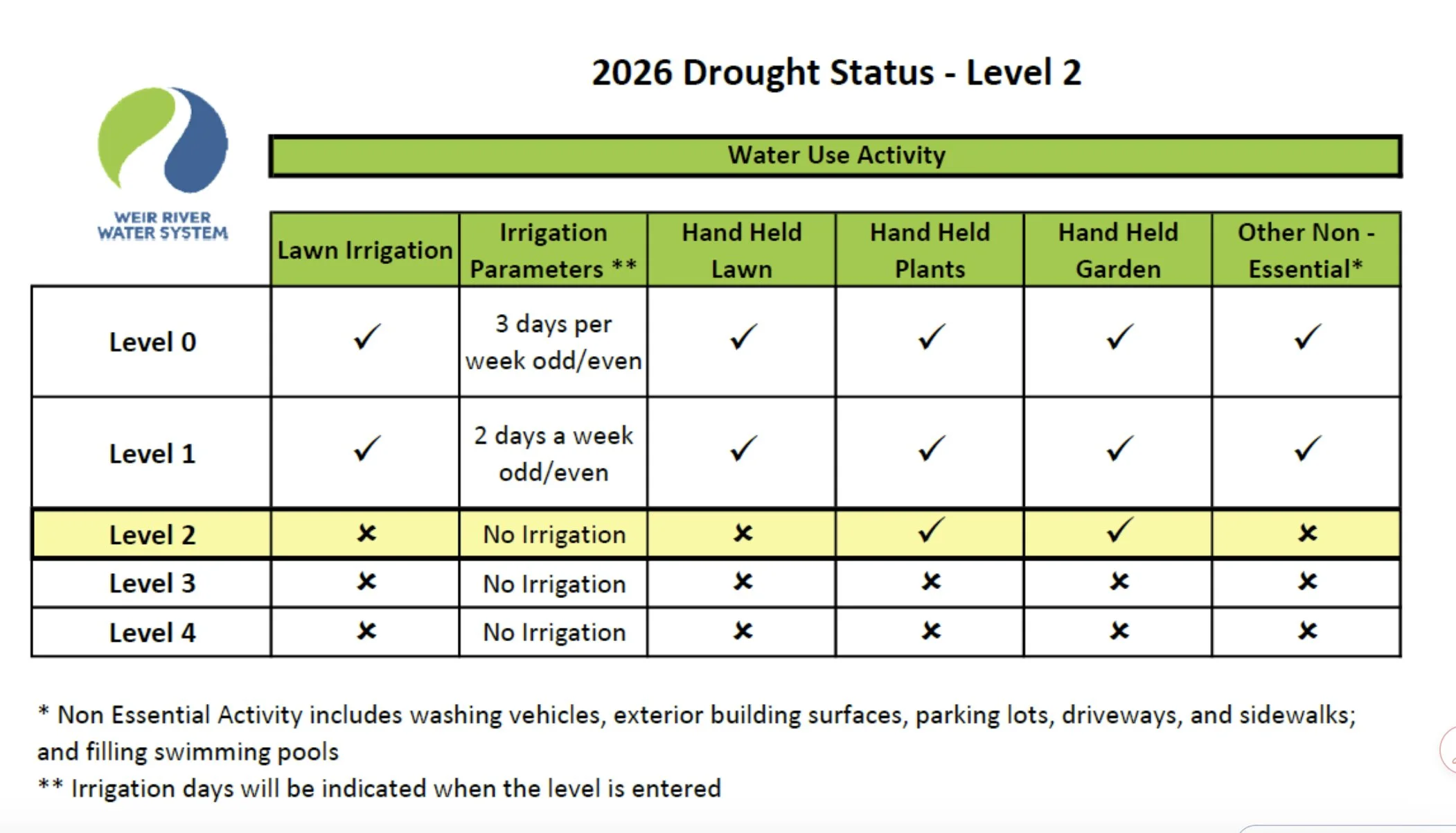
A total water ban – Level 2, representing a “significant drought” – remains in effect for non-essential outdoor usage (lawn irrigation, washing vehicles, exterior building surfaces, parking lots, driveways, and sidewalks and filling swimming pools).
Handheld watering for gardens, landscape plantings, and other essential needs is allowed but could be restricted if necessary.
WRWS Managing Director/Superintendent Russell Tierney explained that the current $50 and $100 fines are not high enough to stop customers from ignoring water restrictions – in particular the prohibited use of irrigation systems – and suggested fines as high as $750 for the first offense and $1,000 for the second offense and termination of water service, and a $1,000 fine for each subsequent offense and a potential termination of service, but nothing has yet been decided. The water commissioners delayed their vote pending CAB input.
The fines are tied to the state drought level the town is in at the time. These proposed fines are for a Level 3 drought, which Tierney said the region could find itself in at a future time.
Commissioner William Ramsey said more discussion is needed about whether to shut off water service for violators.
“Fines first,” he said.
CAB members include Hingham representatives Dave Anderson, Jim Broderick, and Charles Culpin; Select Board Chair Brian McCarthy and Director of Wastewater Operations/Assistant Director of Public Works John Struzziery represent Hull; and Stephen Girardi, Cohasset.
Tierney also encouraged customers to provide their email addresses to the water company for easy notification of water restrictions, emergencies, and other information.
“Out of 12,500 customers, only 8,000 are on our email list,” he noted. Other customers receive letters.
“The water levels, including Accord Pond, are low for this time of year,” Tierney said. “We plan to get the word out earlier next year – March or sooner, as suggested by the CAB – including notifying irrigation system companies so they are aware [of the restrictions] at the beginning of the season.” The next CAB meeting is in mid- to late-October. All CAB meetings are public and posted on the Hingham town website calendar.
‘New irrigation systems take weather into consideration’
Tierney also noted that some newer models of irrigation systems “take the weather into consideration” so they don’t, for example, turn on automatically when there’s a 50% or higher chance of rain.
WRWS and Veolia, which operates the water company, continue to place tags on the front doors of homeowners who use their irrigation systems despite the restrictions.
Ramsey thanked the many residents who have abided by the restrictions.
“I know it’s painful to see newly-planted lawns die out,” he said. “At the same time, many customers have not complied with the restrictions, and that needs to be addressed.”
He agrees that more aggressive fines are in order after the first warning and more enforcement. “This drought situation is unprecedented,” he said. “All you have to do is drive by Accord Pond to see the water level.”
It takes “extra effort to go to [the same] houses a number of times to [put tags on doors],” Tierney said. “Why should someone have four or five chances to not shut off their irrigation systems?”
Citizen concerned about irrigation of town’s athletic fields
Hingham resident Mark Rockoff asked whether WRWS has jurisdiction over private wells, the use of which “also reduces the amount of water in the aquifer.” Tierney’s response was no – “that would need to be a discussion as a whole town, and not just a WRWS decision.”
Rockoff also asked why the town continues to irrigate its athletic fields when citizens are told not to irrigate their lawns.
The cost to replace athletic fields is “astronomical,” Tierney responded. “When fields [dry up], they need to be reseeded the following season. In our opinion, a home lawn is not as important as open space and recreation areas.”
Nevertheless, Rockoff said, “using so much water to keep the fields in great shape is putting the town in a more critical position.”
‘We need a different approach’
Hingham resident John Borger, who is writing a series of articles for the Hingham Anchor on the water crisis, said he believes more needs to be done and that for many, fines are ineffective. “Some people will suck up the fines after investing thousands of dollars in irrigation systems, and green lawns say ‘upscale.’”
“We are [facing] a very serious public safety emergency” due to the shortage of water to fight fires, Borger added. “The fire chief is not crying wolf. Fines and penalties won’t do it. We need a different approach.”
Like what you’re reading? Stay informed and support our work with a Hull Times subscription by clicking here.
Do you have an opinion to share? Click here to write a Letter to the Editor.
© 2026 The Hull Times. All rights reserved.