
After keeping public waiting, light board adopts policy for its payments-in-lieu-of taxes
/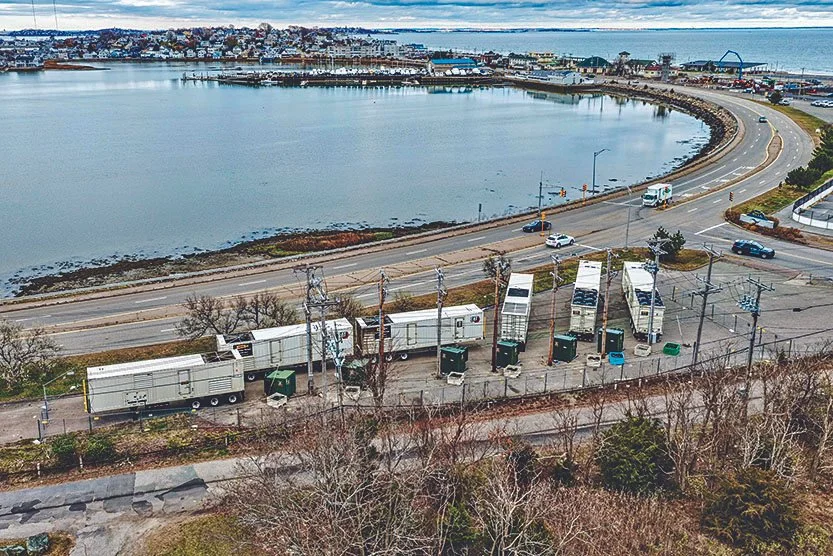
GENERATING ACTIVITY: The Hull Municipal Light Plant has once again rented generators to provide electricity in the event of a townwide power outage. The light board surveyed customers earlier this year and found that 75% of those responding favored spending $824,000 for the season to have the generators on standby from December 1 through March 31. [Richard W. Green photo]
By Carol Britton Meyer
Last week’s light board meeting got off to a very late start when, at the request of Town Manager/Light Plant Manager Jennifer Constable, an executive session that was on the agenda for the end of the meeting was held at the beginning – after the public comment period.
The reason given was to avoid having to pay the substantial hourly rate for light plant attorney Nicholas Scobbo’s services while he waited for the expected lengthy meeting to end and for the executive session related to Spinnaker Island electrical service – in which he would be participating – to begin.
During the public comment period, a few residents expressed dismay – that the audience would have to leave the room while the executive session took place and then return when the meeting reconvened – and concern that the order of the meeting had been changed from the posted agenda for the November 20 meeting.
Resident Lisa French said that the agenda should let the public know exactly when an executive session is scheduled.
The discussion between board members and Constable often was contentious, with back and forth on a number of issues.
One audience member said it made more sense to have one person (Scobbo) wait rather than for all the citizens in the audience to have to leave the room and return, to which Chair Thomas Burns remarked, “That would be an expensive wait.”
The executive session lasted about an hour, and when Burns called the meeting back into open session, he remarked that he saw “a lot of people with solar accounts” in the audience.
Solar rate issues raised by citizens are the reason behind the recent formation of a task force to research solar billing and come up with changes related to the recent switch from net metering to net billing and the negative impacts of this change to solar users in Hull.
Some ratepayers are concerned that this change penalizes solar users, making it impossible to recover the cost of installing their solar arrays, while at the same time discouraging others from investing in solar power.
“We expect to come up with a proposed change for our December 9 meeting, when we will make recommendations centering around transparency and equity,” Burns said. We’re going to deal with the issues that have been brought up. I’m not going to say anything else until then. We’ve received letters from most of you, and we’ve taken them to heart.”
In other business…
• After further review of the nine-point draft payment-in-lieu-of-taxes (PILOT), or voluntary payment to the town, policy previously reviewed by Scobbo and after making a few amendments, a motion was made for the board to accept the PILOT policy as amended, subject to final review by Scobbo – on a unanimous vote by the board.
The amendments concerned having the light plant manager review and present the financial report related to the PILOT policy and to be involved in the discussion; that input will be sought from the town’s chief financial officer; and that the policy will be effective January 1, 2026.
Before the vote on the draft policy, Constable presented data on payments made by other municipal light plants and investor-owned utilities and discussed a new PILOT policy consideration using a formula of: (# of kWh sold per year x $0.00275/kWh) plus a $100,000 annual fixed payment.
Constable also suggested as another option setting the annual PILOT payment to the town at a fixed $200,000.
Member Jake Vaillancourt planned to update the draft policy with the amendments right away and provide a copy to Constable and light plant interim operations manager Mike Schmitt, who will then forward the document to Scobbo.
“I have a lot of concerns about some of the language in the document,” Constable said.
Overall, the PILOT policy relates to 1) board authority over the PILOT program; 2) the annual review and timing; 3) a single annual payment, if any; 4) the condition of the light plant’s surplus funds before any PILOT payment is decided upon; 5) determining the PILOT amount; 6) compliance with Massachusetts law; 7) light board vote and documentation of any such payment; 8) the effective date of the policy once approved by the board; 9) and the provision that the new policy would supersede any previous practices or arrangements that conflict with the intent of the board’s vote to approve the policy.
Vaillancourt suggested that the board not make a PILOT payment until the light plant “is in a strong financial position” and that the amount could be more or less than the $200,000 PILOT payment that has been paid to the town to use as it sees fit for the past 11 years.
During a particularly contentious moment, Vaillancourt advised the board, “Let’s stay calm. We have to work together.”
• There was also some discussion about the proposed combined DPW and light plant building at West Corner and the grant-funded study of the facilities separately and then combined, including resiliency measures. There is some opposition on the board to this proposed project and it will be discussed further.
• Vaillancourt also provided an update on the recently filed home-rule petition to enact the 116-83 vote at this year’s annual town meeting under Article 37 to remove the town manager as light plant manager.
The article proposed returning to the independent management setup that was eliminated in 1993 when town meeting requested that a home-rule petition be filed on Beacon Hill.
Although this year’s article was approved by town meeting voters, Constable told the light board and select board following the vote that legal counsel had deemed Article 37 as “not actionable” because it did not include provisions about filing special legislation.
When pressed to do so, the select board ultimately voted to request that Hull’s state legislators file the home-rule petition to enact the management change.
The home-rule petition is moving through the process as Bill H4739. Click here for more details from the Legislature’s website.
“Anyone who wants to can go to the State House website and type in the bill number to read the details,” Vaillancourt said, noting that the hearings are done digitally and not in person.
Written testimony was due to the Joint Committee by Friday, November 21.
• Light plant finance and office manager Janis Ford presented the draft 2024 annual financial report prepared by Goulet, Salvidio, & Associates, P.C.
Vaillancourt noted a decrease in operating cash ($633,000) for 2024, which Ford attributed to generator and power costs. Board members agreed to review and sign the report individually at the light plant office in the coming week.
• Burns moved to request the light plant manager present a fiscal 2026 budget at the December 9 board meeting. The motion – which passed unanimously – included a request to collaborate with advisors to achieve funding the depreciation fund at 3%.
• A motion, which also passed unanimously, was made to propose a capital project to fund a garage at 15 Edgewater Road to store fleet vehicles, designed to allow for solar orientation and to complement the historic nature of the existing building.
• Under old business, the board approved advising the light plant manager to explore a grid-scale battery project – now in the initial exploration stage – with the Massachusetts Municipal Wholesale Electric Company. MMWEC assists Massachusetts municipal light departments such as Hull’s with their needs to contract for energy.
• In asking the board about its priorities, Constable mentioned the Green Communities program. However, member Dan Ciccairello noted that board members have discussed this and that there are reasons why they do not wish to pursue this designation.
• Vaillancourt provided an update on capacity planning, noting that the capacity planning task force is exploring a “Reduce the Peak” pilot program that MMWEC is running, involving voluntary behavioral changes by ratepayers during peak events.
• Member Patrick Cannon presented updated rate comparison data correcting a previous report, showing that Hull is the fourth-highest municipal light plant rate in the Commonwealth, not the highest. The board agreed to publish the corrected chart on the town website and inform The Hull Times that the chart produced by MMWEC and printed in that newspaper earlier this year contained an error.
The next light board meeting is scheduled for Tuesday, December 9.
A replay of the November 20 meeting is available on demand on Hull Community Television’s website, www.hulltv.net.
Like what you’re reading? Stay informed and support our work with a Hull Times subscription by clicking here.
Do you have an opinion to share? Click here to write a Letter to the Editor.
© 2025 The Hull Times. All rights reserved.