
Running the numbers: True project cost of combined DPW/light plant remains uncertain
/Op/Ed by Jake Vaillancourt
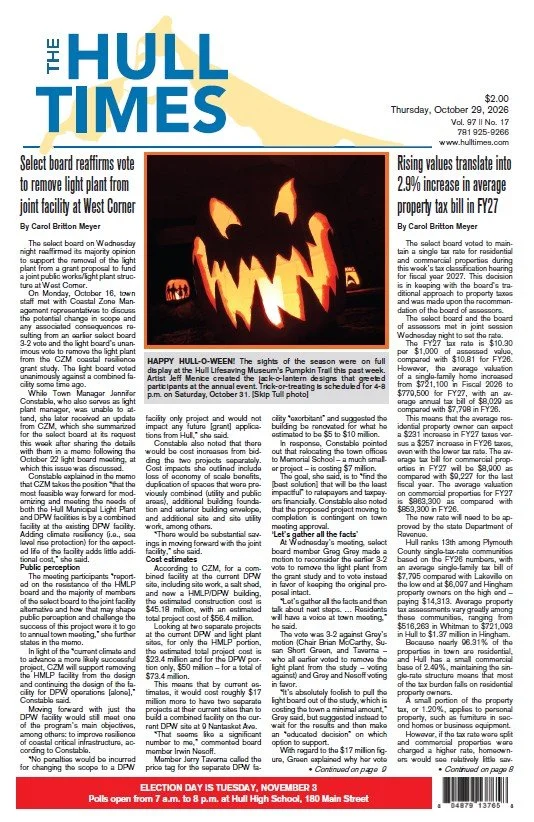
Good news first. On October 19, town staff finally met with the state on whether the light plant could come out of the shared DPW building. The state said yes. With no penalties, and no harm to future grants. That’s from the town manager’s own October 25 email to the light board. Nothing from the state is in writing yet.

The email came with one page: the town’s June cost estimate for the shared building, with new figures written on it in red. The red figures say separate buildings would cost $58.7 million instead of $45.2 million. Subtract, and the message is that Hull’s elected boards just cost you about $13.5 million in construction. At total project cost, the figure the town manager used at the select board on October 28, it’s $17 million. Same sheet, same comparison.
Check the math before you repeat it.
The printed part, from June, prices one shared building at $45.2 million and splits it by percentage: $14.4 million to the light plant, $30.8 million to the DPW. The sheet calls that split “order of magnitude.” A rough share, not a price.
The red part gives “separate” numbers: $18.7 million for the plant and $40.0 million for the DPW. Multiply each June share by 1.3. That’s it. $14.4 million times 1.3 is $18.7 million. $30.8 million times 1.3 is $40.0 million. No drawings, no site, no design. The consultant’s own words, quoted in the email: “rough numbers.” Two buildings do have two roofs; 30% across the board is a guess, and the person who wrote it says so.
What is it pricing? In the written summary’s words, “separate facilities on different sites.” A brand-new light plant building somewhere else, on land Hull would have to buy, because the town says the plant’s “program” won’t fit at 15 Edgewater Road. That program is a wish list from staff interviews in 2024. The light board never adopted it. The board’s plan is a garage outside the flood zone plus flood protection on the building we already own, and that has never been independently priced.
Now put the red figures next to what the town’s climate director told the select board on October 14: “We estimated the cost for the combined facility to be forty-five, with fifteen coming from Hull Light Plant. If Hull Light Plant’s not included in that building, we’re still gonna have to spend 40 to 45 for just the DPW barn.” The red figures agree: DPW alone, $40.0 million.
So by the town’s own numbers, the DPW building costs about $40 million on its own. Adding the light plant adds about $5 million. The plant would be billed $14.4 million. More than $9 million of the “$13.5 million more” is the DPW paying for its own building instead of your electric bill paying for it. The email gives both numbers. It never puts them side by side.
The DPW is paid by taxes. The light plant is paid by electric bills, and Chapter 164 says the plant’s income “shall be used to pay the annual expense of the plant.” The light board supports the DPW building. It just won’t pay for a third of it out of your electric bill.
Why the number exists. The argument about who decides was lost: three light board votes, two select board votes, town counsel, the state. So a number was produced that makes the votes look expensive. On October 28, with that number in front of it, the select board voted down a motion to put the light plant back in, 3 to 2. And for a year the town manager has met each decision the same way, by denying the boards had the right to make it and questioning the people who made it. Her words, in order. June 10: the light board’s vote was “advisory to me” and she “proceeded accordingly.” August 6, in writing: the select board’s votes were “neither binding nor enforceable.” September 24, asked whether she had filed the change the select board directed: “it had not.” October 14: the light board was “exerting authority that they do not have.” October 22: presenting the plant’s financial reports was “the responsibility of management”; the numbers on the board’s slides were hers. October 25, in writing: the boards’ position was “resistance.” Every quote is in approved minutes, on the town’s recording, or in her own email.
One argument, made six ways: an appointed manager decides, and the people you elect advise. It is wrong. Hull’s charter has the select board supervising “through the town manager.” Chapter 164 gives the plant’s board the authority to build and operate the plant. Town meeting voted 236 to 82 in May to put the plant under the board you elect. The number is the last argument standing.
How this should have gone. Two boards vote in July; the manager files the change in August. The cost of staying gets priced by someone independent before anyone writes a number in red. Every document is posted the day it exists, so residents read the record instead of the spin. That’s what the charter says and what most towns do. Hull spent 95 days and a $13.5 million markup getting somewhere it could have reached in a week.
What happens next. On October 22 the light board voted 4 to 1 for an independent study, paid by the light plant, capped at $110,000, to be posted by November 16. It prices the real option so it can be set beside the yown’s numbers. I’m not claiming the garage is cheaper. I don’t know, and neither does anyone else. That’s the point. The light board meets Thursday, October 29, at 6:30 at town hall. When the real numbers arrive, I’ll report them, whichever way they point.
Jake Vaillancourt is an elected member and the Clerk of the Hull Municipal Light Board. He writes for himself. Every document cited here is public, in one folder: https://drive.google.com/drive/folders/1eYlrWkX-mSUNTsi9_-67qkQQ-V86Jz_n
Like what you’re reading? Stay informed and support our work with a Hull Times subscription by clicking here.
Do you have an opinion to share? Click here to write a Letter to the Editor.
© 2026 The Hull Times. All rights reserved.