
Appeals Court rules in favor of town in dispute over ownership of Beach Avenue
/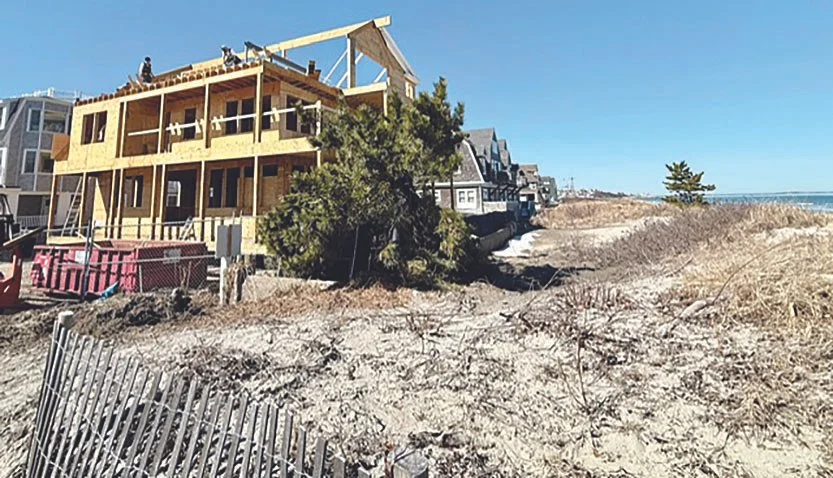
STREET FIGHT: The Appeals Court has decided that the Town of Hull owns an undeveloped section of Beach Avenue adjacent to 169 Beach Avenue, at the corner of Lewis Street. The court overruled a previous Land Court judgment in favor of the abutting property owner. The disputed plot of land is to the right of the new home being built on the property. [Skip Tull photo]
By Christopher Haraden
A yearslong dispute over ownership of an unpaved section of Beach Avenue near A Street has reversed course after the Massachusetts Appeals Court overturned a Land Court decision that had awarded ownership to an abutting property owner.
Instead, the court agreed with the Town of Hull’s contention that the land had been transferred to the town more than 100 years ago.
In the Appeals Court’s March 5 decision, a majority of a three-judge panel vacated the original order and sent it back to the Land Court “for proceedings consistent with this opinion.” It’s unclear what action the court may take to settle the matter or if it will be appealed to the state Supreme Judicial Court.
In 2022, the town sued John and Kathleen Ferrara, the owners of 169 Beach Avenue, seeking clarity on the title of a 60-foot-by-50-foot strip of land that runs between the Ferraras’ house lot at the corner of Beach Avenue and Lewis Street and a second plot of land they own abutting the Atlantic Ocean. The disputed land is part of the layout of Beach Avenue, but that section of the street was never paved.
The Ferraras are in the process of replacing the original home on the site with a new structure, which is currently under construction.
When contacted by the Times, Ferrara referred inquiries about the suit to his attorney, Adam Brodsky, who did not respond prior to our deadline. Town Manager Jennifer Constable also did not reply to questions submitted to her office this week.
Read the Appeals Court decision here and the Land Court decision here.
In response to the town’s 2022 suit to “quiet title” – a legal term for establishing clear ownership of real estate – the Ferraras countered that the disputed land belonged to them under a 1971 Massachusetts law designed to eliminate uncertainty in chains of title of property.
The two court decisions discuss the long history of the area’s real estate holdings over the decades, including ownership at various points by merchant Henry Norwell – who once owned the Rockland House hotel and for whom the town of Norwell is named – and Eben D. Jordan, namesake of the former Jordan Marsh department store.
In 1885, a subdivision plan of land owned by the Nantasket Company outlined house lots and the right-of-way that eventually became Beach Avenue. A year later, the company sold several lots to Norwell – including the two lots now owned by the Ferraras – in a deed that did not describe the parcel within the layout of Beach Avenue. In 1887, the Nantasket Company sold other property in the area to Jordan and specifically described its interest in land within the layout of streets. After Jordan’s death, his heirs sold some of the property to the Town of Hull, including a large section of Beach Avenue, which was described as “running northerly from Quincy Street extended easterly to A Street.”
The town relied on this description in the Jordan deed as proof of its ownership of the length of Beach Avenue. Land Court Judge Kevin T. Smith disagreed, citing the 1971 Derelict Fee Statute. That law was enacted by the Massachusetts Legislature in response to errors in deeds that inadvertently omitted ownership interests in abutting rights of way or adjacent bodies of water. Since real estate deeds are specific in the property they convey – and don’t convey – the lack of detailed language in a poorly crafted document often created “orphaned” strips of land whose ownership was not properly transferred.
The legislation was retroactive, and Smith reasoned that applying the 1971 law to the 1886 deed to Norwell meant that the disputed section of Beach Avenue would have been included then and carried through all subsequent deeds, including when the Ferraras bought the property from the Francine F. Townsend Living Trust in 2017.
Two of the three Appeals Court judges disagreed, arguing that the Nantasket Company understood that it was not transferring the Beach Avenue strip to Norwell since it described land “included in the locations of streets” in the later deed of its nearby properties to Jordan. Under this interpretation, the town has owned that section of Beach Avenue since 1913 when it was acquired from Jordan’s heirs.
Separately, while the town was appealing the Land Court’s 2024 decision in favor of the Ferraras, the select board included the section of land adjacent to 169 Beach Avenue in a 2025 annual town meeting article that sought to take the property by eminent domain as part of plans to maintain the Nantasket Beach dune system. Approval of the article would seemingly have negated the need for the appeal. The town meeting measure failed, 162-156, although voters did agree to take two other Beach Avenue properties for flood control purposes.
Like what you’re reading? Stay informed and support our work with a Hull Times subscription by clicking here.
Do you have an opinion to share? Click here to write a Letter to the Editor.
© 2026 The Hull Times. All rights reserved.