
As committee reviews ‘responsible’ FY27 school budget, chair opposes suggestion of joining with Cohasset
/By Carol Britton Meyer
The Hull Public Schools’ proposed $18.9-million fiscal year 2027 operating budget –representing a 3%, or $551,713 – increase over FY26, will be discussed in joint session with the advisory board at the school committee’s March 23 meeting.
School Business Administrator Diane Saniuk provided an update to the committee this week, noting that “this budget request supplies the needs of the district at this time.”
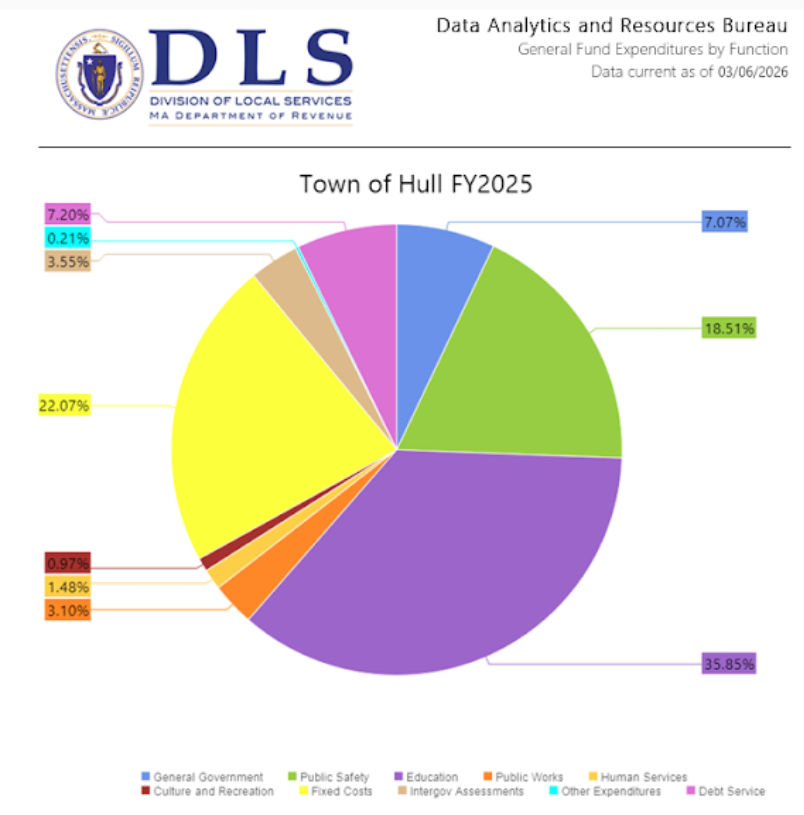
IMAGE FROM THE HULL PUBLIC SCHOOLS FY27 BUDGET PRESENTATION. CLICK HERE FOR THE FULL DOCUMENT.
This is “a fair and reasonable budget that provides the education that the students deserve,” she said. “The youth of today are tomorrow’s leaders, and it’s important to give them the tools they need to succeed.”
Saniuk noted that the Hull Public Schools budget request is 3%, while other communities are requesting a higher percentage or seeking operating overrides to help close budget gaps.
“We are not,” she said. “We’re looking to remain stable and keep things as they are. We’re in a good place, asking for what we need.”
Click here for the full presentation of the school department’s FY27 budget
About 80% of the budget goes toward salaries – roughly $14.8 million in the FY27 budget – as well as $815,909 for non-special education transportation; technology, $285,000; utilities, $718,098; and instructional supplies, professional development, and vocational tuition, $378,868.
School Committee Chair Kyle Conley agreed with Saniuk.
“We are arguably in a much more fiscally solvent place than a lot of neighboring towns,” she said, noting there’s sometimes a “disconnect” about what the schools need and what the town is able to provide.
The budget components include: Total salaries, 78.34%; non-special education transportation, 4.31%; technology, 1.51%; instructional supplies, professional development, vocational tuition, 2%; non-salary special education, 5.99%; maintenance (non-salary), 2.54%; utilities, 3.79%; and all other (non-salary), 1.52%.
The sources of funding for what Saniuk earlier called “a needs-based budget,” are Chapter 70 state Chapter 70 education funding, 19.7%; revolving funds, including school meals, 4.6%; state and federal grant funding, 2.8%; the special education circuit-breaker reimbursement program, 3.3%; and the town appropriation less Chapter 70 of 69.6%.
Saniuk noted that the school department’s share of the overall town budget is a smaller percentage than in other communities, and that the question is sometimes asked why the budget isn’t decreasing as enrollments continue to drop. It’s the schools’ responsibility to “educate our kids, and all of ours deserve the best,” she said. “Massachusetts is at the top in education across the country. There’s a reason for it, but it’s costly and our kids deserve nothing less.”
Conley noted that the HPS operating budget represents “very intentional fiscally responsible decisions on the part of the district over the years that’s an indicator of a shared commitment of good negotiations with and representatives from our Hull Teachers Association partners. We are all able to make sure our students are not in a position similar to some other towns” that are facing cuts in staff and programs, which she said is a sign of good leadership.
“This is the budget we’re taking to the advisory board. It’s something to be proud of. It’s very responsible and meets the needs of students in a way that is appropriate financially,” she added.
In explaining the “long view,” Saniuk said the leadership team is always looking to the “next year and the next to see what’s coming in the pipeline. We’re not doing everything now, but there’s a plan in place to work everything in – just not everything in one year.”
Next steps following the March 23 meeting include a public hearing in April and the eventual town meeting vote on the budget May 4.
In other business…
Conley referred to a conversation in a neighboring community – which she did not name during Monday night’s meeting – about regionalizing with Hull’s schools.
During the February 10 joint meeting of the Cohasset School Committee and that town’s advisory committee, an individual asked if there had been any consideration of regionalizing with Hull to help cut costs. At the time, Cohasset Superintendent Sarah Shannon said that no discussions had taken place.
This week, Conley spoke out strongly against the idea.
“We’re not in need of a life raft in any way,” she said. “We’ve worked really hard, and we are doing really well for ourselves and doing what is best for our students now. No discussions have taken place. It’s incredible that our name would be put out there... We’re always thinking creatively about different options, but we’re not looking to be saved or annexed or taken over, and I wanted to address this publicly.”
Superintendent of Schools Michael Jette said he reached out to the superintendent of that district, whom he talks with frequently about other topics, “but there was nothing with any official dialogue behind it. There would have to be some kind of formal outreach to clarify the ask.”
Regionalization involves “very deliberate steps and relationship-building for it to be successful,” he said, but added that he is in favor of collaborating with other districts for professional development and combined sports teams.
Like what you’re reading? Stay informed and support our work with a Hull Times subscription by clicking here.
Do you have an opinion to share? Click here to write a Letter to the Editor.
© 2026 The Hull Times. All rights reserved.