
‘The Last Islander’ documentary captures uniqueness, beauty of life on Peddocks Island off Hull’s coast
/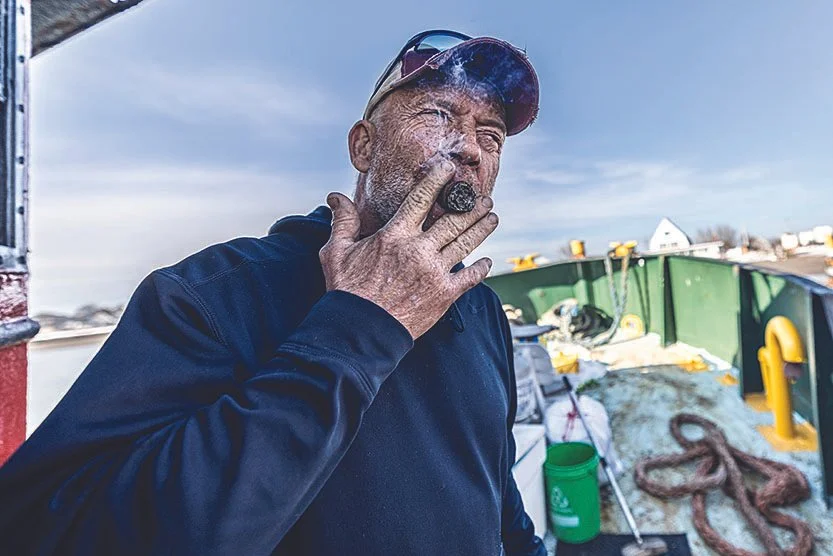
O, CAPTAIN: Hull’s Mike McDevitt, shown aboard the tugboat ‘Acushnet,’ is the subject of a new documentary about life on Peddocks Island, ‘The Last Islander.’ [Photo courtesy of Joe Berkeley]
By Carol Britton Meyer
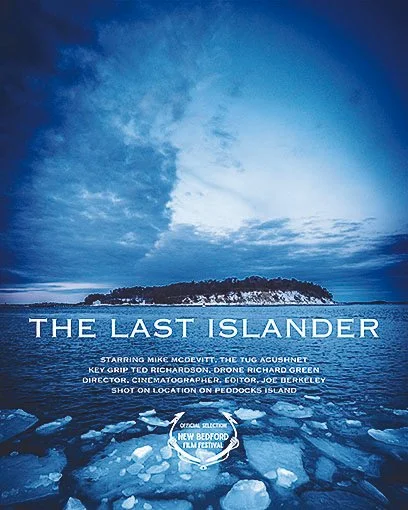
A locally produced documentary about the last full-time resident on Peddocks Island has been selected for inclusion in the New Bedford Film Festival in April, with a viewing in Hull scheduled for May.
Hull resident Joe Berkeley’s recent work is a fascinating documentary titled “The Last Islander” about Michael McDevitt, who lives on the island off the coast of Hull. After McDevitt’s sister, Crissy, died last May, the state – which took the island by eminent domain decades ago – is considering taking a wrecking ball to her home, which is made from building materials that washed ashore from Boston Harbor.
“Mike is attempting to save the home – which is full of history and historical artifacts,” Berkeley told The Hull Times. “Mike’s life on Peddocks Island is extraordinary. He is one of a kind.”
McDevitt makes his home on the island year-round, with no running water and limited electricity, living off the land. He and his three siblings were transported by boat from the island across the Gut to school in Hull by their father when they were children.
A viewing of the film is planned at the newly renovated Hull Lifesaving Museum Boat House at Pemberton Point on May 30. General admission tickets are already sold out, as are the VIP tickets – which cost more but include a once-in-a-lifetime opportunity to circumnavigate Peddocks Island with Captain McDevitt aboard his tugboat, “Acushnet,” before the screening and reception. All proceeds benefit the museum. The New Bedford screening is planned for April 11 at 1 p.m. at Gallery X.
‘I wanted to do something unique’
Berkeley shared the story behind the film.
“In celebration of the 10th anniversary of my passion project, ‘Humans of Nantasket Beach,’ I wanted to do something unique, so I enrolled in a documentary cinematography class with Luc Forsyth of Toronto and learned how to do more with less” after making television commercials with the assistance of “giant crews,” he said.
The course offered tips on blocking out shots, running the camera, and capturing the subject as well as what gear to buy, among others.
Normally Berkeley races small sailboats on Sundays, but this winter the season was canceled due to repairs to the Boston Yacht Club, from which he usually sails.
On a Sunday in early December last year, unable to race, Berkeley was shooting his cinema camera “when the ‘Acushnet’ steamed through my frame. McDevitt landed at the town pier in Hull. We started talking, and he told me his story,” resulting in the documentary.
McDevitt – whose house is also made of found materials – also owns several fishing boats named after family members and the pier beside Jo’s Nautical Bar – also known as Darcy’s after the property’s former owners – where he frequently docks the Acushnet, along with his two dogs – Gunwale, a Ridgeback mix, and Barccus, a Husky mix – who keep him company on the island. He also is the owner of Acushnet Marine.
“Mike’s is an incredible story of resilience and a great representation of what’s possible,” Berkeley said. “He embraces anything that washes up on the Peddocks Island shore. He makes a life from found people, objects, and stories and has made an impact on a lot of lives.”
‘He’s a great Hull character’
McDevitt’s good works aren’t well-known, he noted, “because he’s often out on the ocean with his tugboat. He’s a great Hull character.”
Berkeley refers to “The Last Islander” film as “a passion project with a small but mighty crew” that included Hull residents Richard Green as the drone cinematographer and Ted Richardson – a Hull resident and launch driver at Hull Yacht Club – who was the key grip who carried the heavy gear and “can fix anything.”
Berkeley was the writer, director, cinematographer, editor, “and the guy who made lunch!” he said. “I had to buy some gear to make the documentary, but it was worth it. This is a beautiful story – an ‘only in Hull’ story – soaked in salt water with a dash of piracy … As always, Hull and its surrounding waters made for beautiful imagery and a great story. Mike is an amazing subject in a beautiful environment.”
Green, who collaborated with Berkeley in the past – including on a public service announcement to save MBTA ferry service to Hull a few years ago – told The Hull Times that it was “nice to be part of the crew. Joe brings a lot of excitement to his projects and goes at them full tilt.”
‘Lovely island in middle of everything’
Green especially enjoyed being on “this lovely island in the middle of everything” and the ham and cheese sandwiches prepared by Berkeley’s wife, Lisa, to enjoy on the island – where he met McDevitt for the first time. “Joe tells a good story,” he said.
A few months earlier, Green had read the book “Once Upon an Island: A Century of Life on Peddocks Island” about what life is like there and its rich history, written by longtime summer resident, Matilda Silvia – which he highly recommends.
Richardson also enjoyed being part of the crew.
“It was really peaceful on the island and a really cool experience being there during off-season, riding on the ‘Acushnet,’ and hearing Mike’s stories,” he said. “The cinematography in the film is incredible, and the houses on the island are pretty sturdy – not just pieces of driftwood nailed together!”
Stories to tell
McDevitt intends to stay on Peddocks Island as long as possible, despite the harsh winter weather, with 12 inches of ice on the beach this year. “I really enjoy it here,” he said.
He enjoys living on the island year-round.
“It’s peaceful with the wood stove going, and there are a few chickens left – like a little farm,” McDevitt said. “It does get lonely, though, with no other family members or the Portuguese fishermen who once lived here.” There are still summer residents on the island.
Peddocks features a variety of wildlife, from owls to coyotes to seals.
“Once in a while a seal will get into my rowboat,” he said. “Once I found one in the boat out on the water with no oars in sight. The boat had kept going in the water until I discovered the seal.”
McDevitt noted that the Humane Society had erected little houses on islands up and down the East coast from the Cape to Maine for people who run aground, providing firewood and food until help comes.
While Peddocks is not one of those islands, Crissy’s house served that purpose last fall when a man fell overboard and the boat he had been on kept going.
“He swam to the west side of Peddocks Island and walked seven miles until he found my sister’s house,” McDevitt recalled. “It was amazing.”
Mike’s brother, Edward X. McDevitt, happened to be on the island that day and called him on his tugboat.
“I [led] the Coast Guard to my sister’s house,” he said. After providing assistance, the Coast Guard evacuated the man to Hull.
“Following the incident, the man gave $100 to everyone whose house he had broken into in the hopes of getting help before he reached my sister’s and returned all the blankets from her house that were loaned to him – along with the ones he had taken from a couple of the houses along the way in the freezing cold and wet weather,” he recalled.
Peddocks Island history
According to Berkeley, an English settler with the last name Peddocks took ownership of the island in Colonial days. Much later, the state took it over and built Fort Andrews – which played a prominent military role in the defense of Boston Harbor during World War I and in prior times due to its proximity to the mainland.
The state then sold the island to a gentleman named Isadore Bromfield – who hired McDevitt’s parents, Judy and Edward, as caretakers starting in the 1950s and continuing into the ‘70s and ‘80s.
Edward served as the Hull harbormaster for a time, and Judy ran tugboats up and down the East Coast and was also talented at writing, sewing, photography, and painting.
After the island – which was also home to a number of Portuguese fishermen living in shacks – fell into disrepair, the Commonwealth of Massachusetts took it by eminent domain in the 1970s.
At that time, the state told the current residents – who were also without running water or electricity – that they could remain in their homes until they passed on, but once that happened, they would be knocked down. This is the challenge McDevitt is facing while working to save his sister’s home.
“Before my sister passed, we used to have tea together and talk on her front porch,” he said. “Crissy said to me, ‘Never let anything happen to this house when I pass,’ and I promised her I would take care of it.”
Like what you’re reading? Stay informed and support our work with a Hull Times subscription by clicking here.
Do you have an opinion to share? Click here to write a Letter to the Editor.
© 2026 The Hull Times. All rights reserved.