
$56.6-million budget, 10 citizens’ petitions to highlight Monday’s town meeting
/
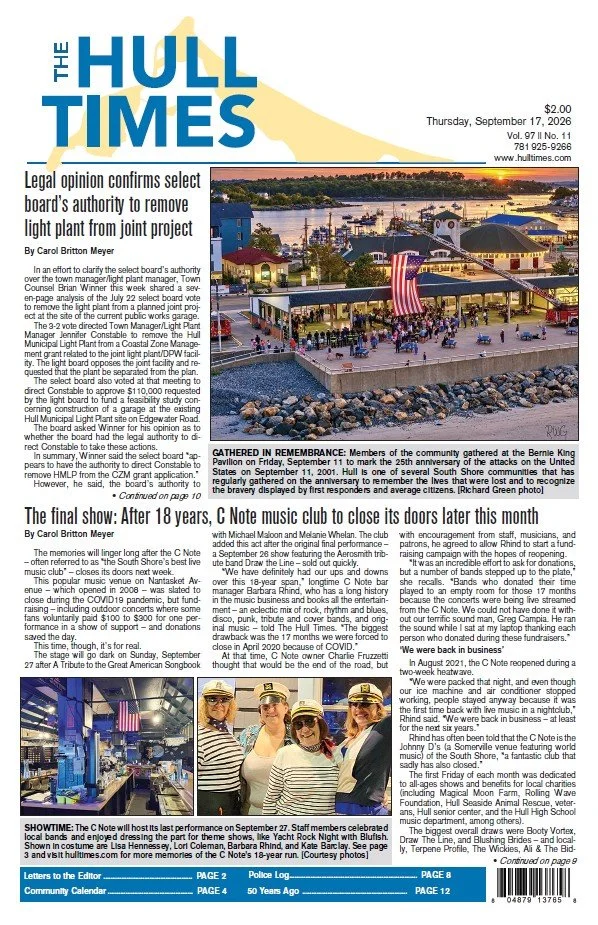
A capacity crowd is expected at Monday night’s town meeting, like this one from 2025. CLICK HERE TO READ THE FULL TOWN MEETING WARRANT.
By Christopher Haraden and Carol Britton Meyer
On Monday night, voters will gather at Hull High School to begin work on a 44-article annual town meeting warrant, which features a $56.6-million budget plan for FY27, $1.49 million in Community Preservation projects, and several citizens’ petitions that would reaffirm last year’s vote to change the management structure of the light plant, require government meetings to be available in hybrid format, and jump start an earlier town meeting vote to acquire privately owned parcels of land to ensure access to the beach at James Avenue in Hull Village.
The meeting is scheduled to begin at 7 p.m. Among the first acts of the assembly will be to act on the “consent agenda” – the standard housekeeping-type articles that must be approved each year in order to operate the government. The 11 articles in this year’s consent agenda, which are bundled into a single vote, range from acceptance of departmental reports to the reauthorization of enterprise funds to allowing the town to cooperate with state agencies throughout the year. These articles are 1, 2, 3, 4, 5, 6, 9, 10, 11, 12, and 14, and the town moderator’s message explains this process and how voters can modify the process if desired.
The town’s annual operating budget is Article 8. Earlier this year, Town Manager Jennifer Constable presented a proposed $56.6 million fiscal 2027 municipal budget, representing a 3.43%, or $1.9 million, increase over this year’s spending plan. Constable proposes to add two full-time fire department positions and an increase in hours for the IT, veterans services, and public works departments, as well as money for a collective bargaining agreement with library employees.
Capital projects in the budget proposal total $765,000, including $156,000 for new police vehicles, $171,000 in technology upgrades ($151,000 townwide and $50,000 for the school department) and $20,000 for a redesign of the town’s website. The budget also includes $20,000 for air conditioning at the library, $25,000 each for HVAC and boiler replacement at the police and fire stations. Additional capital projects include $38,000 for seawalls, $30,000 for maintenance of Straits Pond, $60,000 for townwide line painting, $70,000 for the new online permitting system, and $25,000 each for a beach management survey and the USA 250th Anniversary celebration.
Click below for full coverage town meeting from The Hull Times:
For at least the fourth year in a row, there were no public comments during the annual public hearing on the proposed $18.9-million school department budget, which represents a 3% – or $551,713 – increase over the FY26 budget figure. Voters at town meeting will have the opportunity to ask questions of the school committee and superintendent at town meeting.
The Community Preservation Committee’s seven projects for this year are included in Article 13. The committee proposes using the Community Preservation Act surcharge funds for a $49,770 rehabilitation of the Hull Community Garden on George Washington Boulevard; $26,825 for outdoor recreation space at the Hull Lifesaving Museum; $670,000 for renovation of the Village Playground and basketball court; $58,000 for the Hull Lifesaving Museum’s renovation work at its Windmill Point boathouse; $150,000 toward restoration of the clocktower building, which is leased from the state by the non-profit Friends of the Paragon Carousel; $45,197 for the preservation of historic documents; and $500,000 for the Hull Community Housing Trust.
To prepare for town meeting, the select board this week reviewed the 10 citizens’ petitions – Articles 35-44 – but did not take a position on them. Select board member Jerry Taverna was not present at the meeting, and Town Counsel Brian Winner participated remotely.
• Article 40 is expected to prompt considerable debate. It seeks to petition the Legislature to amend the town’s charter to remove the town manager from the operation of the municipal light plant and restore the statutory authority to the light board. Select board Chair Irwin Nesoff noted that the proposal is essentially the same as last year’s Article 37, which town meeting approved and is currently in a study committee on Beacon Hill.
Proponent Leslie Taylor said for someone to hold both roles is difficult.
“We need a specialized person to [be the light plant manager],” she said. A lengthy, sometimes heated discussion among select board members and light board members Jacob Vaillancourt and Thomas Burns and Taylor ensued around this subject and the role of the light board and the light plant manager, among other issues.
Constable said she feels fully capable of handling both jobs and that while the light plant manager job is “challenging,” the staff she works with has the technical expertise on which she can rely.
Taylor asked Winner, the town counsel, if the article passes whether it would be actionable. Winner said that even with a positive vote at town meeting, the select board is not required to file the article with the Legislature.
Nesoff said the purpose of the discussion was “not to argue but to let citizens know what the issues are.” Vaillancourt said that “we’re all trying to understand each other, and we all love the town and want the best for Hull.” A joint select board/light board meeting will be scheduled for further discussion.
Select board member Greg Grey said he has watched three of the five light board members focus continuously on Articles 37 and 40 during their meetings, “and you’ve set yourselves back. I watched the meetings as citizen and I was embarrassed. The focus should have been on the ratepayers. …I worry about a board that ends up in a silo and about what decisions will be made with no checks and balances.”
• Article 44: This petition would authorize the select board to acquire either an easement in or purchase outright a privately-owned parcel of land on James Avenue that has traditionally been used by the public for beach access. In 2017, town meeting voted in favor of a similar proposal, but no action was taken.
• Article 39: This petition would appropriate funds for the recording of all public meetings and make them available within seven days through Hull Community Television or the town website. At Wednesday’s meeting, concerns were expressed that there is no cost estimate for the equipment that would be required. It was also noted with town hall moving to the Memorial School, there will be more technology available to record meetings, and that could apply to Article 42, which would require hybrid access to meetings.
Select board member Jason McCann said hybrid meetings could be beneficial “to make meetings as public as possible. I get the intention, but the petition is not specific enough.”
Nesoff also said he understood the intention, but noted that committees and boards already have the option of holding Zoom meetings, “when anyone in the public can participate.”
• Article 43: This petition would repeal 2018 annual town meeting warrant Article 11 that authorized the transfer of land in the Hull Redevelopment Authority area in anticipation of reconfiguration of the streets, including opening the roads to two-way traffic. Constable said that if this article passes, any actions taken after the 2018 vote would not be altered and that the article usurps the select board’s role as the town’s traffic commissioners. Similarly, Article 38 would limit permanent traffic direction changes in the Nantasket Beach Overlay District. Winner said he had concerns about the legality of this petition because it might “intrude” on the role of the traffic commissioners.
• Article 36 would appropriate an annual budget for 19 boards, committees, and commissions – up to $3,000 each for professional services and up to $1,500 each for office supplies and administrative support services. Nesoff noted that if approved, the article could incur an additional $85,000 in expenses.
• Article 35 would amend the town’s bylaws to ensure “that major capital projects are coordinated and prioritized by the select board and planning board, with full consideration of recommendations from all town officers, boards, committees, commissions, and councils.” Constable said that a capital improvement planning committee was created and that this petition “looks to shift a lot of their responsibility to the planning board, which is not its role – although a planning board representative sits on the committee. It’s an inclusive process that we’re continuing to refine.”
• Article 41 would authorize citizens to request access to town counsel to review the legal format of citizens’ petitions. “I had a rough time navigating Article 37 and don’t want this happening to someone else,” Vaillancourt said. While Grey said he understands the intent, he thinks it’s an inappropriate use of town resources and that citizens’ petition proponents should seek legal advice on their own.
• Article 37: Funds are being sought to replace the stairs to beach on Western Avenue in Hull Village that were destroyed in a storm in 2022. Nesoff noted that the actual ownership of the steps is uncertain, and is being researched. The board discussed the issue in executive session this week.
A replay of Wednesday night’s select board meeting will be available on demand on Hull Community Television’s website, www.HullTV.net.
Like what you’re reading? Stay informed and support our work with a Hull Times subscription by clicking here.
Do you have an opinion to share? Click here to write a Letter to the Editor.
© 2026 The Hull Times. All rights reserved.