
Reflections on transparency, town meeting, conflict, accountability and alliance
/
Op/Ed by David Kellem
I’ve been participating in Hull town meeting for around 40 years as a citizen, an attorney representing clients seeking zoning or bylaw changes, as a school committee member, and as an advocate for many local causes and public-service organizations. In getting controversial articles passed, I have experienced both hard-fought and well-strategized victories as well as unexpected, harsh defeats. That’s just the way town meeting goes. But be it victory or defeat, civic life and the Town of Hull have gone on.
Last week’s four nights of town meeting were some of the most tension-filled and frustrating ones I have seen. One person described the week to me as “collective trauma.” I have been trying to process what happened in the hope that we can cull lessons and grow from the conflicts.
The citizenry of Hull has changed. In my view, the voters are more engaged, more organized, more intelligent, and more knowledgeable than in the past. With the level of access now available through information technologies, the citizenry sees no reason why public meetings cannot be made more accessible (subject to some transitional technology training and acquisition).
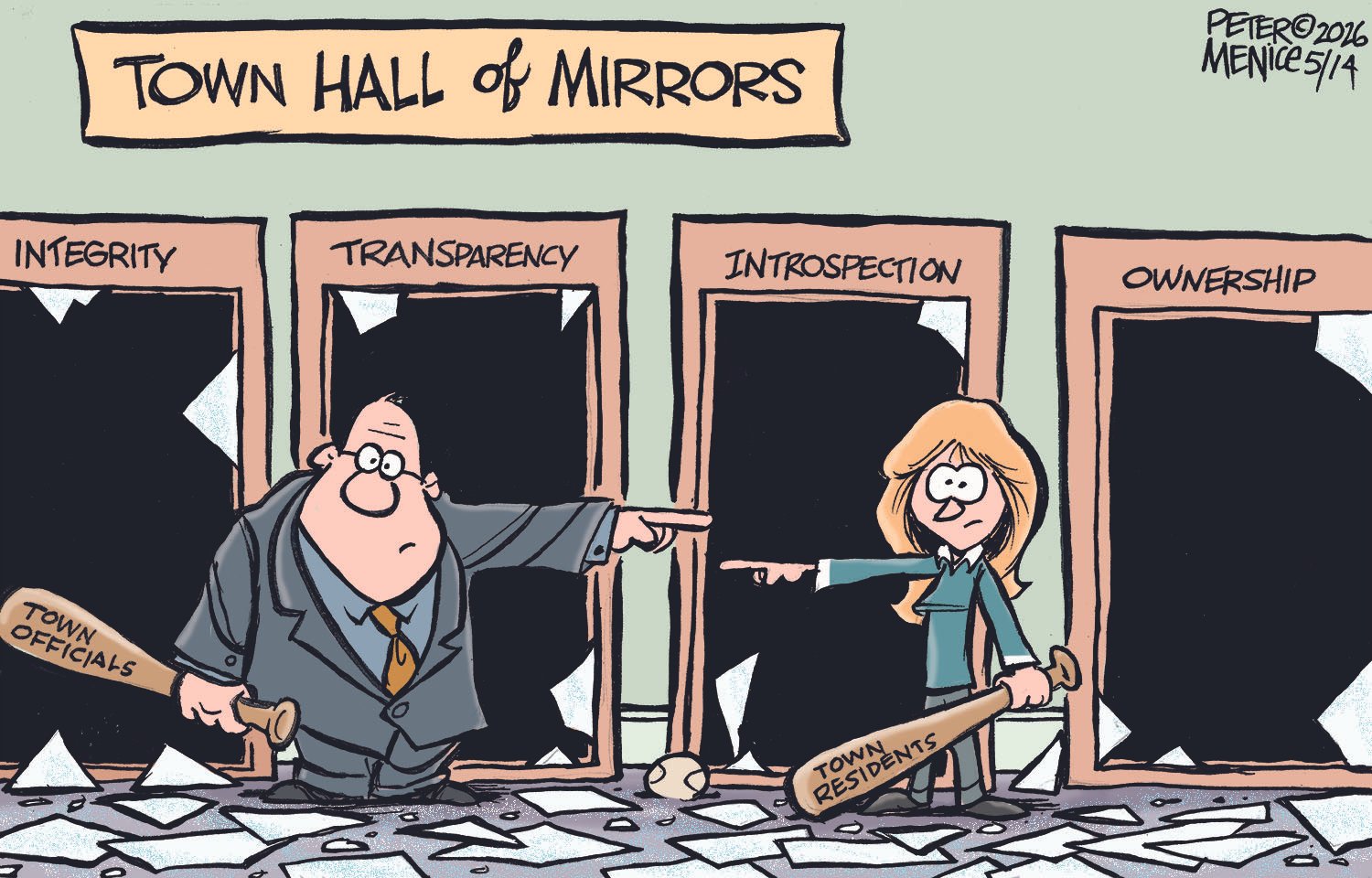
The citizenry insists on transparency. Exactly what that means is not yet fully defined and may be subject to interpretation. But it wants more than bare legal transparency – meaning governmental compliance with Open Meeting and Freedom of Information laws. The people want data. They want information. They want their questions answered. They want to see into the process of municipal decision-making and to be respected participants in it.
That much is crystal clear.
From my perspective serving in municipal government, I have seen how an angry and poorly informed citizenry throws monkey wrenches into the processes of government functioning. If people don’t know the facts, they will invent them; they will tell stories. A lack of information can easily turn into distortions of truth and tendencies toward personal attacks on leaders and staff. The government officers on the receiving end become resentful and highly defensive. They do not want their good intentions and committed efforts slanderously cast as incompetence, self-interest or corruption. They want to do their jobs efficiently and effectively. Cynicism, distrust and toxicity invade the culture.
It is human nature to distrust when one cannot obtain information. One fears what one does not know. Public information stored behind obstacles to access is a breeding ground for suspicion. Suspicion leads to rumor, rumor to misinformation, and misinformation to anger. As we all know, anger fuels conflict.
Conflict in itself is not a bad thing. In fact, it is absolutely natural and essential to human cooperation and decision making. Conflict can be peaceful – a disagreement that is manifested through discussion and debate, for example; or it can be violent – disagreements manifested through verbal or physical fighting. Conflict that begins as peaceful, if unresolved fairly and with truthful information, can morph into conflict that is violent.
Violent conflict does not always mean physical violence. It can mean slander, libel, lying, cheating, stonewalling, yelling, and undermining. Violent verbal conflict decimates truth and hurts people. As citizens, we are good at restraining from physical violence. But we are not good at avoiding verbal or emotional violence. When we feel threatened, mistreated, fearful or unheard, we tend to strike out.
To be heard, by others who summon patience to listen, is a fundamental human need.
In my 70 years, most of which has been lived in Hull, I have witnessed a propensity toward political violence of the verbal, non-physical kind. Sometimes verbal jousting has been sport, a relatively harmless entertainment once the dust settled. Other times it has been war – and people, institutions and community have been badly damaged.
I do think that Hull’s governmental leaders have been victimized over the years by non-physical political violence. And that they are defensive.
As a two-term school committee member in the 1990s, during the battles around education reform, charter schools, and teacher contracts, I saw what anger and fear can do to the effective functioning of government. I saw what verbal attacks did to leaders and governmental workers. It made them defend themselves and fight. It made them want to hide their decision-making processes, withhold data, and to make deals behind the curtain of public scrutiny. Why? So that they could do their important work without angry interruptions and so the business of government could get done.
This kind of defensive protectionism creates a toxic environment. It divides people into loyalists and opposers. Meaningful and productive communication disappears. The conflict becomes a binary battle rather than a nuanced and rational discussion of complex issues.
I have worked as a lawyer for 45 years. My experience has included deep dives into criminal law, municipal law, and divorce law. There is an expression that I have always loved that sums up client types. It goes like this: As a criminal lawyer, you work with bad people who are behaving their very best; as a divorce lawyer, you work with good people who are behaving their very worst.
I think when it comes to local government in Hull, our debates of policy have been more akin to divorce than crime. Good citizens and good government officials have behaved badly because the political culture has felt like a bad marriage.
A bad civic marriage is hard to avoid within a culture of non-physical violence. Everyone is defensive and protective to the point of being elusive and evasive; we ask questions which land as attacks; we try to manipulate outcomes with tactics rather than trusting candid but fair discussion to guide responsible outcomes.
There will always be tribalists who prefer fighting and haters who prefer the rougher versions of conflict. Although these types are the great minority, they often have the loudest voices. We have to remember that loud voices usually make the weakest arguments.
I think we Hullonians do want to debate and decide fairly, not hatefully. As town meeting showed, more than two-thirds of our local legislative body can deliberate and make reasonable decisions.
It takes objectivity. Objectivity requires information. Objectivity requires truth. Objectivity encourages questions and examination of governmental processes and objectivity requires respectful answers to those questions.
I have spent the last 23 years of my legal career working as divorce mediator. One of the fundamental tenets of mediation is that in a non-violent conflict resolution system it is crucial to separate the people from the problem. Problems can be solved by cooperative thinking, discussion and decision making – but this requires objectivity about what the problem actually is. When one is fixated on the people involved – “I dislike you,” or “I distrust you, you are an idiot,” or “you are corrupt” – then one’s feelings about the other person prevent one from examining the actual problem in issue and deriving solutions. This is not an easy task and that is why there is a skilled profession called mediation.
There is another profession called therapy that seeks to free people from and of their resentments, bias, trauma reactions, and self-destructive tendencies. Therapy is helpful for individuals and for families. Family therapy is important because families are pretty much stuck with each other long-term. One often cannot just walk away from family and ignore the family members and systems. But overall, families want to find ways to get along for the good of everyone. They may not enjoy each other day to day, but when the going gets tough, family has your back.
The community of Hull is a form of family. We are small, tight-knit, and stuck with each other. We have big conflicts and difficult personalities that make everyday life challenging and upsetting at times. But I think almost to a person, we all believe in this town and are devoted to what unites us.
What unites us is the great privilege of living on this remarkable peninsula, this barrier beach, this near island located at the end of the world but only eight miles by sea from downtown Boston. We are blessed collectively by nature – both the gentle beauty of the warm seasons and the wild furious dynamic of the winters. Our overarching skies are big and open and our ocean planes are vast. We share the shimmering broad flats of low tide and the pulsing blue fullness of high tide; in one spot we can experience sunrise and sunset in daily display.
Our people have a hardy, stubborn resilience. We share gentle kindness and caring appreciation. We are blessed by those who would risk their lives for us battling fires and floods and by souls who would lead us toward the spirit of our higher selves. Among us are highly intelligent people, motivated activists, successful businesspeople, and deeply charitable individuals and organizations.
Our history is rich beyond compare.
What else unifies us? Our children are committed athletes and scholars, musicians and boat builders. Our waters host fishing boats and commuter ferries, our streets hold dive bars with live music and fine restaurants with good feeling. We are blue-collar, white-collar, artisan and artist, and we willingly provide help for the struggling population among us.
In Hull, we know each other’s names and much more; we are underdogs always striving to do better while holding in our hearts the sweet secrets of our local experiences; we tend our sick, grieve our deceased, welcome newcomers, honor our past, and continually work to make our future.
And sometimes we get a little emotionally worked up.
This is Hull. We are a crazy, oddball community and we like it that way. To quote a great Sinatra song – “That’s Life” – we are puppets, paupers, pirates, poets, pawns, and kings (and queens). We been up and down, over and out, and all around. We get knocked down and we get up again (not Sinatra). We wouldn’t have it any other way.
So, let’s solve this transparency issue. Let’s find ways to make town meeting more productive. Let’s find ways to get the citizens the information they want. Let’s find ways to treat each other more respectfully. Let’s find ways to separate the people from the problems while acknowledging that sometimes certain people can be problematic. Let’s find ways to help our governmental leaders and staff do their jobs to the best of their ability. Let’s trust they are doing their jobs and leading us in good faith – which I believe they are. “Good faith” meaning they have the common good as their goal and the best interest of the people in their hearts. This is true of most. I am certain of it.
If I have to sum this all up, my feeling is that the citizenry should try to be less suspicious and accusatory and the government should try to be less defensive and resentful. We can do it. But it takes a mutual commitment to non-violent conflict resolution. It takes a mutual commitment to openness, truth-seeking, and truth-telling. It takes a level of reciprocal trust that is lacking at this moment. And it takes accountability, by which I mean that if someone makes a mistake, they should own it, acknowledge it, apologize and ask for help in doing better. I think we can all forgive mistakes. We can understand when someone has a change of mind or heart. We can all understand when circumstances change and prior expectations prove unrealistic.
If a reasonable level of trust, accountability and transparency can be built, then government and citizenry can think of each other as actual allies in solving the complex, difficult and seemingly intractable problems our town faces. Allies, remember, are free to have conflict but also committed to resolving it peacefully.
Here is to being actual allies.
Like what you’re reading? Stay informed and support our work with a Hull Times subscription by clicking here.
Do you have an opinion to share? Click here to write a Letter to the Editor.
© 2026 The Hull Times. All rights reserved.