Spelling error on new parking stickers prompts suspension of enforcement in restricted areas

By Carol Britton Meyer

The Town of Hull is issuing corrected versions of restricted parking permits and suspending enforcement of parking regulations following a printing error discovered on a batch of this year’s stickers.

Parking enforcement will be paused until the revised permit issuance resumes in early June.

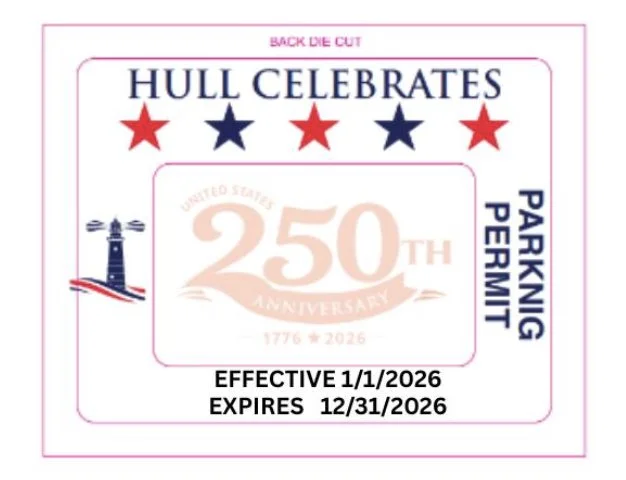
The word “parking” was misspelled by the printing company responsible for producing the permits, so that the word printed on the stickers was “parknig.” The error was identified after a community member noticed the typo.

The town immediately contacted the printing company to correct the mistake upon learning of the error. The cost to reprint the stickers – 52 cents apiece – will be split with the town since the error wasn’t discovered when the sticker was proofread by a staff member.

Town Manager Jennifer Constable last week told the select board that the error originated with the printing company.

“That error shouldn’t have come over to us in a proof, and they acknowledge that,” Constable said at the board’s May 13 meeting. “The proof that was sent to us I feel was prematurely OK’d by one individual and we should all have had a chance to look at that proof and hopefully catch that error.”

Online permit applications will continue to be processed, however, with corrected permits expected to arrive within a few weeks. Senior center and library staff are available as needed to provide assistance to residents who wish to order a parking pass.

While it is not required, residents who already received a permit with the misspelling may request a corrected replacement. Requests for corrected permits may be made at the office of the treasurer/tax collector at town hall.

“We appreciate the public bringing this to our attention, and we moved quickly to address the issue with the printing company,” Police Chief John Dunn stated in a press release. “We thank residents for their patience and understanding while corrected permits are being produced.”

In a statement to the Times, the town manager acknowledged that this year’s price is higher than last year.

“Parking permit prices have been increased for the first time in many years,” Constable said. “Even with the increase in price, Hull's prices remain substantially lower than many neighboring communities.  Sales revenues help support Hull's Community Service Officers who provide important services during Hull's busiest summer seasons, including parking enforcement.

Restricted parking permits and visitor passes are $20 each, up from $14 last year; senior citizens pay $10 (up from $7 last year).

The town also changed the effective dates of the stickers, with the 2026 stickers being sold in May expiring on December 31. Previously, the stickers were valid for 12 months, but Constable told the select board that the change was made in order to avoid bottlenecks in the spring when residents rush to purchase stickers prior to beach season. Future permits will run on the January-December schedule.

“The change in timing provides residents the opportunity to purchase permits well in advance of the summer season and ensures sales are captured in a single fiscal year, allowing for improved planning,” Constable said.
At last week’s meeting, the town manager said that the new expiration date would not affect most neighborhoods in the off-season. The select board is scheduled to discuss parking regulations townwide at its June 10 meeting.

This year, the town transitioned to an all-online system for sales of restricted parking permits and visitor passes, which remains active. The secure payment portal for Hull residents and visitors to purchase a parking permit or visitor pass can be found at epay.cityhallsystems.com.

Users must search for “Hull” in the “Enter Your Municipality” search menu. Constable said the online-only system is expected to save about $30,000 versus the cost of in-person sales.

To purchase restricted parking permits or visitor passes, applicants must provide all required vehicle and residency documentation, including their vehicle registration or property/excise bill. Additional documentation is required for certain situations, such as leased vehicles and vehicles that are registered to a business. Applicants will receive confirmation emails when their request is submitted. Permits and passes will be mailed to the resident address provided in the application.

Restricted permits are available at no charge for veterans with a DD Form 214 or military identification and for active military members with a valid military ID. Residents with a disabled or handicapped placard may also receive one restricted resident permit at no charge for one vehicle with valid documentation.

Residents with questions about the permit program or the ordering process can contact City Hall Systems at 508-381-5456.

Christopher Haraden contributed to this report.


Like what you’re reading? Stay informed and support our work with a Hull Times subscription by clicking here.

Do you have an opinion to share? Click here to write a Letter to the Editor.

© 2026 The Hull Times. All rights reserved.

Despite last week’s announcement of agreement, town delayed the release town manager’s contract

Although four select board members and the town manager announced last week that negotiations had resulted in a new, three-year employment contract, the board did not immediately release the agreement, citing the need for additional review by labor counsel.

The Hull Times first requested the document on May 14 after the board announced the previous night that the agreement had been finalized in an executive session. After the request was denied by Chair Irwin Nesoff, the Times appealed to the state’s Supervisor of Public Records.

The newspaper contends that town’s reliance on the “deliberative process” exemption under the public records law no longer applies, and that draft documents – such as unapproved meeting minutes – are routinely released by public bodies.

In his reply, Nesoff said that a board member was out of town and the document needed an additional signature, although he admitted that “the outstanding signatory does not have the authority to change or amend the contract. Please be assured that once it has been fully signed, you will be supplied with a copy of the contract.”

He also cited town counsel’s contention that “the deliberative process of negotiating the contract would be tainted if the contract were prematurely disclosed.”

The Times’ position is that the board’s announcement of the conclusion of negotiations eliminates the deliberative process exemption under the Public Records Law. In its appeal to the Supervisor of Public Records, the newspaper also objected to the mention of a board member’s absence, as that appears to establish a timetable for the release of public records based on the personal schedules of public officials, which is not contemplated under the law.

The matter remained unresolved at the Times’ deadline this week. On Thursday afternoon, the newspaper received a copy of the agreement by email – seven-and-a-half days after both parties announced that it had been finalized, but within the response window of 10 business days allowed under the law.

-- Christopher Haraden


Like what you’re reading? Stay informed and support our work with a Hull Times subscription by clicking here.

Do you have an opinion to share? Click here to write a Letter to the Editor.

© 2026 The Hull Times. All rights reserved.

Weir River Water System announces watering limits now in effect

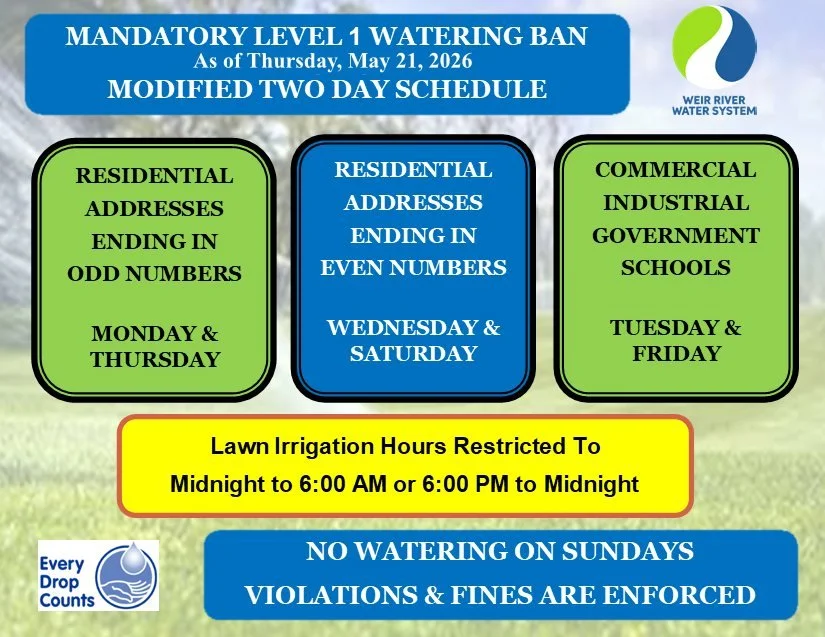
On Thursday, May 21, the Weir River Water System will impose limits on outdoor watering in order to comply with the MassDEP declaration of Level 1 drought conditions for Southeastern Massachusetts. The restricted schedule will be in effect until the drought status changes. All other outside uses are allowed.
Level 1 watering schedule:
• Residential addresses ending in odd numbers: Monday & Thursday.
• Residential addresses ending in even numbers: Wednesday & Saturday.
• Commercial, industrial, governmental, schools: Tuesday & Friday.
• No watering on Sundays.
• Lawn irrigation hours are restricted to midnight to 6 a.m. or 6 p.m. to midnight.
According to the company, violations and fines will be enforced. Full details can be found at www.weirriverwater.org/881/Water-Conservation-Restrictions.


Like what you’re reading? Stay informed and support our work with a Hull Times subscription by clicking here.

Do you have an opinion to share? Click here to write a Letter to the Editor.

© 2026 The Hull Times. All rights reserved.

Weather update: Memorial Day parade canceled; Ceremony at 10 a.m. inside Hull High

UPDATE: Due to the weather forecast, the Memorial Day parade has been canceled. The ceremony has been moved to 10 a.m. at the Hull High gym. Street corner dedications will follow the ceremony. **

By Paul Sordillo, Hull Veterans Service Officer

Hull will once again come together this Memorial Day to honor the men and women who gave their lives in service to our nation. The Town of Hull’s annual Memorial Day parade, ceremony, and street corner dedications will take place on Monday, May 25, and all residents are encouraged to attend and participate in this solemn community tradition.

The weekend begins with the placement of flags at veterans’ graves on Saturday, May 23, starting at 9 a.m. at the Hull Village Cemetery. Volunteers are welcome and encouraged to join in this important act of remembrance.

Memorial Day will begin with the parade, stepping off at 9:30 a.m. from Hull High School. Veterans, scouts, civic organizations, public safety personnel, and community groups will march together in remembrance of those who served and those we have lost. Residents along the route are invited to line the streets, display flags, and show their support.

The parade will conclude at Hull Village Cemetery, at the Gold Star Mothers Memorial, where the Memorial Day ceremony will begin at 10 a.m. This year’s keynote speaker is Kenneth Walsh, whose remarks will reflect on the meaning of sacrifice, service, and the responsibility communities share in remembering their fallen.

The ceremony will include the placement of a wreath, the reading of names, and the traditional rifle salute and playing of “Taps.”

In the event of inclement weather, the Memorial Day parade will be canceled. The ceremony will still be held as scheduled and will be moved indoors to the Hull High School gymnasium. Residents are encouraged to monitor local announcements and the Town of Hull’s official communications for any weather-related updates prior to the event.

Following the ceremony, Hull will continue one of its most meaningful traditions: the street corner dedications honoring Hull service members who have passed and served the United States. At each designated corner, a brief dedication is read aloud, acknowledging the life, service, and sacrifice of the individual whose name the corner bears.

This year’s dedications include:

• Raymond Russell Chase: Samoset Avenue & Phipps Street

• John Patrick O’Hare: K Street & Nantasket Avenue

• Raymond B. Strozewski: Atlantic Avenue & Driftway

• Francis J. Tierney: Newport Road & Nantasket Road

• Frederick Martin Tobman: Centre Avenue & Veterans Road

These dedications, carried out by volunteers, veterans, and community members, ensure that each fallen hero is recognized personally and publicly, keeping their memory alive within the community they once called home.

Memorial Day is not simply a holiday –  it is a day of reflection, gratitude, and remembrance. Hull’s Veterans Services Office invites all residents to stand together in honoring those who gave everything for our freedoms.

For more information about the parade route or ceremony details, contact the Hull Veterans Services Office at 781-925-0305 or psordillo@town.hull.ma.us.


Like what you’re reading? Stay informed and support our work with a Hull Times subscription by clicking here.

Do you have an opinion to share? Click here to write a Letter to the Editor.

© 2026 The Hull Times. All rights reserved.

Reflections on transparency, town meeting, conflict, accountability and alliance

Op/Ed by David Kellem

I’ve been participating in Hull town meeting for around 40 years as a citizen, an attorney representing clients seeking zoning or bylaw changes, as a school committee member, and as an advocate for many local causes and public-service organizations. In getting controversial articles passed, I have experienced both hard-fought and well-strategized victories as well as unexpected, harsh defeats. That’s just the way town meeting goes. But be it victory or defeat, civic life and the Town of Hull have gone on.

Last week’s four nights of town meeting were some of the most tension-filled and frustrating ones I have seen. One person described the week to me as “collective trauma.” I have been trying to process what happened in the hope that we can cull lessons and grow from the conflicts.

The citizenry of Hull has changed. In my view, the voters are more engaged, more organized, more intelligent, and more knowledgeable than in the past. With the level of access now available through information technologies, the citizenry sees no reason why public meetings cannot be made more accessible (subject to some transitional technology training and acquisition).

The citizenry insists on transparency. Exactly what that means is not yet fully defined and may be subject to interpretation. But it wants more than bare legal transparency – meaning governmental compliance with Open Meeting and Freedom of Information laws. The people want data. They want information. They want their questions answered. They want to see into the process of municipal decision-making and to be respected participants in it.

That much is crystal clear.

From my perspective serving in municipal government, I have seen how an angry and poorly informed citizenry throws monkey wrenches into the processes of government functioning. If people don’t know the facts, they will invent them; they will tell stories. A lack of information can easily turn into distortions of truth and tendencies toward personal attacks on leaders and staff. The government officers on the receiving end become resentful and highly defensive. They do not want their good intentions and committed efforts slanderously cast as incompetence, self-interest or corruption. They want to do their jobs efficiently and effectively. Cynicism, distrust and toxicity invade the culture.

It is human nature to distrust when one cannot obtain information. One fears what one does not know. Public information stored behind obstacles to access is a breeding ground for suspicion. Suspicion leads to rumor, rumor to misinformation, and misinformation to anger. As we all know, anger fuels conflict.

Conflict in itself is not a bad thing. In fact, it is absolutely natural and essential to human cooperation and decision making. Conflict can be peaceful – a disagreement that is manifested through discussion and debate, for example; or it can be violent – disagreements manifested through verbal or physical fighting. Conflict that begins as peaceful, if unresolved fairly and with truthful information, can morph into conflict that is violent.

Violent conflict does not always mean physical violence. It can mean slander, libel, lying, cheating, stonewalling, yelling, and undermining. Violent verbal conflict decimates truth and hurts people. As citizens, we are good at restraining from physical violence. But we are not good at avoiding verbal or emotional violence. When we feel threatened, mistreated, fearful or unheard, we tend to strike out.

To be heard, by others who summon patience to listen, is a fundamental human need.

In my 70 years, most of which has been lived in Hull, I have witnessed a propensity toward political violence of the verbal, non-physical kind. Sometimes verbal jousting has been sport, a relatively harmless entertainment once the dust settled. Other times it has been war – and people, institutions and community have been badly damaged.

I do think that Hull’s governmental leaders have been victimized over the years by non-physical political violence. And that they are defensive.

As a two-term school committee member in the 1990s, during the battles around education reform, charter schools, and teacher contracts, I saw what anger and fear can do to the effective functioning of government. I saw what verbal attacks did to leaders and governmental workers. It made them defend themselves and fight. It made them want to hide their decision-making processes, withhold data, and to make deals behind the curtain of public scrutiny. Why? So that they could do their important work without angry interruptions and so the business of government could get done.

This kind of defensive protectionism creates a toxic environment. It divides people into loyalists and opposers. Meaningful and productive communication disappears. The conflict becomes a binary battle rather than a nuanced and rational discussion of complex issues.

I have worked as a lawyer for 45 years. My experience has included deep dives into criminal law, municipal law, and divorce law. There is an expression that I have always loved that sums up client types. It goes like this: As a criminal lawyer, you work with bad people who are behaving their very best; as a divorce lawyer, you work with good people who are behaving their very worst.

I think when it comes to local government in Hull, our debates of policy have been more akin to divorce than crime. Good citizens and good government officials have behaved badly because the political culture has felt like a bad marriage.

A bad civic marriage is hard to avoid within a culture of non-physical violence. Everyone is defensive and protective to the point of being elusive and evasive; we ask questions which land as attacks; we try to manipulate outcomes with tactics rather than trusting candid but fair discussion to guide responsible outcomes.

There will always be tribalists who prefer fighting and haters who prefer the rougher versions of conflict. Although these types are the great minority, they often have the loudest voices. We have to remember that loud voices usually make the weakest arguments.

I think we Hullonians do want to debate and decide fairly, not hatefully. As town meeting showed, more than two-thirds of our local legislative body can deliberate and make reasonable decisions.

It takes objectivity. Objectivity requires information. Objectivity requires truth. Objectivity encourages questions and examination of governmental processes and objectivity requires respectful answers to those questions.

I have spent the last 23 years of my legal career working as divorce mediator. One of the fundamental tenets of mediation is that in a non-violent conflict resolution system it is crucial to separate the people from the problem. Problems can be solved by cooperative thinking, discussion and decision making – but this requires objectivity about what the problem actually is. When one is fixated on the people involved – “I dislike you,” or “I distrust you, you are an idiot,” or “you are corrupt” – then one’s feelings about the other person prevent one from examining the actual problem in issue and deriving solutions. This is not an easy task and that is why there is a skilled profession called mediation.

There is another profession called therapy that seeks to free people from and of their resentments, bias, trauma reactions, and self-destructive tendencies. Therapy is helpful for individuals and for families. Family therapy is important because families are pretty much stuck with each other long-term. One often cannot just walk away from family and ignore the family members and systems. But overall, families want to find ways to get along for the good of everyone. They may not enjoy each other day to day, but when the going gets tough, family has your back.

The community of Hull is a form of family. We are small, tight-knit, and stuck with each other. We have big conflicts and difficult personalities that make everyday life challenging and upsetting at times. But I think almost to a person, we all believe in this town and are devoted to what unites us.

What unites us is the great privilege of living on this remarkable peninsula, this barrier beach, this near island located at the end of the world but only eight miles by sea from downtown Boston. We are blessed collectively by nature – both the gentle beauty of the warm seasons and the wild furious dynamic of the winters. Our overarching skies are big and open and our ocean planes are vast. We share the shimmering broad flats of low tide and the pulsing blue fullness of high tide; in one spot we can experience sunrise and sunset in daily display.

Our people have a hardy, stubborn resilience. We share gentle kindness and caring appreciation. We are blessed by those who would risk their lives for us battling fires and floods and by souls who would lead us toward the spirit of our higher selves. Among us are highly intelligent people, motivated activists, successful businesspeople, and deeply charitable individuals and organizations.

Our history is rich beyond compare.

What else unifies us? Our children are committed athletes and scholars, musicians and boat builders. Our waters host fishing boats and commuter ferries, our streets hold dive bars with live music and fine restaurants with good feeling. We are blue-collar, white-collar, artisan and artist, and we willingly provide help for the struggling population among us.

In Hull, we know each other’s names and much more; we are underdogs always striving to do better while holding in our hearts the sweet secrets of our local experiences; we tend our sick, grieve our deceased, welcome newcomers, honor our past, and continually work to make our future.

And sometimes we get a little emotionally worked up.

This is Hull. We are a crazy, oddball community and we like it that way. To quote a great Sinatra song – “That’s Life” – we are puppets, paupers, pirates, poets, pawns, and kings (and queens). We been up and down, over and out, and all around. We get knocked down and we get up again (not Sinatra). We wouldn’t have it any other way.

So, let’s solve this transparency issue. Let’s find ways to make town meeting more productive. Let’s find ways to get the citizens the information they want. Let’s find ways to treat each other more respectfully. Let’s find ways to separate the people from the problems while acknowledging that sometimes certain people can be problematic. Let’s find ways to help our governmental leaders and staff do their jobs to the best of their ability. Let’s trust they are doing their jobs and leading us in good faith – which I believe they are. “Good faith” meaning they have the common good as their goal and the best interest of the people in their hearts. This is true of most. I am certain of it.

If I have to sum this all up, my feeling is that the citizenry should try to be less suspicious and accusatory and the government should try to be less defensive and resentful. We can do it. But it takes a mutual commitment to non-violent conflict resolution. It takes a mutual commitment to openness, truth-seeking, and truth-telling. It takes a level of reciprocal trust that is lacking at this moment. And it takes accountability, by which I mean that if someone makes a mistake, they should own it, acknowledge it, apologize and ask for help in doing better. I think we can all forgive mistakes. We can understand when someone has a change of mind or heart. We can all understand when circumstances change and prior expectations prove unrealistic.

If a reasonable level of trust, accountability and transparency can be built, then government and citizenry can think of each other as actual allies in solving the complex, difficult and seemingly intractable problems our town faces. Allies, remember, are free to have conflict but also committed to resolving it peacefully.

Here is to being actual allies.


Like what you’re reading? Stay informed and support our work with a Hull Times subscription by clicking here.

Do you have an opinion to share? Click here to write a Letter to the Editor.

© 2026 The Hull Times. All rights reserved.

Voters head to the polls on Monday to choose from 19 candidates for 15 seats

By Christopher Haraden

Voters will head to the polls on Monday, May 18 to cast their ballots in Hull’s annual town election, choosing among 19candidates for 15 seats on boards ranging from the school committee to the redevelopment authority to the town’s top elected body, the select board.

Polls will be open from 7 a.m. to 8 p.m. at Hull High School, 180 Main St. For a sample ballot, see page 11 of this edition.

Contested races include five people seeking the two available three-year terms on the select board. Incumbent Jerry Taverna is being challenged by Michael A. Sampson, Susan Short Green, Patricia Lynn Cormier, and Christopher Niland. Board member Jason McCann did not seek re-election.

The school committee has two three-year terms available, with three candidates – current members Courtney Littlefield and Aleeza Hagerty and former member Ernest Minelli. Mark L. Kohn will face off against incumbent light board members Patrick Cannon and Jacob Vaillancourt for the two three-year seats available on the light board.

On the redevelopment authority, Charles Richardson is the only name on the ballot for a three-year term. He is being challenged, however, by Susan Vermilya, a founder of Save Our Space Hull, who is not among the 19 candidates who turned in nomination papers but has launched a write-in campaign. The candidate for the five-year term on HRA – C. Anne Murray – is unopposed. Write-in candidacies also are possible for two positions on the board of assessors that attracted no candidates by the application deadline.

One seat on the planning board will appear on the May ballot – the five-year position now held by Jeanne Paquin. She is being challenged by Lisa French.

In addition to the HRA candidates, running unopposed are housing authority member Anne-Margaret MacEachern and assessor Pamela Sinton-Coffman, as well as Thu-Hang Tran and Amy Hyde, who are the only candidates for two three-year terms on the library board.

To hear directly from the candidates, the League of Women Voters 2026 Candidates Forum is available on demand at Hull Community Television’s website, https://hulltv.net/?s=candidate. HCTV also filmed individual statements from the candidates that will be broadcast all day Monday. See page 14 of the print edition of The Hull Times for the schedule.

Results will be announced as soon as the votes are counted at the high school. If you voted by mail, you can check the status of your ballot at www.sec.state.ma.us/WhereDoIVoteMA/TrackMyBallot.


Like what you’re reading? Stay informed and support our work with a Hull Times subscription by clicking here.

Do you have an opinion to share? Click here to write a Letter to the Editor.

© 2026 The Hull Times. All rights reserved.

Frustrated with town meeting process, voter launches survey to find solutions

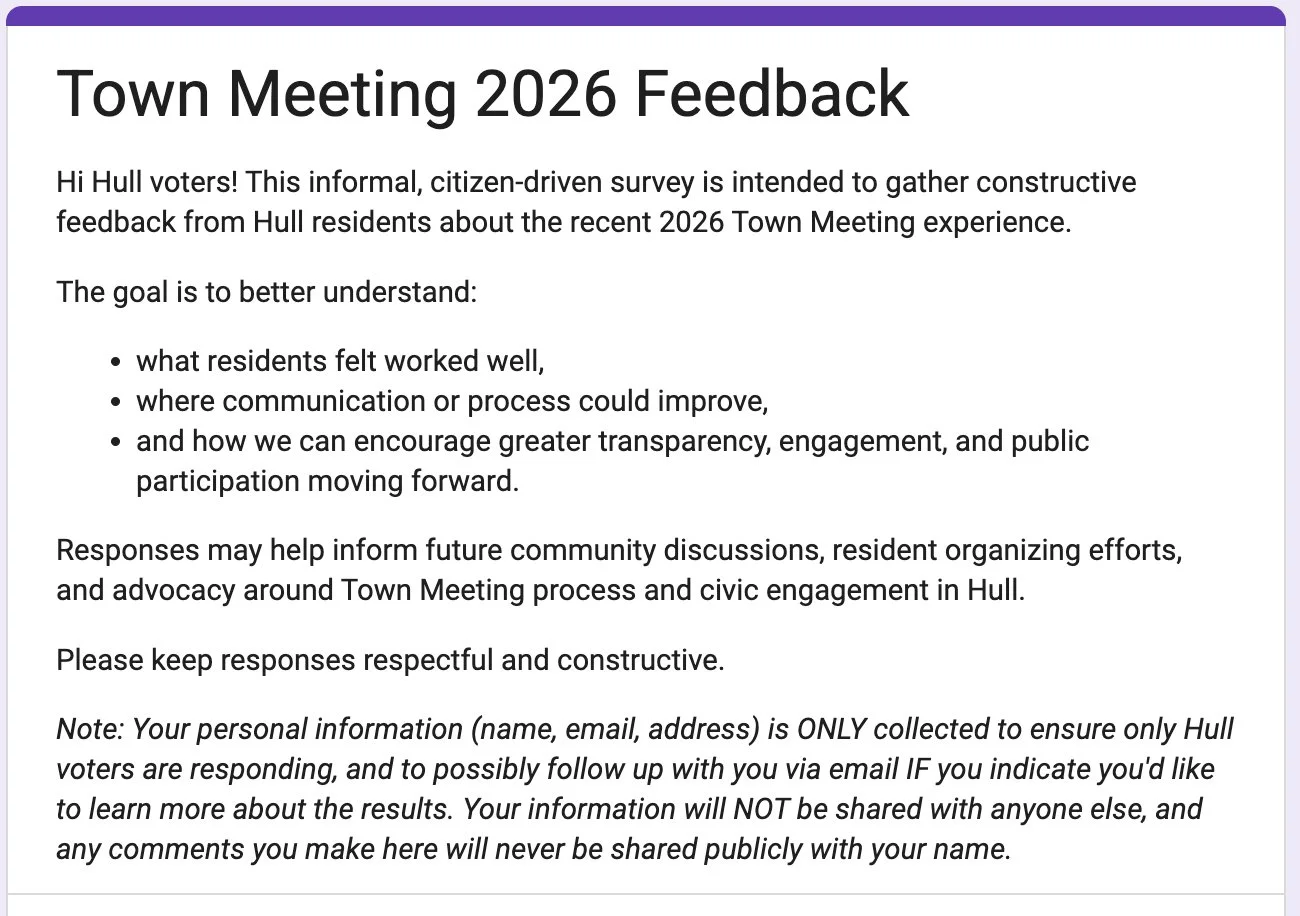
If you participated (or watched) this year's annual town meeting, you are aware of the frustrations expressed by both voters and town officials throughout all four nights. Resident Hillary Taverna is asking fellow voters to fill out an informal survey to collect feedback about potential improvements to the process.

Visit https://forms.gle/eCYqHygXoShszsk27 or scan the QR code to review and answer the 14-question survey, which is an independent effort. There also are open-ended questions where you can contribute your opinions and ideas directly.

“The goal is to better understand what residents felt worked well, where communication or process could improve, and how we can encourage greater transparency, engagement, and public participation moving forward,” Taverna wrote in the introduction to the survey. “Responses may help inform future community discussions, resident organizing efforts, and advocacy around Town Meeting process and civic engagement in Hull.”

Residents are asked to complete the survey by May 20 so that Taverna can compile the results and share them with residents and town officials.


Like what you’re reading? Stay informed and support our work with a Hull Times subscription by clicking here.

Do you have an opinion to share? Click here to write a Letter to the Editor.

© 2026 The Hull Times. All rights reserved.

Board renews town manager’s contract; gives OK to Salt Water Club’s building renovation plans

By Carol Britton Meyer

The select board this week renewed the town manager’s contract for three years, approved the conditional employment of nine summer police officers, discussed the tenor of the recent town meeting, and gave the green light for the Nantasket Beach Salt Water Club – which leases town property at Mariners Park – to move ahead with the first steps in a potential renovation of its building.

Following the regular meeting, the board went into executive session to discuss the town manager’s contract. When the meeting reconvened, Chair Irwin Nesoff reported that the board and town manager had come to an agreement on a three-year renewal contract, effective August 17, 2026 to August 16, 2029.

“It was a very detailed process, and I want to thank the board and the town manager and the personnel lawyer for guiding us through this process,” he said.

Constable said she was pleased about her contract renewal.

“I look forward to a productive three years [to come],” she said.

There was no mention of salary or other details of the negotiations. In April the board voted unanimously to grant Constable a 3% cost-of-living raise prior to beginning negotiations for a new contract.

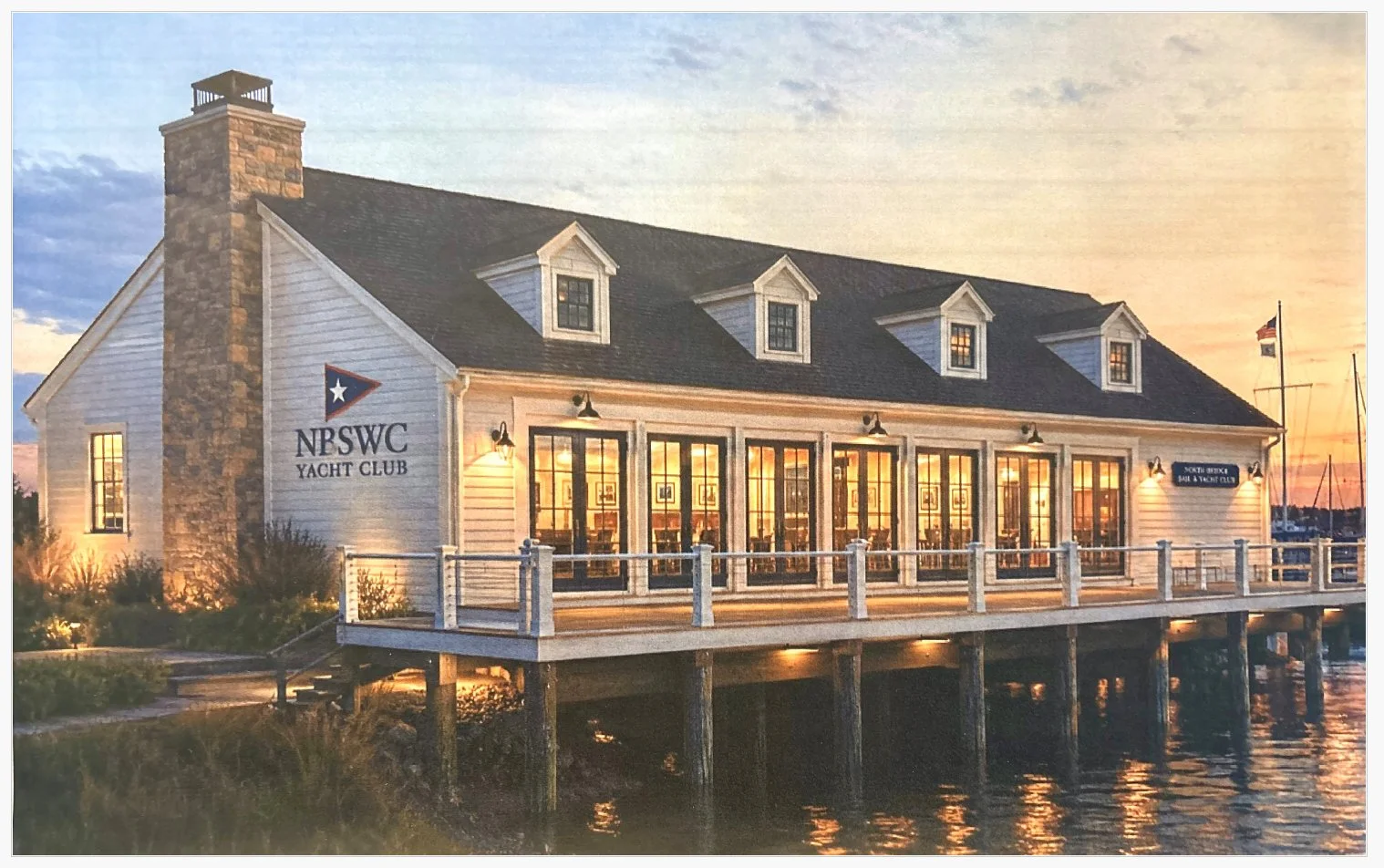
Also during the meeting, Nantasket Beach Salt Water Club President Gary Twombly and other members of the building committee asked the board for its support – in accordance with its lease with the town – to hire an architect and engineer to begin the process of either restoring the existing structure or constructing a new building due to its condition. The town owns the land and the club the building, so any such changes must be approved by the board.

“The building – the former post office once located near the Parrot – is old and it’s time to do something to it,” Twombly said. “It will all be in accordance with the town’s building code and FEMA and ADA regulations.”

A committee member handed a copy of a preliminary conceptual rendering to the board to give them an idea of what the club would like to do.

“This is the first step in the process, with the board giving its blessing to move forward,” Constable said. “Once the plans and specifications are developed, the [building committee] would need to come before the board again regarding the actual buildout.”

The community use would remain the same, according to Twombly.

“We would just like to renovate [and possibly expand] the current building or build a new one,” he said, depending on the cost and other factors. All plans are subject to the members’ approval.

“There will be a lot of questions this board will have in the future regarding financing and setbacks, but there’s not too much to talk about right now,” Constable said.

Nesoff called it “an exciting project.”

In other business

• Upon the recommendation of Deputy Police Chief Neil Reilly, the select board approved offering conditional employment to nine applicants for parking enforcement, details, and other duties from Memorial Day to Labor Day: Sean Thomas Burns, Dylan Patrick Cole, Mick Dockray, Benjamin Thomas Fuller, Waseem El Hammani, James Mackin, Bryce Morrissey, Brady Stephen-James Standridge, and David John Tandy.

Applicants are required to successfully pass CPR and first aid courses before they can be officially appointed.

“In my opinion, all nine candidates would be an excellent fit for the Hull Police Department,” Reilly said before the vote.

This represents an increase over last year’s six community service officers in anticipation of Hull Redevelopment Authority and 250th anniversary activities and events this summer.

• The board accepted planning board member Cindy Borges’ resignation, effective May 15. Both boards will meet in joint session at an upcoming meeting to interview candidates to replace her.

• Constable said she had a significant amount of feedback “relative to the tone of town meeting” and also encouraged more citizens to attend in the future, “where decisions are made on the previous year’s worth of work.”

She also noted that with the passage of the warrant article related to the relocation of town hall to Memorial School, she met with the owner’s project manager and the architects on Wednesday. “They will be putting together bid documents, which takes some time,” with the expectation of putting the project out to bid in July. “Everyone wants the project completed yesterday,” Constable quipped, “so it will move as quickly as possible.”

• She also reported that the new parking stickers with the corrected spelling error will be available soon and that a notice will go out to the community with further details.

Senior center and library staff are available to provide assistance to residents who wish to order a parking pass.

• Board member Jason McCann – who sits on the executive committee of the Paragon Carousel – mentioned a recent incident involving a truck driving into the Paragon Park Museum, which has delayed its and the Carousel Creamery’s opening. However, the carousel is operating.

“We’re sorting it all out right now,” he said.

This was McCann’s last meeting, since he isn’t running for another term in the May 18 town election.

He expressed appreciation for the opportunity to serve and thanked the select board and volunteers on other boards and committees for their service.

McCarthy praised McCann for his “grace and intelligence” in getting things done. “The job you did was second to none. The town will miss you – you are one of the best select board members in the last 10 to 15 years,” he said.

Board member Jerry Taverna seconded McCarthy’s remarks and expressed appreciation for McCann’s “diplomacy and reason.” Greg Grey was not present at Wednesday’s meeting.

• Taverna requested that a joint meeting be scheduled with the light board and state Representative Joan Meschino and state Senator Patrick O’Connor to discuss the affirmative town meeting vote to remove the town manager from her light plant manager role.

This article was similar in intent to last year’s town meeting-approved Article 37 – which is currently in a study committee on Beacon Hill. This year’s Article 40 requested special legislation to amend the town charter. After nearly a 1-1/2-hour discussion, the article passed on a 236 to 82 vote.

• Also regarding town meeting, Taverna said he heard a large number of citizens “voicing their displeasure – there’s a big lack of trust in [town] government and a request for more transparency. About 15 people I have never met spoke to those things. I think we need to acknowledge what was said and move forward in a cooperative way and be more open and forthcoming with information regardless of what it is, because people can handle it – but not finding things out after the fact. That drives them bananas.”


Like what you’re reading? Stay informed and support our work with a Hull Times subscription by clicking here.

Do you have an opinion to share? Click here to write a Letter to the Editor.

© 2026 The Hull Times. All rights reserved.

HRA discusses how DCR’s coastal resiliency plan for Nantasket will impact proposed traffic changes

By Carol Britton Meyer 

Two members of the Hull Redevelopment Authority recently met with the state Department of Conservation and Recreation about coastal resiliency planning and provided an update at Monday’s HRA meeting.

Members Dan Kernan and Chair Bartley Kelly told fellow HRA members about how the DCR’s plan affects the entire Nantasket Beach Reservation and the proposed two-way traffic reconfiguration plan.

This project, with the goal of protecting the Reservation and state property – including Nantasket Avenue, Hull Shore Drive, and Hull Shore Drive Extension – is part of a statewide flood resilience plan. Nantasket Beach was identified as at the “highest risk” of the proposed statewide list of sites and thus was chosen as the initial site for implementation of this DCR plan.

Also attending the meeting were Town Manager Jennifer Constable, Assistant Town Manager Stacy Callahan, Director of Climate Adaptation and Conservation Chris Krahforst, Director of Community Development and Planning Chris DiIorio, and representatives from TEC, Inc. – the civil engineering consulting firm involved with the two-way road project.

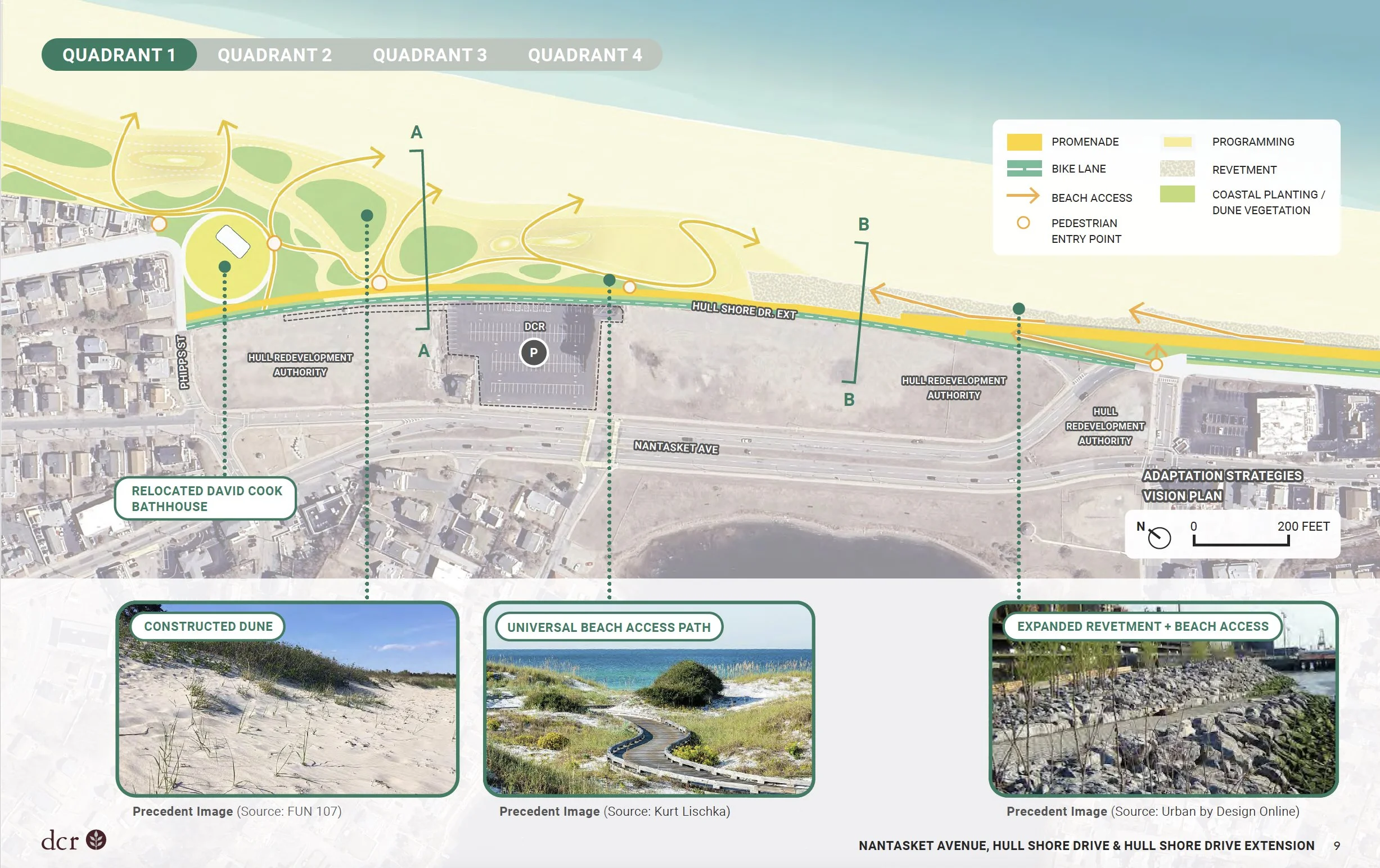
“The purpose of the meeting was to identify and understand existing Town of Hull plans that should be considered before the DCR begins the community engagement phase of its detailed coastal resiliency plan, which was presented at the meeting and covers the full length of the Nantasket Beach Reservation, from the former aquarium site to Phipps Street,” Kernan said.

‘Current two-way road design a key focus’

According to Kernan, a key focus of the meeting was the “current” two-way road design, developed earlier by TEC for the town and shared with the DCR.

“No visuals of this road plan were presented during the meeting, and the discussion centered on identifying any major incompatibilities between the DCR coastal resiliency designs and this two-way road concept,” Kernan said.

He also pointed out that the DCR flood resilience plan is non-negotiable, including raising the seawall and revetments.

“The implicit goal is to begin narrowing DCR design options by eliminating those that conflict with the Town of Hull’s existing priorities – specifically, the two-way road plan,” Kernan said.

Also discussed was initiating the process for public engagement as the DCR refines options and determines solutions to meet coastal resilience requirements and to reflect community priorities.

The “existing conditions” part of the “DCR Parkways Flood Resilience Adaptation Strategies” document provided to those attending the meeting indicates that DCR’s Nantasket Beach Reservation is a “dynamic and highly utilized coastal landscape where the parkways – Nantasket Avenue, Hull Shore Drive, and Hull Shore Drive Extension – play a vital role in connecting visitors, residents, and local businesses to the shoreline and broader community.”

However, these parkways are increasingly vulnerable to flooding from storm surge, sea level rise, and extreme precipitation events.

‘High or very high vulnerability’

Based on the 2025 Parkways Climate Vulnerability Assessment of the area – part of which already experiences flooding at certain times – large portions of the corridor are classified as “high or very high vulnerability” by 2070.

A map included in the strategies document includes shading that represents the extent of coastal flood risk expected for a 100-year (1%) storm for both 2030 and 2070.

The document includes a strategies overview for the Reservation divided into four quadrants, with the HRA property located in quadrant one. Kernan’s commentary focused on the DCR’s plans for the HRA area.

Speakers at the meeting included DCR Deputy Commissioner of Policy & Public Affairs Kendra Amaral and DCR Director of Climate Resilience Sarah White, who shared information about a planned raised boardwalk and “high tide park,” noting that the closer the seawall is to the water, “the higher it must be.”

Incorporating a park buffer and raised boardwalk allows for a lower wall, Kernan reported. This plan requires a significant increase in seawall height and some loss of parking, a reduction in travel lanes, and a narrower Hull Shore Drive.

Project in early stages

The project is in the very early stages, with no formal timeline. The immediate focus is aligning stakeholders, addressing high-level questions, and initiating community outreach, according to Kernan.

“The next step is to assess how the proposed two-way road plan constrains or eliminates DCR design options,” he said.

During the meeting, according to Kernan, Constable raised concerns about reduced parking and its impact on local businesses included in the DCR’s plan and the project schedule and timing. She also recommended that the DCR present all design options during public outreach.

DiIorio expressed a preference for a raised boardwalk option rather than a raised seawall.

Other next steps include the DCR providing a formal response to the two-way road plan, outlining how it constrains current resiliency options, and posting the resilience plan on its website as well as identifying funding programs.

Kelly said an important next step is engaging citizens at public meetings “so the townspeople can weigh in on all these options. We all have a part to play.”

He said that, for example, he’s not sure “how the public will feel about an eight-foot wall along Nantasket Beach [making it] so you can’t see the beach.”

This meeting provided a “60,000-foot view of what the DCR is proposing – a look at the possibilities,” Kelly said. “Nothing is set in stone, and hopefully we can find a sweet spot where the goals [of the stakeholders] are reached.”

The next DCR meeting has not yet been scheduled. The HRA will meet next on Monday, June 1 at town hall.

The HRA’s Kernan discussed the state’s plans in relation to its property, from Water Street north to Phipps Street. Click here for the full DCR presentation.


Like what you’re reading? Stay informed and support our work with a Hull Times subscription by clicking here.

Do you have an opinion to share? Click here to write a Letter to the Editor.

© 2026 The Hull Times. All rights reserved.

On fourth night of town meeting, voters OK additional funds for town hall move, support access at James Avenue beach

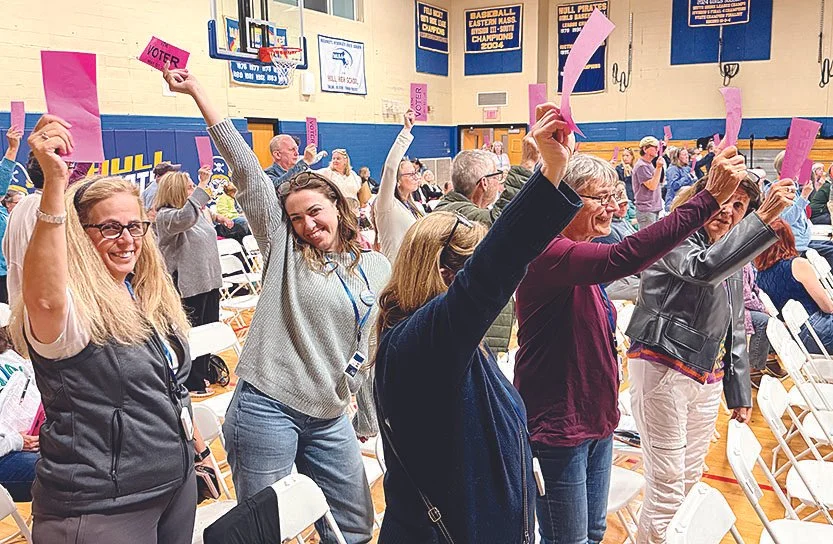
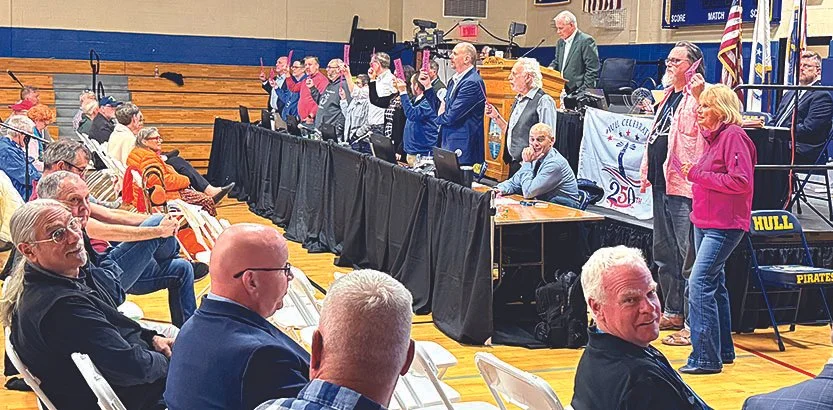
MOTION EMOTION: Faced with an uncooperative electronic voting system, Hull residents were forced to go back to the ‘old way’ of casting their votes on motions, amended motions, and substitute motions – voice votes and holding up cards to be counted manually by tellers. Some were more enthusiastic than others in making their feelings known about particular articles. [Skip Tull photos]


By Carol Britton Meyer

Emotions ran high throughout the four-hour discussion of the remaining dozen warrant articles during the fourth session of the 2026 town meeting on Thursday, May 7, with town moderator George Boylen and citizens urging one another to be respectful. There were 44 articles in all.

On Thursday, voters approved the appropriation of an additional $4 million to pay for the relocation of town hall to the former Memorial School, put limits on traffic changes in the Nantasket Beach Overlay District, and reaffirmed a 2017 vote to pursue privately-owned land in order to ensure access to the beach at James Avenue in Hull Village.

About 400 citizens attended the first session, with attendance tapering off to the low 200s by the fourth night.


Click below for full coverage town meeting from The Hull Times:

Night One — Night Two — Night Three — Night Four


At the beginning of Thursday’s session, Boylen remarked, “Hopefully this will be the last night of town meeting [for 2026],” which proved to be true.

The usual protocol of not beginning discussion on a warrant article at or after 10:30 p.m. unless the moderator believes it will wrap up by 11 p.m. was waived at the request of advisory board Chair Jason Frady in the hopes that the remaining articles could be addressed that night.

The electronic voting system malfunctioned again, causing Boylen to call for voice votes at first, followed by voters holding up “yes” and “no” cards if the result was not clear, which proved time-consuming.

These warrant articles were approved Thursday night:

⦁ Article 15: $800,000 was transferred from free cash ($100,000 each) to funds for Stabilization,

Capital Stabilization, Other Post-Employment Benefits, Police & Fire Injury Leave Indemnity, Worker’s Compensation, Employment Liability Reserve, Unemployment Compensation, and the

Grant Matching Fund.

⦁ Article 17: Authorized the town to accept an easement from the Paragon developer for a portion of the ArtWalk, allowing access to the public to occasionally view art installations and to create overall public access from beach to bay. The ArtWalk is built mostly on land owned by the Horizons condominium association and crosses land owned by the Procopio Companies at the George Washington Boulevard end of the walk.

⦁ Article 19: Transferred $6,658,900, received in a legal settlement between Allied World Insurance Company and the Town of Hull over work on the Crescent Beach Seawall, to the general fund to pay the costs of designing and constructing repairs to the seawall.

⦁ Article 20: Approved $545,000 to purchase and equip an ambulance.

⦁ Article 26: The capital request for town hall closure and relocation, involving a lengthy and sometimes heated discussion with many questions asked, was approved 147-56, meeting the required 2/3 vote. Following a lengthy discussion, voters approved an additional $4 million to complete the relocation of town hall offices to Memorial School on top of the up to $3.6 million approved at the 2024 town meeting. The targeted move-in date is spring 2027. The town is expected to use the space for municipal services for 30 years under the current memorandum of understanding with the school committee, with space available for community use.

Select board Chair Irwin Nesoff said the current working conditions at town hall “are substandard. There’s no storage, and it’s not a place where professional business should be carried on or the townspeople come to,” he said, noting that the cost would be significantly higher if repairs were to be made to the current building or a new facility built rather than relocating to Memorial School.

“We owe this to our town employees,” resident Polly Rowe said. “Let’s think long-term.”

Abby Klieman, a member of the planning board, said she wanted a better understanding of “the numbers” before voting on the article.

“We’re being asked to approve significant amounts of money without a thorough understanding of what they represent,” she said. “There are no architectural renderings, just floor plans.”

A substitute motion to refer the article for further study, with a report at the next town meeting, made by Jacob Vaillaancourt, failed. A motion to reconsider the motion by Bartley Kelly failed to pass, ensuring that the vote couldn’t be revisited.

Before the vote on the substitute motion, a citizen spoke against further study, saying that “this project will be a lot more expensive next year,” which was greeted with applause.

“If you go with the amended motion, you are essentially killing the project,” Nesoff said of the proposal for study.

Resident Danielle Dolan opposed the substitute motion.

“There’s a lot of mistrust between residents and town officials that’s evident at this town meeting from a perceived lack of transparency and clarity – and attitudes projected on both sides,” she said, noting that “a significant amount of work has been done on this project.”

A resident speaking in favor of the substitute motion said it would “not be killing the project to reassess what is needed – offering the townspeople an accounting of everything that’s expected to be done. . . . [The intent is to] ensure that everything is done to its best, not only for employees and other users of the building but also for the townspeople who would be paying for the project.”

Kelly, the town’s building commissioner, opposed the substitute motion.

“The building is in deplorable shape, and we can’t keep kicking the can down the road,” he said. “We’ve all got to work together. Tempers are flaring, me included, but at the end of the day, we’re all here to do what’s right for the town. We’ve got to lighten up because we’re all in this together. Start paddling!”

Resident Patricia Lambert said the high standard of behavior expected from citizens participating in town meeting should also be applied “to you, Mr. Moderator, and to other town officials,” noting that “sarcasm and bullying” are disrespectful.

Town Manager Jennifer Constable said more detailed information about the project will be posted on the town’s website.

⦁ Article 29: Authorized the town to request special legislation allowing integrated contracting for the operation, maintenance, and improvements of Hull’s sewer system.

⦁ Article 31: Amended the zoning bylaw for non-conforming uses, eliminating the by-right option to extend the height of a single- or two-family house up to 35 feet within the existing footprint when the setback is at least five feet from the property line and the house is at least 15 feet from the abutting primary structure.

⦁ Article 32: Amended the Flexible Plan Development zoning bylaw to include a reduction in the maximum height, density, and intensity of land use, changes to permitted uses, application, and permitting procedures, and updated development guidelines related to property of 10 acres or more.

⦁ Article 34: Amended the Nantasket Beach Overlay District to revise the definition of open space and design standards related to the scaling, spacing, and massing of buildings and to incorporate new shadow control standards.

⦁ Article 38: A citizens’ petition sponsored by Linda Hetue limited permanent traffic direction changes in the Nantasket Beach Overlay District, requiring town meeting approval for any permanent traffic direction changes in that area. 

⦁ Article 44: A citizens’ petition sponsored by Kathleen Wolf passed on a vote of 191 to 11 following a lengthy discussion, meeting the two-thirds vote requirement, authorizes the select board to acquire either an easement in or purchase outright a privately-owned parcel of land on James Avenue that has traditionally been used by the public for beach access. In 2017, town meeting voted in favor of a similar proposal, but no action was taken.

According to the advisory board commentary in the warrant, the parcel at the end of James Avenue has been a contentious point for the town and residents for a decade: “The owner of the parcel has blocked public access to the beach from the wharf at James Avenue for several years. The town previously brought forward an article that was moved “no action” as the town was negotiating with the owner. The town has attempted to prevent the owner from installing poles and fencing blocking access to this historically popular location for launching small boats, swimming, swimming lessons, and general enjoyment. Currently, the public cannot safely access this public beach from James Avenue due to one owner’s efforts.” In supporting public access to public lands, the advisory board voted unanimously to support the article, with one abstention.

Wolf made a presentation on the floor of town meeting, including photographs, noting that the intent of the warrant article is “to protect the public access that has been available for years to this townwide resource. … This would simply allow people to continue to take four or five steps onto [the property owner’s] land to access the beach. The select board and abutters should work together in a timely manner [to resolve the issue].”

An abutter said he has enjoyed this beach a lot, “and it’s on my deed that I own part of [it]. I hope the town comes to me to sign the rights to allow that beach to be public. I know the other neighbors, except for one, want to do this, too.”

James Avenue resident Jim Kilfoyle spoke in favor of the article.

“It strikes me that this should be supported for public safety reasons,” he said. “The wires that have been put up across the beach interfere with the delivery of essential services to 3 James Avenue and constitute a genuine hazard. [Letter carriers] have to scramble over the rocks to deliver mail.”

While the parcel involved is small, passage of this article “would give our community a beach to enjoy,” Susan Vermilya said. “[Potentially] providing an easement for this small amount of land doesn’t seem like that big of a deal, but the benefit outweighs any negatives.”

⦁ In addition, Article 37, a citizens’ petition submitted by Paul Goes, was not discussed nor voted upon because there was no motion submitted by the proponent, according to Boylen. It sought to replace the stairs to beach on Western Avenue in Hull Village that were destroyed in a storm in 2022. Select board chair Irwin Nesoff noted earlier that the actual ownership of the steps is uncertain and is being researched. The board discussed the issue in executive session recently.

A replay of the entire town meeting is available on Hull Community Television’s website, www.hulltv.net.


A replay of the entire town meeting is available on Hull Community Television’s website, www.hulltv.net.


Like what you’re reading? Stay informed and support our work with a Hull Times subscription by clicking here.

Do you have an opinion to share? Click here to write a Letter to the Editor.

© 2026 The Hull Times. All rights reserved.