
Voters approve budget, turn down one citizens' petition in chaotic first night of town meeting
/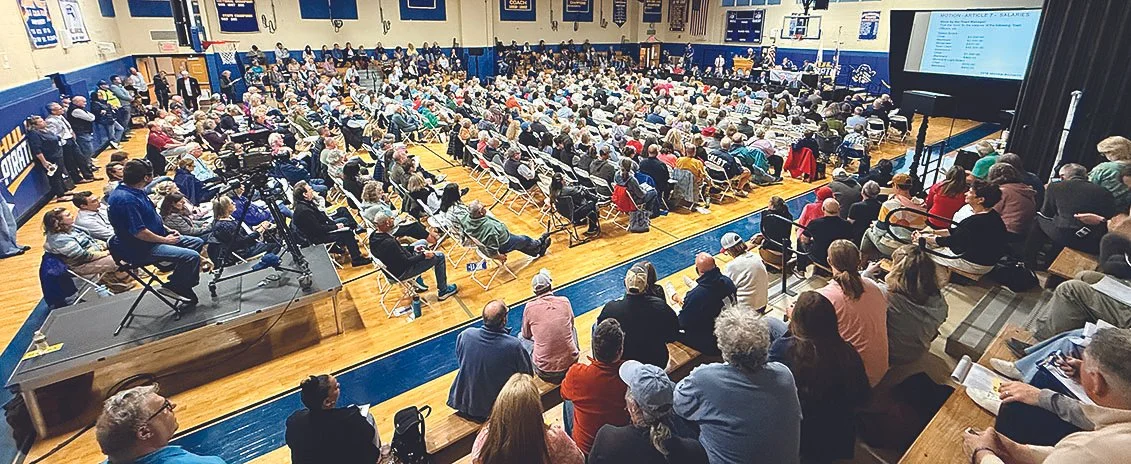
More than 400 citizens — AT LEAST 56 OF WHOM WERE ATTENDING FOR THE FIRST TIME — PACKED THE HIGH SCHOOL GYM DURING THE FIRST NIGHT OF HULL’S ANNUAL TOWN MEETING. [SKIP TULL PHOTO]
By Carol Britton Meyer
Town Meeting 2026 got off to a slow start Monday night, with a faulty electronic voting system resulting in voice votes instead of the use of clickers and the accomplishment of only the consent agenda and three other warrant articles – salaries of elected officials, the general government and school budgets, and a citizens’ petition – out of a total of 44.
More than 400 citizens were present at the beginning of the meeting, which started shortly after 7 p.m., including 56 whom Town Moderator George Boylen said “are here for the first time.”
Voters approved without discussion allocating $100,000 from free cash to pay the costs associated with feasibility studies, design and permitting associated with the potential relocation of the senior center – or a multi-generational center – to the Memorial School, where the town hall is being relocated.
The vote on Article 24 also included authorizing the town manager to apply for and accept grants and gifts to accomplish this project.
Click below for full coverage town meeting from The Hull Times:
Town clerk receives a raise
Under the salaries of elected officials article, voters approved a nearly $20,000 increase in Town Clerk Lori West’s current $26,000 part-time town clerk salary – to $45,500 – after much discussion, including a substitute motion to cut the proposed increase by $20,000 and another to increase her salary to a competitive market salary of $100,000. The original motion in the warrant article that would raise West’s salary to $45,500 passed.
West also holds a position in the select board office at a Fiscal 2027 salary of $85,400 – which advisory board member David Clinton said had nothing to do with West’s town clerk earnings. “Our town clerk is the model for many of the town clerks in the Commonwealth,” he said, noting that the position has “changed drastically” in recent years – especially since COVID19 pandemic – including the adoption of election laws related to early voting and voting by mail that resulted in a heavier workload.
Resident Christopher Sweeney said he thought West’s current town clerk salary is adequate.
“This is a town of 10,400 people, and I can’t understand these pay raises,” he said.
During the long discussion about the proposed town government and school budgets – $54.6 million including town operations and the capital budget – and $18.9 million for the schools – Sara Ventetuolo, who had placed a hold on the school budget, made a substitute motion to reduce the 3% proposed school budget increase by half – or by $284,132.
“I’m not anti-school,” she said, before calling for a “rigorous review of the school budget” in light of decreasing enrollments and tax impacts to Hull’s growing senior population and other taxpayers. The motion failed to pass.
Before the vote, Superintendent of Schools Michael Jette noted that about 80% of the school budget is comprised of salaries, along with increases in utilities and classroom materials costs. “A really good product [education] is being delivered at a reasonable expenditure by taxpayers,” he said.
The school department held its annual budget hearing in April but did not receive any feedback from the public.
Community encouraged to take school survey
Jette added that community members are encouraged to participate in the current survey about the Hull Public Schools strategic plan.
“We’re aware of declining enrollments. Help us work to produce a better Hull Public Schools in the future,” he said.
His remarks drew applause from voters, who approved the school and town budget – with the addition of $10,000 in the Department of Public Works to hire an individual for the summer to help maintain Fort Revere Park, at Hull Village resident Randy Gould’s suggestion.
A couple of citizens said cutting the school budget would send a message to competing communities – including young families who might move to Hull – that the town doesn’t care as much about its schools as other communities care about theirs.
A citizen praised the school administration and committee for staying within a 3% increase “while multiple communities are looking for millions of dollars in increases” to fill budget gaps. “The school department deserves a round of applause,” she said.
A citizens’ petition submitted by Lisa French to amend the town bylaw related to the powers and duties of the capital improvement planning committee – including a public input process – was not approved by voters.
There were many holds on line items in the proposed town and school budgets – many by Gould – and a number of substitute motions, which caused some confusion.
This led to a citizen remarking at the end of the session that the “voting process tonight was chaotic and inherently undemocratic. Whoever shouts the loudest or gets those around them to shout the loudest doesn’t indicate democratic voting. Something needs to be done to ensure fairness and equity.”
An apologetic Boylen noted that the purpose behind electronic voting that is operating properly is to accomplish just those benefits and that voice votes/holding up cards indicating votes would be used until the electronic system is fixed. The CEO of the company was present at the meeting to help iron out glitches.
The late Pat Finn honored
Clinton read a resolution in honor of Patrick Finn, who passed away last year – referring to his longtime service to the town in a number of capacities and as a “dedicated attendee” at town meeting over many years.
“Pat will be missed by all who met him in the town he loved so much,” Clinton said.
Town Manager Jennifer Constable spoke briefly about the successes of Fiscal 2026 and “the successes we look forward to” in Fiscal 2027. She started the meeting “on a positive note,” remarking that “the town has no intention of taking down the A Street Pier!” contrary to social media posts on this subject based on a recent capital improvement committee discussion of options for addressing the pier’s deteriorating condition.
Select Board Chair Irwin Nesoff said it was “gratifying seeing so many people here as the legislative body of this town.”
Sean Olson, the young son of Hull Police Sgt. Kevin Olson, led attendees in the Pledge of Allegiance.
Planning board member Abby Klieman, noting some frustration in the town moderator’s response to the large number of holds and questions and among some board members present at the meeting, said that while she understood it, “the reality is that citizens have questions and should get them answered.
“With all due respect, not all questions are answered” in various committee and board meetings leading up to town meeting, “and the meetings aren’t recorded, so people don’t feel much transparency,” she said. “I don’t know what the answer is, but being more patient when citizens ask questions [would be helpful].” Her comments met with applause.
Resident James Canavan called for the meeting to adjourn at 10:30 p.m. after what many agreed was a very long first session of town meeting. There was a casual reference made earlier in the session that if the pace of addressing business items continued, the 2026 town meeting could go on for three or four nights — in the end, it did just that.
Like what you’re reading? Stay informed and support our work with a Hull Times subscription by clicking here.
Do you have an opinion to share? Click here to write a Letter to the Editor.
© 2026 The Hull Times. All rights reserved.