Allerton condo appeal delayed; developer alleges ‘witch hunt’ by opponents to deny project

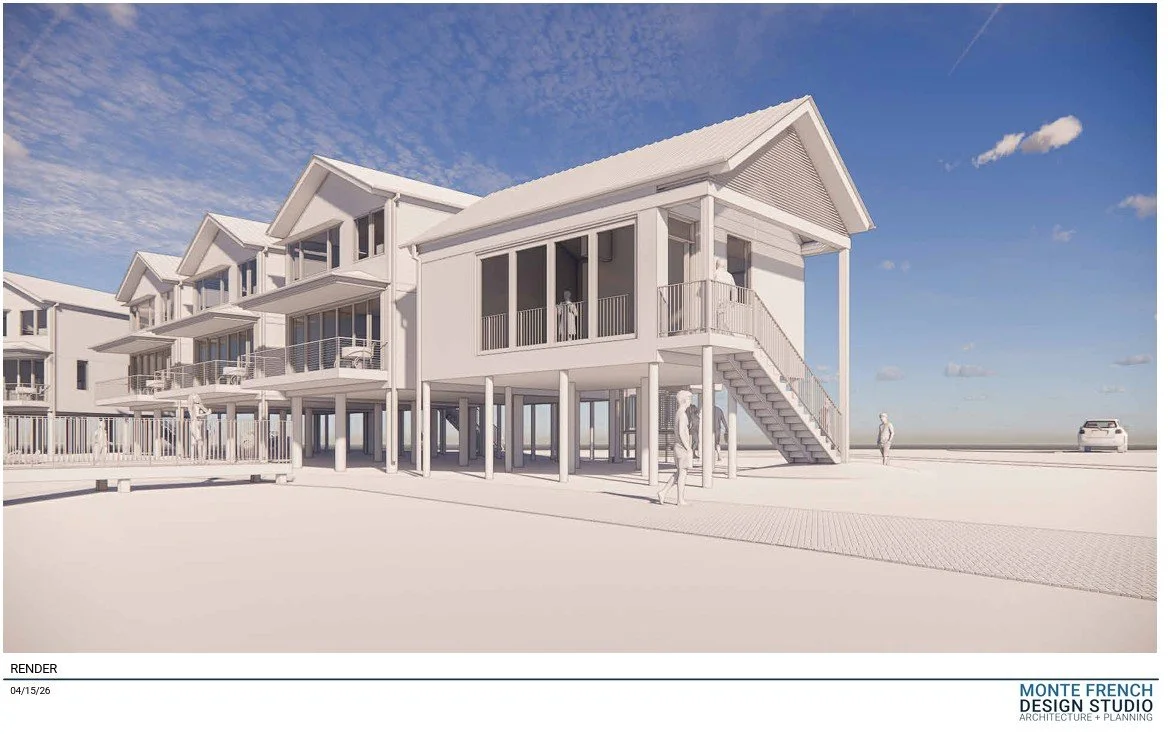
An architect’s rendering of the Point Nantasket project, from the water side. Source: Town of Hull

By Carol Britton Meyer

The zoning board of appeals hearing on the townhouse project at the foot of Allerton Hill was postponed until next month due to a last-minute cancellation by the ZBA’s attorneys.

The July 21 public hearing on The Point Nantasket Realty LLC’s challenge of the planning board’s May 14 unanimous denial during the site plan review process was continued to August 11.

Under the town’s zoning bylaws, building permits cannot be issued for projects without site plan approval.

“We were ready to go for tonight, and town counsel – representing planning board members – is present, and the attorney for the applicant,” ZBA Chair Richard Hennessey said. “As chair, I requested [the ZBA] have its own representation for this hearing based on what could be seen as a fairly complex and novel [issue],” referring to the nature of the appeal.

“Regrettably, the attorneys from the firm assigned to represent us are unable to be here tonight,” he said. “I received confirmation of that at about 4:30 p.m. today, and as a result, there’s an agreement to open this hearing and continue it, which [many will find] frustrating.”

Town Counsel Brian Winner said that during a meeting that afternoon among the attorneys, it was decided that due to circumstances “outside of our control,” the earliest continuation date would be August 11, and the “planning board has no objection to that.” Some planning board members attended this week’s ZBA meeting.

The developer’s attorney, Adam Brodsky, clarified that his client was prepared to “present this evening. He’s not taking a position for or against the continuance request … He hasn’t agreed to it, but he doesn’t oppose it.”

Click here to read the full text of the developer’s appeal

The developer is proposing nine “residential cottages” connected by a common deck at the former Sunset Marine property at 839-845 Nantasket Avenue, as well as a pavilion, boat ramp, boardwalk, and other amenities on approximately 3.28 acres. 
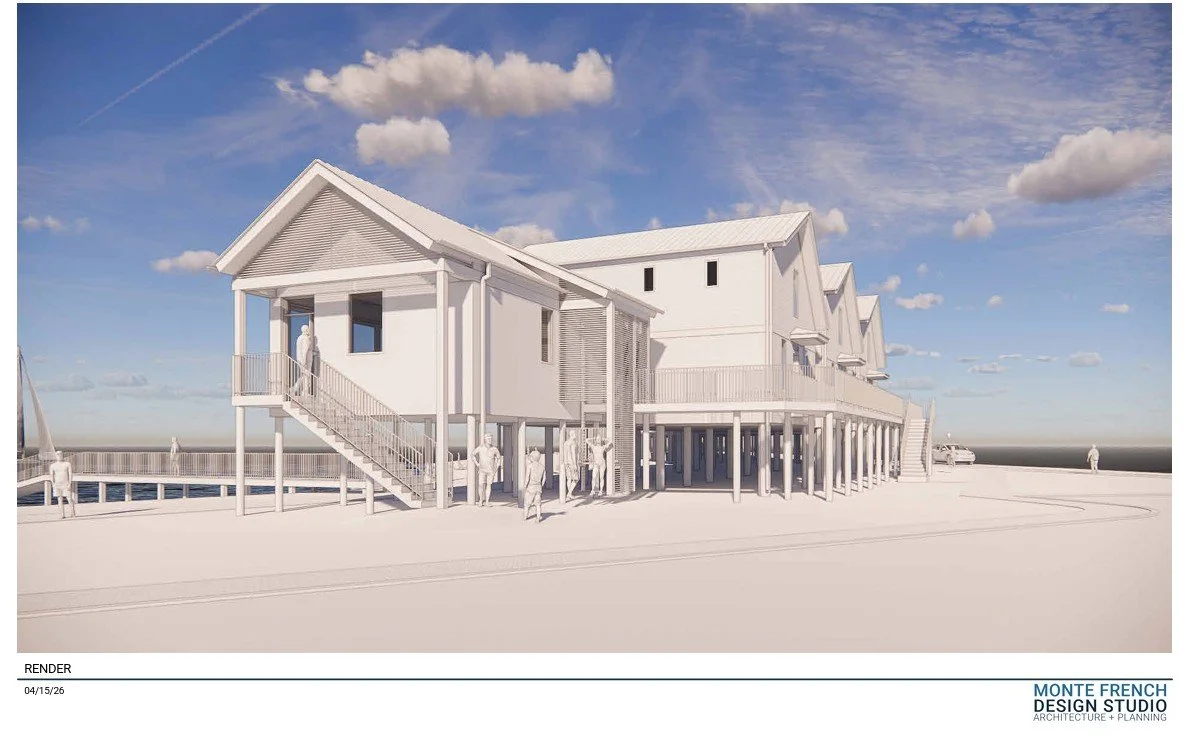
An architect’s rendering of the Point Nantasket project, from the street side. Source: Town of Hull

The proposal calls for demolishing the existing structures, which have been boarded up and surrounded by fencing for years, and repairing the existing dock.

The project is being proposed by Chris Reale of Hingham, who formerly owned the Paragon Boardwalk property at Nantasket Beach, along with Hingham builder Tom Fleck, whose father once ran the boat yard at the site.

‘Planning board’s decision should be annulled’

In a 20-page appeal posted on the ZBA page on the town’s website (www.town.hull.ma.us/786/07212026-Meeting), The Point Nantasket Realty, LLC asserts that “the planning board’s decision should be annulled” and that the board “engaged in improper procedure, had no legal or factual basis to deny approval, and failed to impose reasonable conditions.”

The appeal, written by Brodsky, alleges that “egged on by a small vocal group of opponents, the planning board, together with the design review board, engaged in a witch hunt seeking to, among other things, challenge the Building Commissioner Bartley Kelly’s zoning determination and reviewing the project for conformance with the Massachusetts Building Code, none of which falls within the planning board or design review board’s authority.”

In response, Winner wrote a memorandum to the ZBA on behalf of the planning board dated July 21, 2026 (posted on the same page as above), but there was no time to discuss it because the meeting was continued.

Winner wrote the memo after he reviewed the planning board’s decision and discussed it with members of that board, noting that the decision is “the product of the reasonable exercise of the planning board’s authority” under the town’s zoning by-laws and that its decision “is supported by substantial evidence both as a factual matter and as a matter of law.”

On behalf of the planning board, Winner requested that the ZBA deny The Point’s appeal and affirm the planning board’s decision. He also included a summary of the ZBA’s role in the appeal. Winner also provided a summary of why the planning board believes its decision should be affirmed.

In his letter to the ZBA, Winner notes that “a board may lawfully reject a site plan that fails to furnish adequate information on the various considerations imposed by the bylaw as conditions of the approval of the plan.” A board “also possesses discretion to impose reasonable conditions under a bylaw’s requirements in connection with approval of a site plan, even if the conditions are objected to by the owner or are the cause of added expense to the owner,” according to Winner.

In some cases, he continued, “the site plan, although proper in form, may be so intrusive on the needs of the public in one regulated aspect or another that rejection by the board would be tenable.”

‘Project is insufficiently described’

Winner also said the planning board’s decision sets forth that the board requested at least two additional meetings with the applicant to discuss revisions to the proposal, but that the applicant “only agreed to a single additional meeting and has made it clear there would be no additional meetings. As such, the board finds that the project is insufficiently described, the applicant has been uncooperative, and that the board, therefore, cannot make fair a determination on the merits of the project.”

Planning concerns also related to traffic, primarily at the intersection of Fitzpatrick Way and Nantasket Avenue, and the “great number of unresolved questions” about the proposal.

“The applicant did not provide the planning board with sufficient information and, moreover, did not provide the planning board with sufficient time to receive, review, and evaluate such information – assuming it ever was to be submitted,” Winner wrote. “The Point alludes to the planning board’s denial not being about the reasons stated in its written decision but rather being about some underlying objection to the project,” among other “entirely speculative motivations,” none of which Winner considers “worthy of response as none pertain to the singular legal issue before the zoning board.”

Winner also said that the planning board “requests that the zoning board affirm its decision and deny the petitioner’s appeal. If, however, a supermajority of the zoning board believes there is any merit to the petitioner’s appeal, it should vacate the decision and remand the matter to the planning board for further proceedings.”

At the final Site Plan Review hearing in May on the townhouse development, planning board members said they felt that the developer had not addressed all of their concerns and had presented plan revisions in a piecemeal format. That sentiment differed from comments board members made the previous month, when the developer was lauded for “responsiveness” and “making a lot of good progress” in modifying the plans in response to feedback.

Also, Design Review Board Chair Julia Parker told the planning board that the DRB had voted against the project on May 13.

‘Regrettable’ situation

On Tuesday, the ZBA unanimously agreed to the continuance “to its own time slot on Tuesday, August 11, at 7 p.m.,” Hennessey said, calling the situation “regrettable…. Given the size of this space [the high school exhibition room], we hope to be back here at that time.”

“Our team will be available August 11,” Brodsky confirmed.

Hennessey, Philip Bellone, and Edwin Parsons are the voting ZBA members for this appeal.

A replay of the ZBA meeting is available on Hull Community Television’s website, www.hulltv.net, and planning board hearings on this project are available at www.youtube.com/@HullTVGovernmentMeetings.


Like what you’re reading? Stay informed and support our work with a Hull Times subscription by clicking here.

Do you have an opinion to share? Click here to write a Letter to the Editor.

© 2026 The Hull Times. All rights reserved.

Citing high cost, light board votes to discontinue rental of rarely used winter generators

Richard w. green photo

By Carol Britton Meyer

As part of a four-hour meeting July 16, the light board voted 3-2 against installing generators as a townwide backup for the upcoming winter in the event that both National Grid circuits feeding the peninsula from Hingham are out of service.

The rented generators, which were installed in December 2020 during the pandemic emergency and every winter since, are located at the Department of Conservation and Recreation parking lot at the end of Rockland Circle and can take up to four hours to start and come online, depending on conditions and the status of the light plant’s internal system, according to Operations Manager Mike Schmitt, who made a presentation to the board.

“The generators allow residents to shelter in place safely during winter storms,” he said during the lengthy discussion. “They also protect vulnerable populations such as the elderly or medically dependent as well as maintain critical services – water, heat, and medical facilities.” The generators aren’t utilized during short outages because of the time it takes to get them up and running, and cannot be used for spot outages.

The generators have operated only twice since they were installed – for a total of about seven hours – at a cumulative cost of $4.8 million.

The cost to install the temporary generators for the 2026-27 winter season would be roughly $1.3 million due to additional equipment and price increases, compared with a cost of $860,000 last winter.

“There’s strong competition for these generators – they can’t be built fast enough to meet the demand,” Schmitt noted.

This would have increased the ratepayer generator surcharge from $10.43 to $17.60 per month for 12 months – or about $211.20 per year – in addition to the $9.11 monthly customer service charge, which is in place with or without generators.

With the majority of the light board voting not to install the generators this winter, the $10.43 surcharge will come off ratepayers’ bills at the end of September.

Schmitt told the board that the risk of a multi-day outage remains possible.

“We’ve been lucky so far,” he said. “It’s a gamble.”

Before the vote, Town Manager/Light Plant Manager Jennifer Constable noted that ratepayers would need some time to digest “all [this] new information” if the board approved the installation of generators.

Commissioner Stephanie Landry – who along with Commissioner Dan Ciccariello voted in support of continuing the use of temporary generators this winter – suggested surveying ratepayers before making the decision, but with the August deadline looming, that was not considered to be a viable option.

Commissioners Jacob Vaillancourt, Mark Kohn, and Chair Thomas Burns voted to discontinue the use of generators for this year.

Burns said that he is “not in favor of governing by survey. We’re elected to make decisions. Sometimes they’re easy, sometimes not quite so easy. Nearly $5 million is gone for seven hours of generator usage. The cost of a new feeder line would be in the range of $5 to $10 million.”

A number of other factors also weighed into the board’s decision to discontinue generator use, including what Schmitt called the “good news” that National Grid has done some significant tree trimming, pole raising, and hardware work to help minimize the risk of a future outages, and the withdrawal of the light plant’s legal action against National Grid and the resulting inability to seek recovery of generator costs.

Public feedback at the meeting related to the age and condition of the National Grid conductors serving the town; the potential outage duration if generators are not installed this winter; the exposure of businesses and town departments during an extended outage as well as homeowners; the history of the generators’ performance over the past few years; potentially redirecting program funds toward longer-term resilience investments such as new feeder lines or local generation; and the value of peace of mind when the generators are installed. 

“The board is not here to give everyone a soft, fuzzy feeling that everything will be fine,” Burns said in response to the last comment.

In other business

• On a 4-1 vote (with Landry in opposition), the board approved testimony in support of the home-rule petition to submit town meeting-approved Article 40 to the state Legislature for action. The purpose of the article was to remove the town manager from the light plant manager role.

Both Article 40 in the spring town meeting – which was approved by a 236-82 vote – and Article 37 of the 2025 town meeting (approved by a 116-83 vote) would revert to the light plant management setup that was eliminated in 1993 when town meeting amended the town’s charter.

The charter change requires approval by the Legislature; last year’s proposal remains in a committee at the state level.

• Schmitt reported on interim storage options for the incoming line truck expected in October and said that a solution will be in place before the truck arrives. Under discussion are two potential rental locations in Hull, and reconfiguration options at the light plant location at 15 Edgewater Road – including relocating a door, removing shelving, and modifying a garage overhang – are being evaluated. Costs for these changes is not currently available.

• Burns and Vaillancourt presented an analysis of the 15 Edgewater Road site following the board’s unanimous vote of November 20 to propose a capital project to fund a garage at that location to store fleet vehicles, designed for solar orientation and to complement the historic nature of the existing light plant building.

Board members have repeatedly voiced opposition to the proposal currently under consideration to combine the light plant’s headquarters and the Department of Public Works into one building at the current DPW site.

Also last week, the light board authorized a professional feasibility study, at a cost not to exceed $110,000, covering a cost estimate and conceptual site plan for the garage; flood protection and preservation feasibility for the historic Edgewater Road building; a determination of the applicable historic preservation requirements; and a like-for-like comparison of protecting operations in place against relocation, and other considerations – with findings to be presented to the light board for further action.


Like what you’re reading? Stay informed and support our work with a Hull Times subscription by clicking here.

Do you have an opinion to share? Click here to write a Letter to the Editor.

© 2026 The Hull Times. All rights reserved.
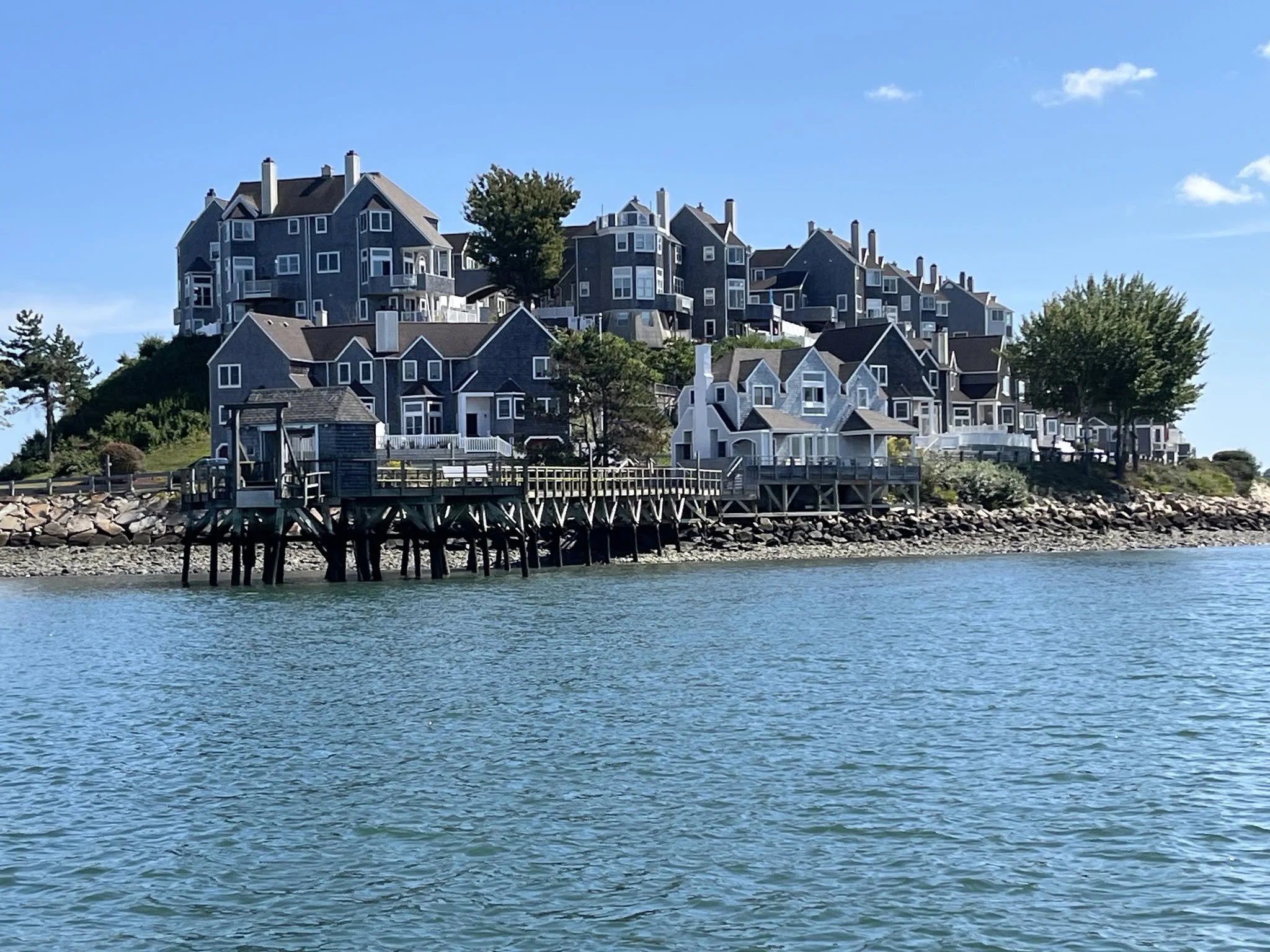
Dispute over Spinnaker Island electrical equipment continues in light board’s closed session

Spinnaker island is a condominium community built in the 1980s on the former hog island off the coast of hull.

At the end of its regular meeting on July 16, the Hull Municipal Light Board held an executive session to discuss litigation involving Spinnaker Island. Public boards are permitted to discuss strategy for ongoing or threatened lawsuits in closed session.

According to a 2024 letter sent to the Spinnaker Island and Yacht Club Condominium Association, the light plant has determined that “the aging condominium electric infrastructure” needs to be upgraded or replaced. However, the light plant contends that the “town does not own the electrical infrastructure on Spinnaker Island. Consequently, the HMLP is not obligated to replace/upgrade or operate and maintain the condominium electrical facilities, other than the meters.”

Residents of the island have pushed back, objecting to the assertion that the light plant is not responsible for the electrical equipment on the island, citing HMLP’s decades of maintenance since the housing complex was constructed in the mid-1980s. Utilities to the island traverse a privately-owned bridge from the mainland.

The 2024 letter, signed by Town Manager Jennifer Constable and then-Operations Manager Panos Tokadjian, acknowledges the 40+ years of maintenance provided by the light plant.

“To date, HMLP has provided maintenance for the condominium's electric infrastructure,” according to the letter. “However, given the results of the HMLP's review of the ownership this is neither financially, nor operationally correct, nor is it fair to the HMLP ratepayers.”

Spinnaker homeowners say the 2024 letter caught them by surprise. They also speculate that if the light plant is successful in transferring the cost of replacing the electrical equipment – which could be in the millions of dollars – the effects could potentially be felt by condominium associations off-island as well.

–– Christopher Haraden


Like what you’re reading? Stay informed and support our work with a Hull Times subscription by clicking here.

Do you have an opinion to share? Click here to write a Letter to the Editor.

© 2026 The Hull Times. All rights reserved.
New community group to advocate for green space, ‘thoughtful stewardship’ of HRA land

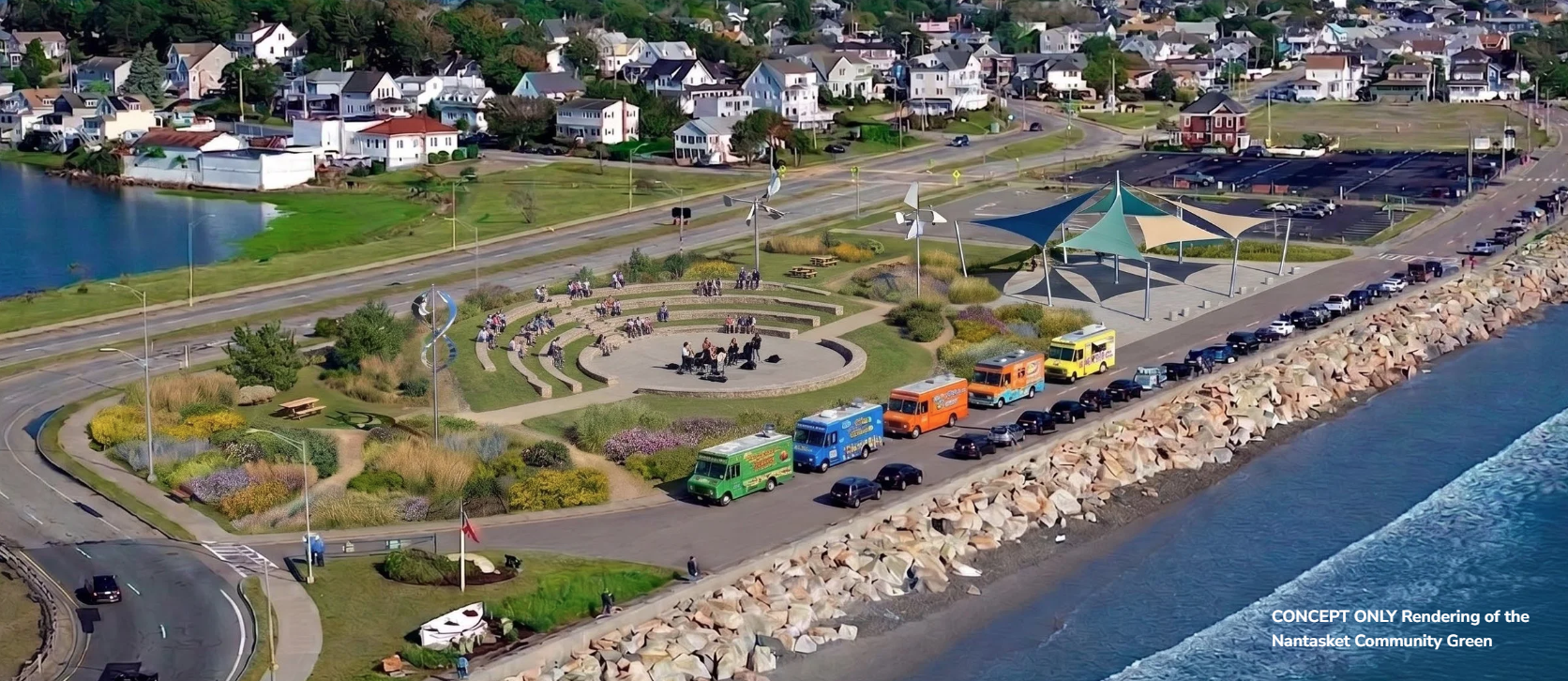
A new advocacy group, Nantasket Community Green, formed last week with a mission to imagine, advocate for, and protect the Hull Redevelopment Authority land – its bay, its beach, its open horizon – as a living landscape woven into the rhythm of community life.

Nantasket Community Green will advocate for responsible development that prioritizes green space and protects sweeping sunrise and sunset views through the thoughtful placement of community gathering places. The space should strengthen the quality of life for the community and minimize impacts on infrastructure and utilities.

Nantasket Community Green envisions green spaces that breathe, structures that tread lightly, and systems that work with the tides and seasons rather than against them. Sustainability is not a feature to add; it is the foundation the group will build on.

And at the heart of it, Nantasket Community Green wants to help create a place for people: A lawn to gather on, a stage for sharing stories and songs; or a spot to grab a meal with neighbors and watch the sun set over the water. It aims to protect what makes this place worth protecting and to gather here together for generations to come.

By transforming underused land into shared green spaces, gathering areas, and gentle public amenities – such as food trucks and places for passive recreation like bocce, cornhole, and picnics – it creates a destination that brings people together while honoring the beauty that makes it worth protecting in the first place.

“We are committed to advocating for thoughtful, sustainable stewardship, protecting fragile habitats, minimizing our footprint, and ensuring that whatever we build here strengthens rather than diminishes the land's natural resilience,” said co-founder Kelly Crummey. “We are pleased that the HRA survey so strongly and definitively reflects the community’s wishes for the land to be both green space and public, and it is our goal to collaborate with stakeholders to help create a space which will support the community’s desire.”

Nantasket Community Green began organizing in April 2026 after three of its board members and Hull residents – Kelly Crummey, Jim Ianiri, and Susan Mann – resigned from the board of SOSHull. Valerio Romano, a Hull resident who brings deep expertise in conservation and land-use planning to the team, joined them to form the organization. They are in the process of becoming a registered 501(c)(3) nonprofit organization.

To learn more, visit www.nantasketgreen.org.


Like what you’re reading? Stay informed and support our work with a Hull Times subscription by clicking here.

Do you have an opinion to share? Click here to write a Letter to the Editor.

© 2026 The Hull Times. All rights reserved.

Meet the life-saving Hullonian whose decades of blood donations add up to more than 27 gallons

NEWSWORTHY: Scott Belgard met WBZ News Anchor Lisa Hughes at the annual 9/11 blood drive at Fenway Park. His blood donations total more than 27 gallons. [Courtesy photo]

Submitted by Mike Milner, Blood Donation Coordinator

Knights of Columbus Council #4865

“Wow, this is huge!” – that was my reaction to one of our Hull neighbors who was checking into our recent blood drive the end of May.

In my 50+ years of working with blood donation programs, I have never seen someone who had recorded 222 units of blood given on my check-in roster! I knew that I had to let everyone know about this milestone, so I asked Scott to tell me a bit about his journey to 27+ gallons of donated blood. I also had to tell my contacts at the regional office of the American Red Cross to get their reaction.

As Scott shared with me that day in May, his 50+ year blood donation journey started when he was 18 years old when he joined his father at his Jewish War Veterans Post 302. His Dad had asked him to come along to meet his fellow veterans and so they traveled to a donation center on Huntington Avenue off the Jamaicaway.

His Dad said to him, “Hey son, you’re 18 now and eligible to donate blood. Go ahead and give it a try.” So he climbed aboard one of those very comfortable, green contoured benches and made his first blood donation. He didn’t know that this first donation who become a lifetime commitment to give the “gift of life.”

Scott also said that in 1978, his commitment became very personal as his Dad was undergoing bypass surgery. He offered up a unit of blood to the blood bank at Beth Israel Hospital in case his Dad needed it! His Dad didn’t get his blood, but Scott knew that someone in the hospital that day was helped.

He donated on a regular basis over the years, setting a goal to donate the maximum amount of whole blood he was allowed. He got to know the staff of the Weymouth Red Cross blood donation center well and even got to meet some of the local Boston radio personalities who were promoting local drives. The WBZ Blood Brotherhood events gave him the chance to also meet WBZ news anchor Lisa Hughes at the annual 9/11 drive at Fenway Park.

In my role as a local blood drive coordinator, I have made some connections at the American Red Cross headquarters here in Boston. Knowing that Scott had just donated his 223rd unit to help our blood drive meet our local goal of 40 units, I just had to tell someone.

“Scott’s commitment to blood donation is truly inspiring,” said Kerrie Ann Jack, regional donor services executive. “Reaching more than 27 gallons is an incredible milestone, but what makes his story especially meaningful is that he began donating at 18, encouraged by his father to give back to others. His lifelong dedication is a powerful reminder of the impact one person can have, and we’re grateful for Scott and all the donors who help ensure blood is available for patients in need every day.”

As a reminder, a single whole blood donation can be separated into components that benefit patients in various ways. Whole blood, like what is collected at our town blood drives, is often used to help save those involved in traumatic accidents. Packed red cells help replace lost blood during surgery, platelets aid those with blood clotting disorders, and other blood components provide specific clotting factors for inherited conditions such as Von Willebrand’s Disease and hemophilia. White blood cells can also be processed and given to individuals struggling with difficult infections. In essence, one blood donation can save multiple lives.


The Hull Knights of Columbus Council #4865, under the leadership of John Barbuto, holds blood drives every two months at St. Mary of the Assumption Parish/St Ann Church on Samoset Avenue. Thanks go out for continued support from parish leaders including Father Scott Evuard, our dedicated K of C members, and to local Hull volunteers like Craig “Wolfie” Wolfe and Mary Ann Hunter. Also, Tara Grasso at Hull High School has helped recruit and involve an average of 6-10 student volunteers each drive during the last two years. These students greet donors, serve refreshments afterward, and assist the Knights in cleaning up. It’s truly a team effort in Hull. Appreciation goes out to everyone who donates and those who help run these events.

If you’re interested in donating blood or have questions about eligibility, visit the American Red Cross website at www.redcrossblood.org or call 1-800-RED CROSS. If you’re interested in learning how you can help in other ways, please give me a call at 646-812-1139.

Thanks, Scott, for your lifetime of giving and for allowing us to share this milestone with our neighbors. You make us all proud, and we can believe that your Dad is super proud of you, sir!


Like what you’re reading? Stay informed and support our work with a Hull Times subscription by clicking here.

Do you have an opinion to share? Click here to write a Letter to the Editor.

© 2026 The Hull Times. All rights reserved.

Lifesaving Museum to light up the night on July 25 with annual Harbor Illumination

Continuing a tradition begun in 1881 along the town’s miles of shoreline, the Hull Lifesaving Museum will present its annual Harbor Illumination on Saturday night, July 25.

Volunteers will light flares that have been purchased to honor, remember, or celebrate loved ones along the two-mile stretch of the bay from A Street to Hull Village. Information on purchasing flares is available on the museum’s website, www.hulllifesavingmuseum.org.

The collective celebration and personal remembrance event begins Saturday at 5 p.m. at the Hull Village Cemetery, where the legacy of Captain Joshua James and the lifesavers who patrolled the shores in the late 1800s and early 1900s will be honored. This will be followed by an open house at the lifesaving museum beginning at 6 p.m. The Forever Flare memorial ceremony will begin at 8 p.m. near the A Street Pier. The general lighting of the flares begins at 8:30 p.m., as the community and visitors gather along Hull Bay from the A Street Pier to James Avenue in the Village.

In Hull, lighting the harbor with candles and torches began as an end-of-summer celebration, with the first illumination organized by the yacht club in 1881. By the next year, The Boston Globe reported that the locals had ironed out any wrinkles, and the second annual event cast a bright glow from the verandas of local hotels and cottages along the shoreline.

“The residents of the charming village of Hull, as a rule, entered heart and soul into the preparation for the illumination… seen from the landing at the Hotel Pemberton, the many-colored lights decorating the cottages on the hill were mirrored in the surface of the water below, the twinkling lights reflected in the bay producing a most charming and delightful effect,” the Globe reported on the morning of September 5, 1882.

Individual flares are available for purchase, while Forever Flares – which the museum will display every year to remember loved ones – are an extra-special way to honor someone. Visit www.hulllifesavingmuseum.org to buy flares or to purchase T-shirts and sweatshirts to support the museum’s diverse programming calendar throughout the year.

To prepare for the harbor illumination, staff members place the flares along the shoreline, and area captains are responsible for lighting them on cue.

Volunteers are always needed to help the captains in each neighborhood ignite the flares to ensure a consistent glow. Email maureen@hulllifesavingmuseum.org for more information.

The Hull Harbor Illumination was an annual event in the late 1800s and early 1900s before being discontinued. The museum brought the tradition back for several years in 1989 as part of Joshua James Heritage Days, and in recent years the event has become part of the lifesaving museum’s annual fundraisers and community-building efforts.

Proceeds from the event support programs for children, adults, veterans, and underserved individuals throughout the year, including the new Maritime Apprentice Program, boat building and rowing programs

The Illumination is a favorite event of photographers on land and sea throughout town, and with favorable weather in the forecast, the museum staff is looking forward to a repeat of the Globe’s assessment of the 1882 illumination: “The scene was one never before witnessed in this vicinity, and rarely surpassed by the display upon any similar occasion elsewhere. It was a picture of striking beauty, and one that, once seen, will not easily be forgotten.”


Like what you’re reading? Stay informed and support our work with a Hull Times subscription by clicking here.

Do you have an opinion to share? Click here to write a Letter to the Editor.

© 2026 The Hull Times. All rights reserved.
Survey reveals residents’ preference for open space, low-impact uses for HRA

SOURCE: HULL REDEVELOPMENT AUTHORITY

By Carol Britton Meyer

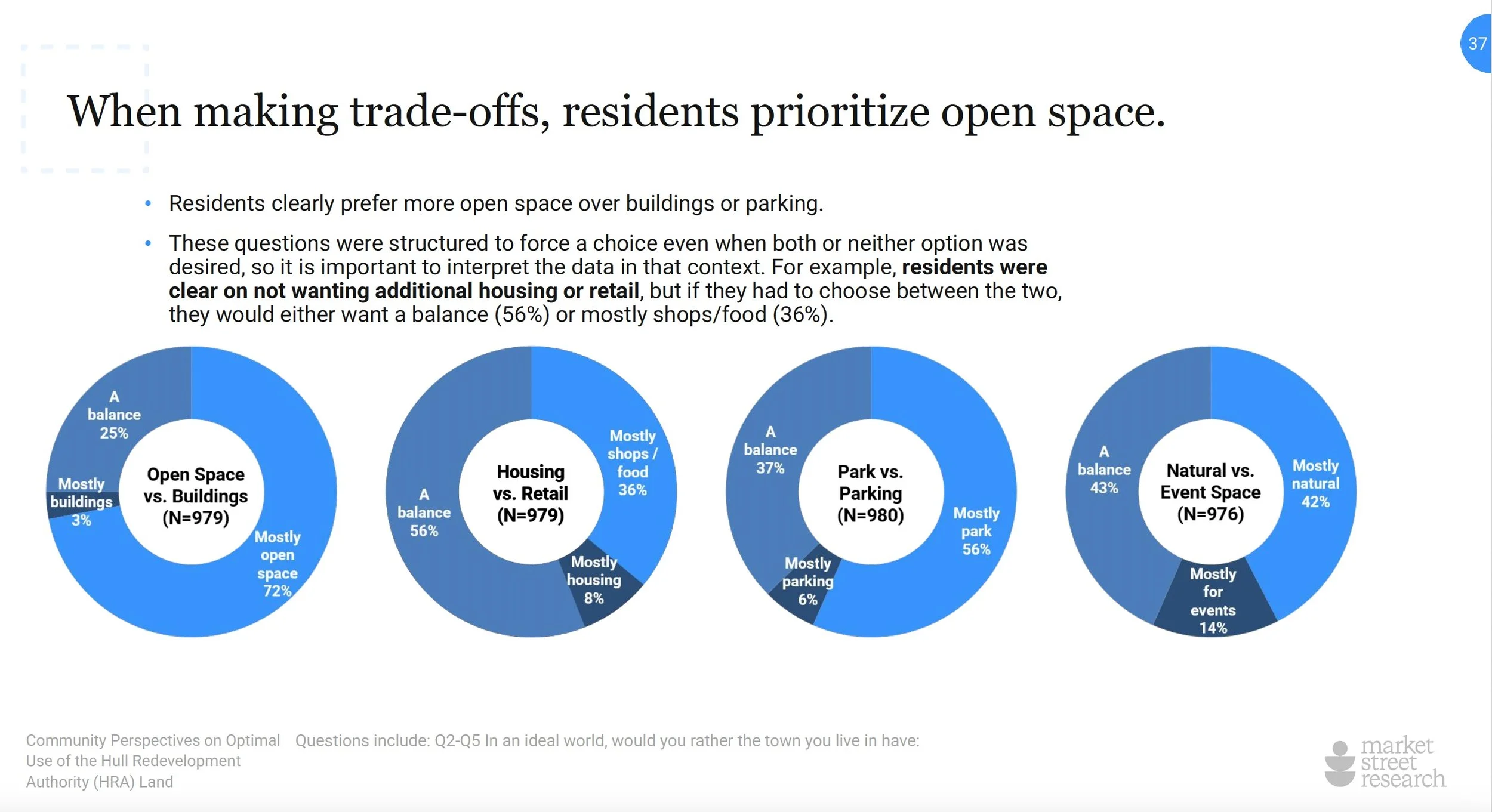
Most Hull residents responding to the Hull Redevelopment Authority’s survey about future uses of its property said they are not interested in large development and highly interested in open space, according to the consultant hired to conduct the townwide poll.

Market Street Research President Stephanie Gonthier this week presented the results, indicating the community’s preferred uses for the HRA property as an opportunity for the board and the public to make comments and ask questions.

At the beginning of Monday’s meeting, 38 people were participating in the Zoom call, including board members.

MSR – a marketing research firm that utilizes a customized approach – was hired to conduct the survey.

“This was obviously a complex topic,” Gonthier said. “The use of the HRA land is not simple.”

There were about 1,000 responses from among the approximately 9,000 registered voters with Hull addresses that the survey was mailed to – which is considered to be a very high response rate.

The key takeaways from the 37-page “Community Perspectives on Optimal Use of the Hull Redevelopment Authority Land” report included a preference for no intensive use or development of the property; maintaining open space with public access; and protecting the natural beauty of the property.

Click here for the full presentation of the survey results

The survey results are key to moving forward with the long-in-the-works Urban Renewal Plan to guide redevelopment of the parcel.

A survey goal was to understand current perceptions of Hull and the HRA property, including “familiarity with the land and general desires for Hull” and to assess residents’ priorities and concerns with the HRA land by measuring both broad goals (general character of the area) and specific goals (particular land uses), as well as how potential land uses may work together.

While most respondents indicated they are familiar with the HRA property, just under 1 in 4 residents “feel very familiar with the current HRA planning process.”

SOURCE: HULL REDEVELOPMENT AUTHORITY

Ready for the end of this process

The results revealed in part that residents are “ready for the end of this process with the HRA land, not interested in large development, and highly interested in open space that supports community and nature.”

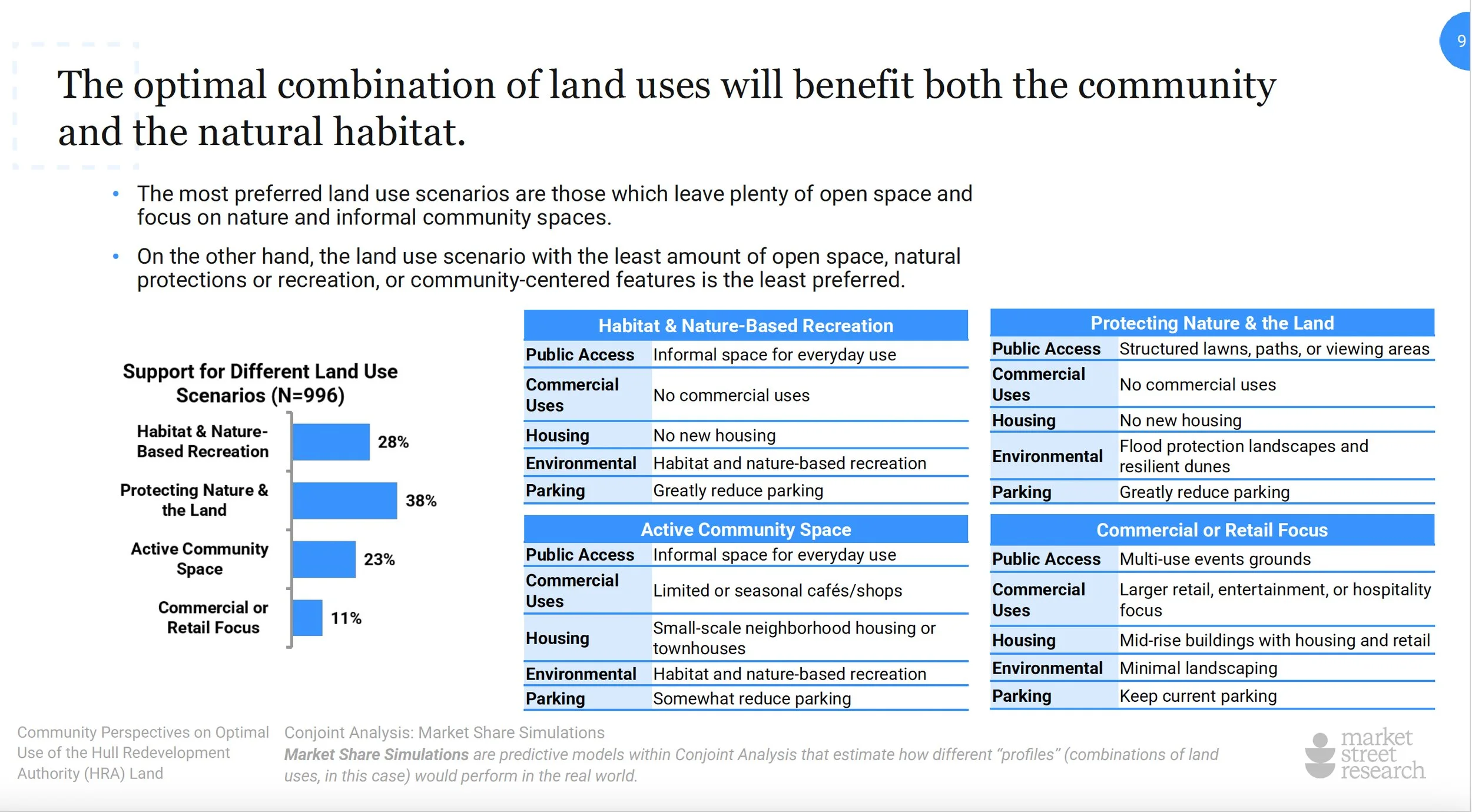
On the other hand, “the land-use scenario with the least amount of open space, natural protections or recreation, or community-centered features is the least preferred,” according to the report presented to the authority.

Beyond just the HRA property, some residents consider commercial – especially larger retail, entertainment, and hospitality – or new residential buildings as “diminishing the character of their community,” and sizable buildings and housing “are not appealing to residents.”

The survey results also show that respondents are overall against private ownership of the HRA land “because they doubt that would lead to decisions made in the residents’ best interests.”

Public open space and year-round community uses are among the most appealing to survey respondents, as well as protecting the dunes, natural habitat, and green space.

Maintaining neighborhood character

“Neighborhood character is important to residents; they don’t want to lose what they feel makes Hull unique or a desirable place to live,” the report states. One comment expressed interest in maintaining “the traditional character of our quirky little seaside gem of a town.”

There’s also a preference for open space that can serve multiple purposes, including gatherings, and a desire for natural open spaces and environmental protection.

“The least appealing use was adding new housing,” Gonthier said.

When Gonthier asked the board for feedback or whether members had any questions, member C. Anne Murray said she would like to hear Chair Bartley Kelly’s reactions and thoughts as a longtime HRA member.

“The responses were pretty much what I thought they would be,” he said. “Now the board has to grapple with how to balance the wants and needs,” including how to fund the cost of maintaining open space and other priorities outlined in the survey results once the board decides on next steps and what direction to take heading into continuation of their work on the urban renewal plan for the property. This project has long been delayed for a number of reasons, including waiting for the survey results.

The first priority, Kelly said, is to “take the data we know in our hearts and from the community and as a board decide what direction we should go in. We’ll need to fit the pieces of the puzzle together so we have some kind of plan moving forward to accomplish different objectives, especially the ones pointed out in the survey results.”

Hiring a consultant a possibility

The board also talked about possibly hiring an urban planner, landscape architect, or other consultant once a consensus is reached to provide guidance through the URP process, based in large part on the survey results.

Resident Susan Mann called the results “good news” and agreed that hiring someone to help with the planning is a good idea. However, she questioned whether hiring an urban planner would be the right decision since the URP requires approval by the state – which might be looking for certain things in an urban plan that you might not be able to give them at this point, she said.

It was also noted that there are various groups such as the Wildlands Trust and others that the HRA could partner with, and grants that the HRA might be able to access.

MSR’s recommendations based on the survey results included keeping the land open, supporting a sense of community by using the HRA land as a space that everyone can enjoy, and protecting nature.

“We have our work cut out for us as we move on to the next steps,” Kelly said.

MSR submitted the lowest bid of $22,000 and aligned most closely with the solicitation of services for a townwide survey design and analysis issued by the HRA earlier.

Services included working with HRA members on the design of the survey questions and format, survey response optimization features, analysis of response data, and submission of the survey report this week.


Like what you’re reading? Stay informed and support our work with a Hull Times subscription by clicking here.

Do you have an opinion to share? Click here to write a Letter to the Editor.

© 2026 The Hull Times. All rights reserved.
In split vote, HRA members agree to extend closing time of parking lots until 8 p.m.

By Carol Britton Meyer

During a two-hour meeting this week, the Hull Redevelopment Authority heard a report on the results of a recent community survey about proposed uses for the HRA property (see related story); gave the go-ahead to HRA Technical Operations Manager Mark Hamin to begin the process of organizing the HRA’s historical records; approved an extended closing time of 8 p.m. for parking lots A and C for the rest of the season; and approved a rate increase for a staff member who has worked for the HRA in a number of capacities for many years.

Board members agreed 3-2 (with C. Anne Murray and Dan Kernan voting against) to allow the operators of the A and C parking lots to remain open until 8 p.m. for this season rather than the 6 p.m. closing time outlined in their contracts.

This is with the understanding that they will clear their lots of trash at the end of the now-later closing time in accordance with their lease agreements, ensure they are clear of debris in the morning when the lots open, and on the condition that neither operator charges more than $15 for anyone to park between 6 and 8 p.m. rather than the usual $40 a day charge.

At Water Street parking lot operator Joseph Reilly’s request, he was granted permission at the board’s June 29 meeting on a unanimous vote to extend the hours of operation for lot C until 8 p.m. for the summer season from the current 6 p.m. closing time following some discussion – contingent on fulfilling the part of the contract requiring signage to be posted in this case, by Friday, July 3 – stating that residents with town parking stickers can park there for free. Hamin confirmed this week that this requirement has been met.

The lot manager was present at the earlier meeting and was reminded that the initial contract included plans to work with businesses in the area to offer some kind of parking discount to customers.

Even though the operator of parking Lot A did not make such a request, the majority of the board voted in support of extending the closing hour for both operators in the interest of fairness this week.

Murray wondered who would “police” the lots every day to ensure the trash is being cleared – a task Chair Bartley Kelly said he is already doing – and noted that Lot C is closer to the businesses with regard to granting the 8 p.m. lot closing time to both operators with the reduced parking fee.

The original intent was that because lot C closed at 6 p.m. under the lease contract, patrons of the restaurants and other businesses would be able to park there at no charge after that hour.
Kernan noted that the later lot closing hour is not included in the lease agreements.

At an earlier meeting, the board granted this season’s parking lot operators – including Reilly – the ability for extended hours – until 10 p.m. – during the July 18 fireworks display in honor of the country’s 250th anniversary.

Increase in pay approved

In recognition of her long service to the HRA, the board unanimously approved an increase in Catherine Goldhammer’s rate of pay from $65 to $75 an hour even though she has cut back her hours as she heads into retirement and since she hasn’t had a raise in recent years.

“She has always done whatever is needed,” Kelly said.

Hamin noted that Goldhammer’s skills and institutional knowledge are “very valuable” to the HRA and that if someone were to be hired at a lower rate, there would be a big learning curve “and the job would take a lot more hours.”

Murray emphasized that the increase is due to Goldhammer’s “long-term service to the HRA and not specifically connected to the position going forward” when eventually occupied by another person.

The board also approved Hamin handling the organization of the many boxes of HRA historical files “in a way he sees fit” – whether by himself working on a task that the board agreed he is overqualified for, although Hamin is willing to do it – or finding someone such as a college student to do the work under his supervision.

“If we brought on a staff person at a lower pay rate to take on this role with guidance, that could be a cost-saving measure,” he said. “I will explore that option.”

A replay of Monday’s HRA meeting will be posted on Hull Community Television’s website, www.hulltv.net.


Like what you’re reading? Stay informed and support our work with a Hull Times subscription by clicking here.

Do you have an opinion to share? Click here to write a Letter to the Editor.

© 2026 The Hull Times. All rights reserved.

Armed with a 215-foot crane, volunteers return to Hull’s rocky coastline to remove marine debris

Staff and volunteers from the Center for Coastal Studies returned to Hull Monday to employ a 215-foot crane to remove heavy debris left behind following an earlier cleanup along the shoreline.

In April, the Provincetown-based marine conservation organization enlisted dozens of volunteers from its “beach brigade” to remove more than 8,000 pounds of wire lobster traps and rope debris that were loose or able to be hauled by hand over the rocky shore. But considerable heavy and cumbersome debris remained, often wedged among the rocks. Much of the debris had accumulated during storms over several decades.

“Winter storms at sea have energy that is hard to comprehend. Nor’easters will tear up tons of fishing gear off the ocean bottom, and the wave activity can roll the fishing gear into entangled masses that are often deposited on shore,” said volunteer Tony Lacasse.

To remove the remaining debris, a highly technical operation was required to hoist the material hundreds of feet to a staging area above. A new crane from Winkler Crane and Construction Company of North Truro provided the most efficient method of removal. Among the large debris removed Monday was a massive 5,400-lb. tangled knot of nylon rope.

Often working with partner agencies, CCS leads efforts to conduct shoreline cleanups on Cape Cod, the Boston Harbor Islands, Cuttyhunk, and many other locales, as well as to remove ghost gear, or lost lobster pots and other fishing gear, from the sea bottom.
“Unless removed and disposed of properly, plastic debris on our coast remains forever, shedding microplastics and posing problems for habitat and wildlife,” said CCS Marine Debris and Plastics Program Director Laura Ludwig. “We were fortunate to work with Hull residents and others to help preserve this unique urban coastline.” 

Now celebrating its 50th year, the Center for Coastal Studies is a non-profit organization dedicated to understanding, preserving and protecting marine ecosystems and the coastal environment through applied research, education and public policy initiatives. For more information, visit www.coastalstudies.org.


Like what you’re reading? Stay informed and support our work with a Hull Times subscription by clicking here.

Do you have an opinion to share? Click here to write a Letter to the Editor.

© 2026 The Hull Times. All rights reserved.

Residents’ input is needed to help the MBTA improve Hull’s transportation service

Submitted by Steven M. Greenberg

In Hull’s Golden Age, public transportation provided the backbone to bring all the customers we needed to our beautiful little town of Hull. From the steamships bringing visitors to Steamboat Wharf, to the first electric railroad that moved people all over the peninsula, to the trolley and buses from Dorchester or Mattapan, public transportation has always been a cornerstone of what made Hull the place to visit and enjoy.

Generations of visitors and residents alike experienced Hull without needing to drive their own car. To continue this tradition, representatives of the MBTA are hosting an in-person event where you can learn about the project, view drawings of the proposed bus stops, and provide feedback of Phase 1 of the project to provide the bus stops from Hingham Depot to W Street.

Phase 2 will cover W Street to Pemberton Pier. The goal is to complete the Phase 1 stops in 2027. They are currently in the design phase and are looking for feedback from the public on the bus stop locations before they move forward.

Plans for future bus stops will mark a change from our existing flag-stop system and will help serve our town for generations to come. Your participation in this meeting will help the MBTA planners gain feedback and insight from the community.

This meeting and your support for increased and improved bus service also support the MBTA’s decision to continue to have two buses per hour after the existing one-year pilot program stops. Together, we can all start thinking about the 714 bus as an alternative means of transportation to reduce some of the traffic and parking issues we face.

Please attend and make sure your voice is heard as we go through the planning of this most important public transportation project in Hull. The meeting is on July 20, from 6-8 p.m. at Hull High School, 180 Main Street.

Don’t forget about the upcoming no-fare days July 18 (fireworks) and August 14 (parade and field day).Visit MBTA.com/714BusStops to learn more.


Like what you’re reading? Stay informed and support our work with a Hull Times subscription by clicking here.

Do you have an opinion to share? Click here to write a Letter to the Editor.

© 2026 The Hull Times. All rights reserved.