Volunteers restore memorial honoring veterans buried in Hull Village Cemetery

A MEMORABLE PROJECT: In 2007, Eagle Scout candidate Jeffrey Cameron created a memorial to deceased veterans buried in the Hull Village Cemetery. Earlier this year, Hull’s Randy Gould led an effort to restore the memorial board and update the list of names. The completed memorial was unveiled at the cemetery on August 14. [Photos courtesy of Jennifer Whelan]


The deceased veterans bulletin board at the Hull Village Cemetery was originally dedicated on Veterans Day, November 11, 2007, in honor of Hull veteran Edwin A. Cameron, who served in the Navy during the Korean and Vietnam conflicts.

His son Jeffrey, as a member of Boy Scouts Troop 20, completed his Eagle Scout community project by building a display for the names of Hull’s veterans buried in Hull Village Cemetery. Over several months on weekends, the Boy Scouts and community volunteers searched the cemetery for veterans’ graves. The Boy Scout troop had approached the select board for permission to do this project on town property.

Donations from Hull Glass and the workmanship of the late Mike Schaffer and Jeffrey Cameron built the deceased veterans memorial.

Fast forward to 2026, when Hull Village resident Randy Gould decided the memorial needed some tender loving care and that the names of veterans buried in the cemetery needed to be updated. With the blessing of the Cameron family, he sanded and stained the original wood memorial, on advice from JoAnn Cameron, moved the bulletin board to the center of its frame in order to use the back for additional space, replaced the sign, and along with Sheila Fleck from Daley and Wanzer, researched and updated the list of deceased veterans and the locations of their gravesites.

After several months, with donations from Daley and Wanzer and research by Miranda Ahlstedt from the Hull Department of Public Works, the restoration was finally completed.

It was unveiled on August 14 in the presence of the Cameron family.


Like what you’re reading? Stay informed and support our work with a Hull Times subscription by clicking here.

Do you have an opinion to share? Click here to write a Letter to the Editor.

© 2026 The Hull Times. All rights reserved.

Select board creates committee to review data, improve town’s parking policies and procedures

By Carol Britton Meyer

The select board this week voted to create a parking management advisory committee to audit Hull’s current parking policies and to recommend improvements to the board, with a focus on citizens, neighborhoods, and local businesses.

The committee – which will be appointed at an upcoming board meeting – will be comprised of three local business owners or employees; four residents, possibly including one who lives in Hull during the summer only; a member of the economic development committee or chamber of commerce; and a planning board member.

There will also be a select board liaison without voting rights since the board also serves as the town’s traffic commissioners and will vote on any recommendations.

Members of the committee will talk with town staff who have been, and are, involved in numerous parking-related discussions.

The goal is to collect data related to current parking policies; the new Pay By Phone parking app and related concerns as well as positive feedback; visitor passes and the desire of some residents to be able to buy parking stickers in-person at town hall and not only online and their cost; ticket fines; a review of the municipal parking lots; and other related issues and then make recommendations in time to implement any approved changes by next spring.

While there have been some complaints about the Pay By Phone parking app, Assistant Town Manager Stacy Callahan noted that since May 2025, the monetary value to the town from the app has amounted to about $40,000.

Board member Susan Short Green presented details of what such a committee – which the board talked about during its summer retreat – might look like and its charge, and the rest of the board supported what she suggested, with a few changes. Irwin Nesoff was not present.

“The idea is to look at the whole picture and determine what’s going right and keep it, and if something’s not going right, to fix it,” Chair Brian McCarthy said.

Once appointed, committee members will serve one-year terms, with annual reappointments as long as the committee remains active.


Like what you’re reading? Stay informed and support our work with a Hull Times subscription by clicking here.

Do you have an opinion to share? Click here to write a Letter to the Editor.

© 2026 The Hull Times. All rights reserved.

Hull High principal resigns; departure creates school’s third leadership change in four years

Hull High School Principal Robert Shaw has resigned to take a job at Cambridge Rindge and Latin School, Superintendent Michael Jette announced Wednesday.

In an email to parents, Jette said that Shaw “accepted a leadership position” at the Cambridge high school, and that his last day in Hull would be Friday, August 21.

The departure of Shaw – who was hired in 2024 to replace Michael Knybel, who left after two years –leaves Hull High with its third leadership transition in the span of four years.

Click here for the Times story on Shaw’s hiring in 2024

According to Jette, current Assistant Principal Anthony Hrvinak has been appointed interim principal while parallel searches are conducted for both an interim leader and the permanent principal. Hrvinak, who previously was principal of the Memorial School, has been in Hull for 15 years.

“We believe that each posting will appeal to a different candidate pool, and we will work with our school community to select the one best leader for the future of HHS,” Jette wrote. “We want to assure parents and students that the Hull High School schedule has been finalized, all teaching slots have been filled, and we are ready to welcome students back on September 2nd for another amazing school year.”

– Christopher Haraden


Like what you’re reading? Stay informed and support our work with a Hull Times subscription by clicking here.

Do you have an opinion to share? Click here to write a Letter to the Editor.

© 2026 The Hull Times. All rights reserved.

Making a ‘Point’ – At ZBA hearing, Allerton developer challenges planning board’s unanimous denial

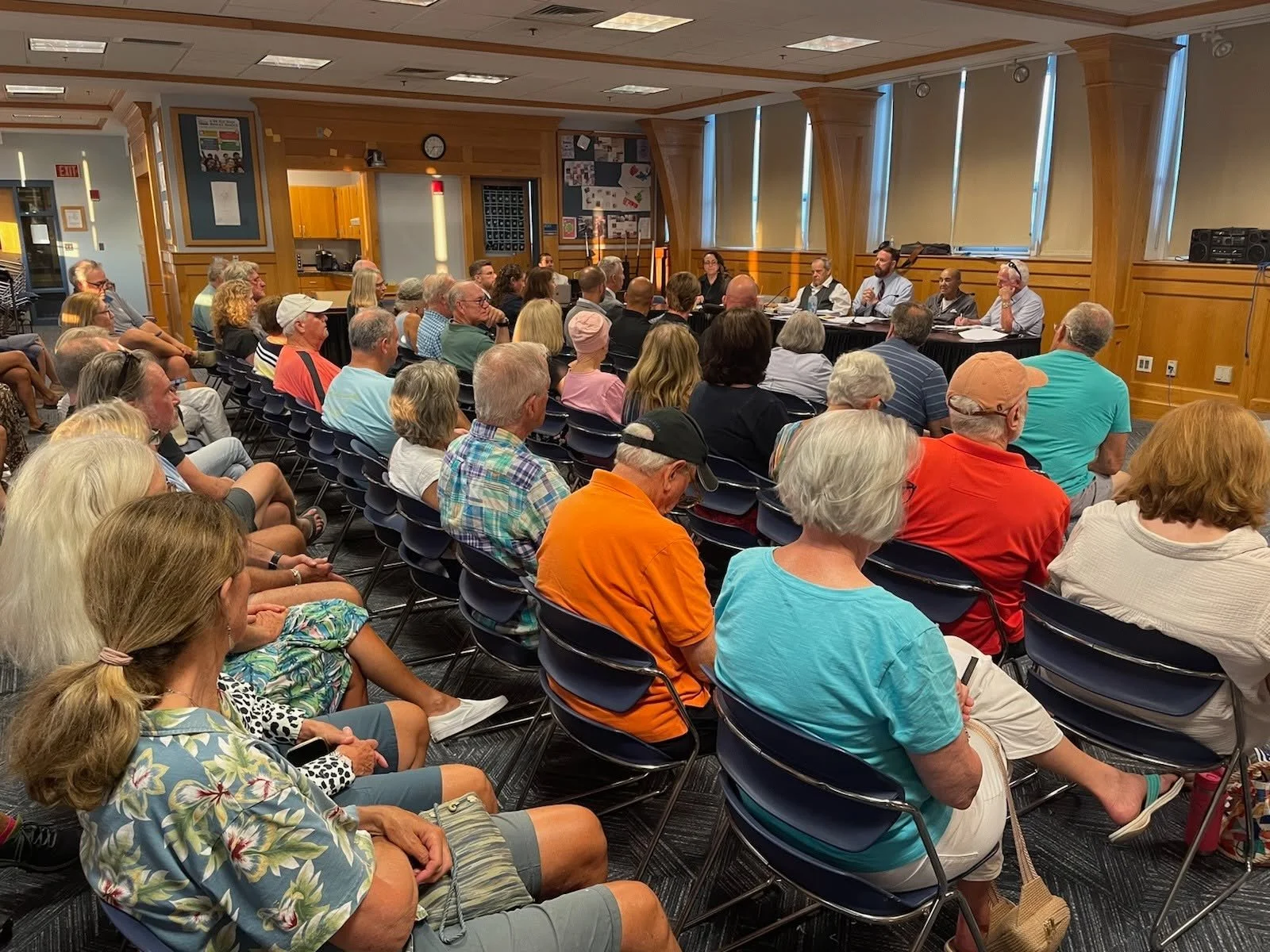
A capacity crowd filled the hull high exhibition room as the zoning board of appeals began the hearing on the point, a project proposed for 839-845 nantasket Avenue. [Photo By the Point ALLERTON ASSOCIATION]

By Carol Britton Meyer

The zoning board of appeals hearing on The Point project proposed at the foot of Allerton Hill was continued Tuesday night following a nearly three-hour presentation by the attorney for the project and related discussion.

The hearing was the result of The Point Nantasket Realty LLC’s challenge of the planning board’s May 14 unanimous denial during the site plan review process.

The high school exhibition room, where the hearing was held, was “packed with folks who have strong feelings one way or another,” noted ZBA Chair Richard Hennessey. He then asked for their cooperation in not making any remarks that might interrupt the meeting. No public comments were accepted.

The planning board will make its presentation on Tuesday, August 18, at 7 p.m., which will allow them equal time as needed. In May, planning board members said they felt that the developer had not addressed all of their concerns and had presented plan revisions in a piecemeal format.

Town Counsel Brian Winner requested the continuation to allow members of the planning board – a few of whom attended this week’s hearing – to discuss the presentation by Attorney Adam Brodsky and other members of the development team at their already-planned meeting the following night, August 12. A meeting of the planning board was not posted for Tuesday’s hearing, so all the members were unable to attend.

The developer is proposing nine “residential cottages” connected by a common deck at the former Sunset Marine property at 839-845 Nantasket Avenue, as well as a pavilion, boat ramp, boardwalk, and other amenities on approximately 3.28 acres.

Click here for more information on the project and to read the filings by the developer and town counsel.

The project is being proposed by Chris Reale of Hingham, who formerly owned the Paragon Boardwalk property at Nantasket Beach, along with Hingham builder Tom Fleck, whose father once ran the boat yard at the site.

The presentation and back-and-forth between Hennessey and Brodsky and other development team members was detailed and complex, with references to the planning board’s denial of site plan approval and the reasons behind the developer’s 20-page appeal of that decision, which is posted at www.town.hull.ma.us/786/07212026-Meeting.

Under the town’s zoning bylaws, building permits cannot be issued for projects without site plan approval.

A main point of discussion revolved around Brodsky’s assertion that the board did not have grounds for such a denial. According to the appeal, the planning board “engaged in improper procedure, had no legal or factual basis to deny approval, and failed to impose reasonable conditions.”

During the hearing, Brodsky claimed that the planning board made “procedural errors” and denied that the development team had not provided adequate information to the board for their review of the proposal.

The one exception, he said, “is that we were asked to present a physical model of the proposed development to scale. [However], no one builds physical models anymore – so we provided computer-generated 3D models,” – which Brodsky said is not grounds for denying site plan approval. A development team member noted that the bylaw doesn’t include the word “physical” for the model reference.

Brodsky also claimed that the board’s “allegation that they were not afforded sufficient time to review the project” is inaccurate. The development team also asserted that the project is in compliance with the related town design guidelines and is “fully zoning compliant.”

Brodsky advocated for the ZBA to send the case back to the planning board “for all the reasons set forth in our appeal. It’s important to have fair and impartial hearings, with guardrails [in place].”

“There need to be legitimate grounds – based on the zoning bylaws and design guidelines -- [to justify a denial],” he said.

When asked by Hennessey whether he had any comments during the development team’s presentation, ZBA member Phillip Bellone had no questions, but said “there seems to be a lot of nitpicking going on by Mr. Brodsky – someone did this or that, and I don’t buy any of it.”

When making a few comments near the end of the presentation, Reale objected to Bellone’s remark, noting that he found it “offensive.”

According to its August 12 agenda, the planning board was to enter into executive session to discuss the “Open Meeting Law complaint against the planning board filed by Christopher Reale on August 5, 2026” but did not offer details on the nature of the complaint. The agenda also listed an executive session to discuss strategy with respect to litigation regarding the permitting appeal for The Point.

A replay of the meeting will be available on Hull Community Television’s website, www.HullTV.net.


Like what you’re reading? Stay informed and support our work with a Hull Times subscription by clicking here.

Do you have an opinion to share? Click here to write a Letter to the Editor.

© 2026 The Hull Times. All rights reserved.

Beach traffic, Prohibition, and political intrigue – how Hull celebrated the summer of 1926

By John J. Galluzzo

For the first time ever, no Civil War veteran attended the Hull Memorial Day ceremonies. It had been 61 years since the end of the war and with the death of John W. Jordan of Kenberma in 1925, an era had come to an end. World War I veterans from the Oscar Smith Mitchell Post, American Legion, took the honor in the parade, joined by members of their Auxiliary, Sons of the Veterans of the Civil War, and the local Girl and Boy Scouts. The Memorial Day ceremonies typically heralded the coming of grander summer festivities throughout the beachside community.

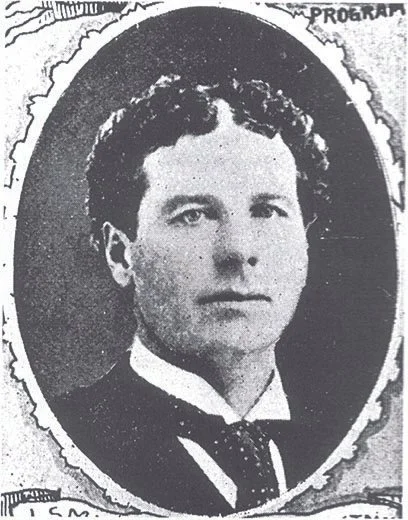
THE OLD BOSS: In July 1926, Hull selectman and political boss John Smith died. He had been a member of the board of selectmen since 1893, and led the political organization known as the Citizens Association, known informally as the ‘Old Ring.’ [Photo courtesy of the Hull Historical Society]

Hull summers, though, had become more volatile of late. The constant sting of liquor raids had put a label on the Nantasket resort businesses. For some, of course, the notion that liquor could be found at the beach at the height of Prohibition made it a destination. Crowds surged each summer, with many individuals gambling that they wouldn’t be the ones to get caught with booze on their breaths. As the 1920s progressed, it became an increasingly risky game.

Still, on June 1, 1926, prospects for a healthy summer season looked good. Houses were selling, at Holbrook Avenue, S Street and Hillside Road. All along the peninsula, real estate transactions hinted that Hull was still a desirable place to be.

School was still in session. Robert Brown, son of Mr. and Mrs. Fred Brown of Nantasket, was having a breakout season for the Hingham High School baseball team. In years to come, he would be known as “The Hull Howitzer” Bobby Brown, ace of the Boston Braves, but for now he was just Robert, a freshman making a splash. As he did, the Boston papers began reporting on the long list of summer arrivals from all around Greater Boston. Houses were unshuttering, sunlight shining on rooms long locked up.

David Stone announced that his Paragon Park ballroom would hold a special dancing social the first Saturday in June, but most Hull news remained confined to the Village throughout the month. The most shocking news of all was that Bob Smith’s barbershop had closed and become – gasp! – an ice cream parlor. The old landmark had been in place for as long as anyone could remember; when the town’s Civil War veterans returned home from the fight in 1865, they went to Bob’s for haircuts and shaves. So, too, did the Spanish-American War soldiers and the Doughboys of World War I. And now, Bob’s was gone.

The Commonwealth of Massachusetts announced that work on the “Nantasket Road” would begin immediately. The road in question was not in Hull but started in Quincy and passed through Weymouth and Hingham on the way to Nantasket Beach. It had become increasingly congested during the summer months as more Americans took to automobiles for day trips to the beach from Boston and the surrounding towns. Why the state decided to complete the widening project between June 5 and September 1, when traffic would be at its heaviest, was not explained. Road closures began immediately.

Hull was reachable by other means, though, and none was more pleasurable than steamboat excursions. Boston companies and clubs had long been planning their summer outings to Nantasket Beach and oftentimes their journeys started at city wharves. The Proparvulis Club, a nonprofit women’s organization founded in 1922 that would volunteer at the Sunset Camp for more than 90 years, announced they would hold their informal supper dance at the Pemberton Inn on June 14. “Proparvulis” meant “for the little ones,” and all proceeds from the dance would go to support “delinquent children of Boston” through the Catholic Charitable Bureau. By the time they arrived, the American Mutual Liability Insurance Company’s 500 employees would already have visited the beach.

The Boston Automobile Dealers’ Association, of course, chose to brave the roads on June 9. Each year, the Association paraded 2,000 children to Nantasket Beach in between 10 and 80 brand new cars in what was one of the most high-profile publicity stunts of the summer season. Decorating the cars, they even gave the kids noisemakers to draw more attention. The children, gathered from orphanages, hospitals, and other places in Boston, spent the morning at the beach, gathered for a five course “shore dinner” at the Nantasket Hotel, then returned home, exhausted, before the sun was down.

As a rash of unexplained fires broke out at as-yet unoccupied summer homes, Fire Chief Henry J. Stevens unveiled the town’s new motor ladder truck, the latest model, at the Central Fire Station. News dropped that the state would not open its Nantasket bathhouse until July 1, with Revere opening on June 12; it was yet another sign that Nantasket’s allure was slipping away. The Hull Athletic Association began lining up its baseball schedule for the summer and something even newer was added. Jimmie Gallagher and his orchestra, Ray Stewartson and his orchestra, Doc Eisenberg and his orchestra and the Paragon Park Military Band would begin broadcasting weekly dance music programs live from Nantasket Beach on WNAC radio. For the first time ever, if you couldn’t get to the beach, you could listen in and pretend you where there.

Or you could just read the Boston papers. Mid-June saw the eruption of a scandal, the likes of which had not been seen in years. A group of Cambridge High and Latin seniors left their prom on the M.I.T. campus, drove to Hull, broke into a summer cottage, started a fistfight and got caught with a pint of gin in hand. The next day, the school’s superintendent admitted that “for about a year there has been a suspicion in the minds of many that gin has been and is being sold in the corridors and coat rooms of the Cambridge Latin Building.” Students uncovered the details, fingering five boys who worked on commission, selling gin at $2 a quart. Some even went as far as saying that students were known to get drunk in school. The federal government took notice.

On June 13, Nantasket Beach witnessed the first big beach day of the season, as 150,000 people thronged the sands, with 70,000 automobiles passing in and out of town. The Hull Police took closer notice of speeders. The Nantasket Beach Steamboat Company added additional trips to the Boston-Pemberton-Nantasket route for upcoming Saturdays. On June 17, 175,000 people and 80,000 cars reached the beach. On June 18, a sixth unexplained fire broke out in a summer cottage, this one on Edgewater Road. Hull Lobstermen that same day lauded their first great hauls since 1917.

The liquor raids started on June 20. Hull Police Chief Frank Reynolds, Sgt. William Armour and patrolmen Glawson, Sousa, Manley and Bergan charged into two cottages owned by Joseph Ykainos and seized 100 gallons of beer, two gallons of whiskey and a copper still. That day, more than 85,000 cars carried 100,000 people to Nantasket Beach. Despite what the state said, Hull’s summer was under way well in advance of July 1.

So, too, felt the Massachusetts Society of Certified Public Accountants, which threw a bash at the Pemberton Inn, and the Travelers’ Insurance Company, which chose the Atlantic House. The Maryland Casualty Company brought more than 100 to the Atlantic House the following day and the R.H. Stearns Company of Boston just told its employees to get on a boat for a sail to an unannounced destination. When they landed at Pemberton, the crowd was overjoyed.

As July approached, the locals celebrated the graduation of young Lillian M. Jacobs from Hyannis Normal School, ready to embark on a career as a schoolteacher on Martha’s Vineyard. The concept of zoning – new to Massachusetts in 1918 – forced a special town meeting for Hull’s year-round residents. Disgruntled Hingham Water Company customers gathered in Temple Israel Community Hall to voice their opinions and, in fact, start a petition. The water company countered by saying that if their estimates no longer worked for their customers, the company would install water meters at each home. That was bad news for the K Street Zouaves, the volunteer fire company, who figured they could no longer practice their craft with garden hoses lest it become too expensive.

On June 28, Sgt. Armour and Officer Titus O. Jacobs raided a cottage on Berkley Road and nabbed “a large quantity of moonshine and other hard liquor.” That same day Chief Reynolds and a squad of men raided a home “in the Bay Street section” and arrested two men and nine women. The women claimed the men broke in and refused to leave. The men were detained and booked, the women allowed to walk free.

The state bathhouse opened on July 1, and the summer officially began.

On July 3, Sgt. Armour pulled over a car of five young men he’d been watching closely for several weeks. Finding a loaded .45 caliber revolver in the automobile, he arrested them all. That night, Fourth of July festivities began with a “night before ball,” with word that the next day Louis E. Timson, a Swampscott resident, would swim from Nantasket Beach to Blaney Beach in his hometown, a journey of about 18 miles.

That night, between 2 and 6 a.m., Hull police, aided by Metropolitan District Policemen, arrested 39 people on drunkenness, disturbing the peace, disorderly conduct, operating while under the influence of liquor and keeping and exposing liquor. The owners of 20 Hillside Road and 266 Nantasket Avenue were taken into custody with evidence of the liquor charges against them. That day 125,000 cars headed for Nantasket Beach. The next day, 300,000 people hit the sands.

Chief Reynolds said that in his 30 years of service to Hull, he had never seen such a large and disorderly crowd as he had that weekend. More than 50 people were arrested. Sixteen false fire alarm pulls and deliberately-set fires kept the new Hull engine running around town. Three men beat traffic officer George Eaton unconscious at Gunrock Beach. Numerous people reported to the Hull and Metropolitan District police that they had been held up at gunpoint. No one was ever captured to face those charges.

All of this led to Arthur Crowley Night at the Palm Garden. Arthur, the son of Boston Superintendent of Police Michael Crowley, had served in World War I and befriended a young ballplayer of the time, Babe Ruth. The Babe promised that he would get special dispensation from his manager with the New York Yankees, Miller Huggins, to break free from the regular season grind and attend the party at Nantasket with Governor Alvah Fuller, Ex-Mayor James M. Curley, sheriffs, senators, lieutenant governors and radio personalities from WEEI. Judging by the box score, he didn’t make it. He did, though, hit his 27th home run of the season that day, in Cleveland. Perhaps he pointed toward Nantasket Beach and called his shot for Arthur.

On July 11, 180,000 people visited Nantasket Beach, 2,000 of them utilizing the enlarged state bathhouse. Buses joined the parade, with special “flyers” dispatched from as near as Wollaston and as far as Fitchburg. As congestion worsened, news broke that federal officials were targeting “gambling and bootlegging” at Nantasket Beach.

Five days later, Miss Irene Spellman, 18, “a bobbed-haired beauty of 159 Western Av., Allston,” said The Boston Globe, won the title Miss Nantasket at Paragon Park, standing out from 300 other contestants. Band concerts started at the state reservation pavilion on Thursday, Saturday, and Sunday afternoons and evenings.

On July 18, the news came hard and fast. Two hundred and fifty thousand people choked the beach, 50,000 of them entering the water. More than 150,000 cars lined the streets. Thirty children lost their parents in the crowds, the local police reconnecting them. Chief Reynolds led his second raid on 266 Nantasket Avenue, again arresting the owner, seizing 84 quarts of Canadian ale and an undisclosed amount of whiskey. At 6 p.m., lightning struck the electric train of the Nantasket Branch at Allerton, terrifying the hundred or so passengers, but causing no injuries.

That night, Boss John Smith died.

Smith, elected to the Hull Board of Selectmen in 1893, had led the formation of the Old Ring, a political machine that held every office in town for the past quarter century. During his tenure, Hull became famous for its roads, a project he personally undertook. Behind the scenes, out of sight of the vast majority of the community, the members of the Old Ring would fight to replace him.

Smith’s foresight had built the streets on which the cars bow traveled, bringing thousands of dollars into the community each summer. The Brockton Enterprise, meanwhile, exposed what that truly meant in 1926. “‘Wet and wide open is the report of the federal agents who have been mingling with the crowds,” read the paper’s editorial entitled “Nantasket Needs Scrubbing” on July 19. “Not the moisture of the rolling surf, nor the open door of hospitality, but the wetness of the bootleggers and the vicious arrogance of gambling and vice, if the agents tell the truth. At Nantasket, as everywhere, these elements are in the minority. They thrive only because of indifference or assent. Tolerance of this sort isn’t good business, apart from other reasons which readily suggest themselves, for unless the blackguards are driven out Nantasket will decline in popularity and prosperity.”

The descent had already begun. Ironically, Deputy Superintendent Thomas F. Goode of the Boston Police Department suffered a nervous breakdown trying to work out the nightmare traffic situation in the city. His doctor told him he could use some time off in a nice quiet place, somewhere like Nantasket Beach. On July 22, which proved to be the hottest day yet of the summer, the Globe reported that “Never in the history of Nantasket were so many automobiles parked at the open grounds bordering the state reservation highway.” Each week brought a new record.

And still the groups came: the Clinton Chamber of Commerce, the Framingham Rotary Club, the Caecilian Guild, the Omar Grotto, the Chickering Piano Company, the Rose Rat Exterminator Company. Some wanted out; the Surfside Amusement Company, midsummer, put their large dance hall, bowling and billiard room, flying horses, stores, stands, 16-room house and cottage, and 33,000 feet of ocean front land, up for sale. State Representative Thomas J. Griffin of Abington wanted to double down, calling for state funding to rebuild the Nantasket Reservation roads.

As August arrived, the Hull Citizens’ Association, the Old Ring, posted Henry John Stevens, chief of the fire department, for the empty selectmen’s seat. No matter who opposed him, he would win, even when that “who” was John L. Mitchell. Mitchell, Stevens’ predecessor, and a former partner in a coal business with John Smith who had fallen out of favor with the Old Ring, had served two terms as state Representative. James Griffith, former manager of newspaper titan Floretta Vining’s estate at Stony Beach, suddenly reemerged in town, indicating his intent to run for Boss Smith’s seat as well. Mysteriously, Mitchell pulled out of the race the day papers had to be filed.

Tides turned at the beach. Numerous bathers found themselves in strong undertows in early August or knocked down by enormous breakers. Rescue stories abounded. On Saturday, August 7, fog engulfed the harbor tightly, steamers running hours late. The next day, as if to make up for lost time, 275,000 people invaded the beach in 190,000 cars, with the local police once again declaring it “the biggest day of traffic yet recorded here.” Strong tides – the strongest witnessed in years – deposited kelp in unheralded quantities on the beach. “The beachcombers and others who find delight in gathering driftwood and other gifts of the sea,” said the Globe, “have been in their element, for much has been tossed along the coastline.”

As summer would down, several new projects reached their happy conclusions. Mrs. Bowen Tufts of Winchester and Allerton Hill presented a play with a cast of summer residents, “A Mid-Summer Night Surprise,” at the Municipal Building with more than 1,000 attendees. On August 17, Prince Toumanoff, a member of Russian royalty living in Hull Village, presented a concert of Russian and American music performed by the Balalaika Orchestra on WBZ radio. Paragon Park joined the beauty pageant business, crowning Miss Rella Harrison of 258 Warren Street, Roxbury, Miss Paragon on August 20. On August 21, the Catholic Charity Bureau staged training camp work and boxing exhibitions featuring George “Kid” Lee, Lou Bogash, Rocky Stone, Johnnie Vacca and Ray Cross to raise money for the Sunset Point Camp.

On August 23, Henry Stevens soundly defeated James Griffiths for selectman, winning 748 of the 787 votes at the first-ever special election held in Hull history.

Summer rapidly drew to a close. On Friday night, August 27, the 19th Annual Hull Gala Day committee arranged a “night before ball” at the Pemberton Inn for 1,200 dancers, coincidentally the same night that 1,000 party-goers attended the annual Firemen’s Ball at the Municipal Building. As both celebrations swung into the night, a severe electrical storm arrived. The Firefighters’ Ball closed early as an alarm sounded and all eyes suddenly turned toward the bay, where the USS Nitro was loading munitions from the Hingham Ammunition Depot on the Back River. Suddenly, its presence caused Hull residents to start counting down the days until its departure for Yorktown, Virginia.

The Hull Gala Day celebration took place on August 28 with races, junior baseball games, golf putting, quoit pitching, tennis, field events, free movies and gifts for children. Aquatic events took place at high tide, in the afternoon, with an illumination of Quincy Bay sponsored by the Boston Yacht Club punctuated by Gala Day fireworks. On Sunday the 29th, 280,000 revelers took their turn at Nantasket Beach.

All that was left was one last fling. One last rumrunning story floated throughout town. A well-known bootlegger sadly told of how he had passed through Hull Gut and past the Coast Guard ships all dolled up for the harbor illumination, figuring that a drop off while the Coasties were otherwise engaged would be wonderful strategy. Out he went offshore to pick up the goods; in he came to the prearranged drop site. No sooner had he pulled ashore than hijackers held him and his men at gunpoint, absconding with the booze. Labor Day parties might be drier than usual this year in Hull, he lamented.

On Thursday, September 2, 60 Massachusetts State Policemen descended on Nantasket Beach, raiding 16 different establishments: the Worrick Inn, Randolph House, Pacific House, Foster House, Straits Pond House, the Randolph Club, Checker’s Lunch, Checker’s Garden, Porrazzo’s barbershop, the Surfside House, the Marlboro House, the Kearns House, the Piedmont House and, of course, 260 and 266 Nantasket Avenue. They arrested 15, six of them women.

Labor Day weekend arrived and The Boston Globe reported that fewer than 3,000 people visited Nantasket Beach. Throughout the weekend, Hull police continued their raids, cleaning up what was left of the illegal booze.

As the Globe poignantly stated in its Labor Day article, “The ‘No Business’ sign was hung out today at Nantasket.”



Like what you’re reading? Stay informed and support our work with a Hull Times subscription by clicking here.

Do you have an opinion to share? Click here to write a Letter to the Editor.

© 2026 The Hull Times. All rights reserved.

U.S. government seeks new owner for historic Boston Light off Hull’s coast

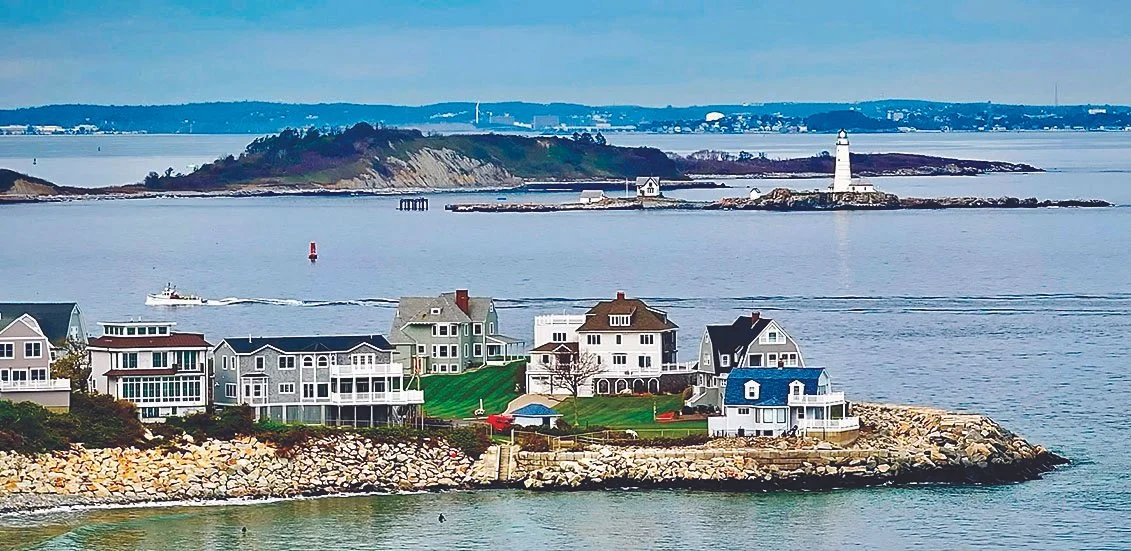
AVAILABLE LIGHT: The federal government is looking to divest itself of Boston Light on Little Brewster Island, the country’s oldest lighthouse station off the coast of Hull. The historic lighthouse is just off the northern edge of the peninsula; Point Allerton is in the foreground. [Richard W. Green photo]

By John J. Galluzzo

On Monday, August 3 – the day before Coast Guard Day and four days before National Lighthouse Day – the General Services Administration announced that the federal government is looking to divest itself of the country’s oldest lighthouse station off the coast of Hull.

“The U.S. General Services Administration today announced a unique opportunity for eligible organizations to acquire, at no cost, the historic Light Station Boston, commonly known as Boston Light, on Little Brewster Island in Boston Harbor,” stated the announcement. The report erroneously stated that “At 310 years old, Light Station Boston is the oldest continuously operating lighthouse in the United States.”

While the country’s first lighthouse began operation on Little Brewster Island in 1716, it was blown up in 1776 during the American Revolution. The current lighthouse was built in 1783. The site is the oldest light station in the United States. The oldest lighthouse in the United States is the Sandy Hook Lighthouse in New Jersey.

“GSA is dedicated to the responsible stewardship of our nation’s assets, and that includes preserving significant landmarks like Light Station Boston,” said Acting Public Buildings Service Commissioner Michael Gelber. “It is fitting, as we continue to celebrate our country’s 250th birthday, that we protect and preserve this national treasure for the enjoyment and education of future generations.”

The full property includes Little Brewster Island and six structures: “the lighthouse tower, a boathouse, a keeper’s house, a sound signal building, a cistern building, and a small oil house.” At this time, according to the announcement, federal, state, and local agencies, nonprofit organizations, educational institutions, and community development organizations may apply for ownership of the historic light station; it will be offered for private sale if no public or non-profit owners step forward by October 2. The Coast Guard would retain responsibility for maintaining the beacon and fog signal.

Aside from its long operational history, awash in tales of storms and shipwrecks, Boston Light has been, since 1989, a shining symbol of the dedication of the American lighthouse keeper. Faced with the prospect of automation and the loss of human keepers at the site, preservationists called out to Senator Edward Kennedy for help. Kennedy sponsored an amendment to that year’s Coast Guard Reauthorization Bill to keep the station permanently manned. The light was automated in 1998, but keepers remained on duty until the retirement of Sally Snowman in 2023.

“Boston Light is not just a historic site,” said Gary Thomas, executive director of the Foundation for Coast Guard History on Tuesday. “It has been a living history site enjoyed by the public for many years. We at the Foundation for Coast Guard History strongly support new ownership that will protect its historic character, ensure responsible long-term care, and keep it meaningfully accessible to the public. The transfer of ownership offers an opportunity to preserve an irreplaceable part of our maritime heritage while maintaining the public access and educational value that make the site so memorable to so many.”

Thomas warns, though, that “Any acquisition effort should recognize that securing title to the light and its associated structures is merely the first step, often the easiest. Keeping a historic lighthouse standing is only part of the responsibility. To be successful in the long term, the new owner will have an obligation to ensure that the site remains historically authentic, financially sustainable, and interpreted in a way that allows the public to understand and experience its significance.”

“Boston Light is a national treasure and the crown jewel of Boston Harbor,” said lighthouse historian Jeremy D’Entremont on Tuesday. “The historic value of the place as the first light station on the continent is clear. The beauty of the place is also indisputable. My friend, the late Ken Black, ‘Mr. Lighthouse’ and founder of the Maine Lighthouse Museum, once said to me that Boston Light is ‘what a lighthouse should be.’ When the average person hears the word ‘lighthouse,’ they’re likely to conjure an image of something much like Boston Light in their mind’s eye: a graceful, white, stone tower on a small rocky island.”

Like Thomas, D’Entremont calls for a thoughtful approach to the light station’s preservation. “My hope is that Boston Light will find the steward it deserves through the NHLPA process,” he said. “The Coast Guard’s attention, dictated by their mission and budget, has been focused on the light’s importance to navigation rather than its role as a maritime icon and National Historic Landmark. Boston Light needs someone who fully appreciates what a magical place it is and who will work to make it publicly accessible again. Boston Light has long been a front door to Boston, and it’s time to put out the welcome mat.”

D’Entremont admits, too, that “for me and so many others, there’s a strong emotional attachment. My association with Boston Light goes back to the late 1980s when I helped give tours on the island for the Friends of the Boston Harbor Islands. What a special privilege it was to have the opportunity to tell people about the history, the keepers, the lens technology, and more. I know that the love I feel for Boston Light is shared by so many local residents and lighthouse fans everywhere.”

The sale of Boston Light follows other recent divestitures of area lighthouses by the federal government. In 2013, a Boston-area businessman paid $933,888 for Graves Light, and in 2014, Minot’s Ledge Light was sold at auction to a private owner for $222,000.

For property details and application information on Boston Light, visit disposal.gsa.gov.


Like what you’re reading? Stay informed and support our work with a Hull Times subscription by clicking here.

Do you have an opinion to share? Click here to write a Letter to the Editor.

© 2026 The Hull Times. All rights reserved.

The Hull Times Summer Guide is here to help you celebrate the season!

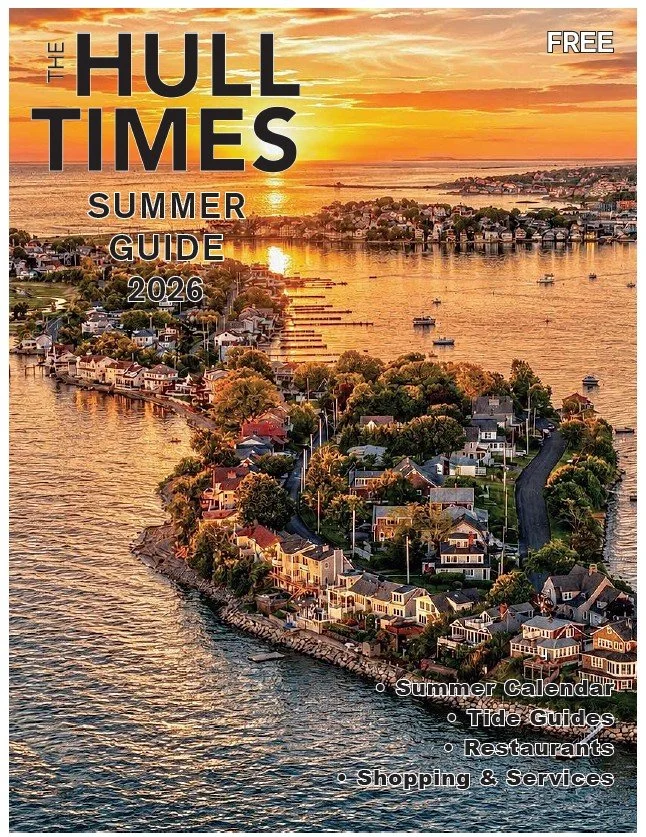
It’s fitting that as the summer solstice dawns this weekend, we also welcome the arrival of the 2026 Hull Times Summer Guide along with this week’s edition, both in your mailbox and at your favorite local store, and here at this link.

This publication is our most anticipated issue of the year. The Guide is free, mailed to all Hull households, and thousands of extra copies are printed and distributed all over town through the fall, for easy pick-up.

The Guide is full of detailed information about upcoming events, special offers from the business community, great stories about Hull from our talented reporters, and of course, it's all supported by our loyal advertisers.

We’re always grateful to our local businesses that support us by advertising each week and in specialty publications like the summer edition; please help us show our gratitude by patronizing these merchants and letting them know that you saw their ad in the Guide. The centerpiece of the publication is the comprehensive community calendar – the best place to find out what is going on in town. Please have a look at the pages of events and activities and mention the Times when you attend an event.

You can always check our website and the print edition of the paper throughout the summer for updates on scheduled events and new opportunities to enjoy the season. It’s never dull around here!

We hope you find the Summer Guide a useful tool for enjoying life in Hull. We know that residents and visitors will find something new and be reminded of all of the things that make this peninsula the best place to spend your summer!


Like what you’re reading? Stay informed and support our work with a Hull Times subscription by clicking here.

Do you have an opinion to share? Click here to write a Letter to the Editor.

© 2026 The Hull Times. All rights reserved.

Fireworks, field day and family fun highlight this weekend’s finale of 250th celebration

SOURCE: HULL SEMIQUINCENTENNIAL COMMITTEE

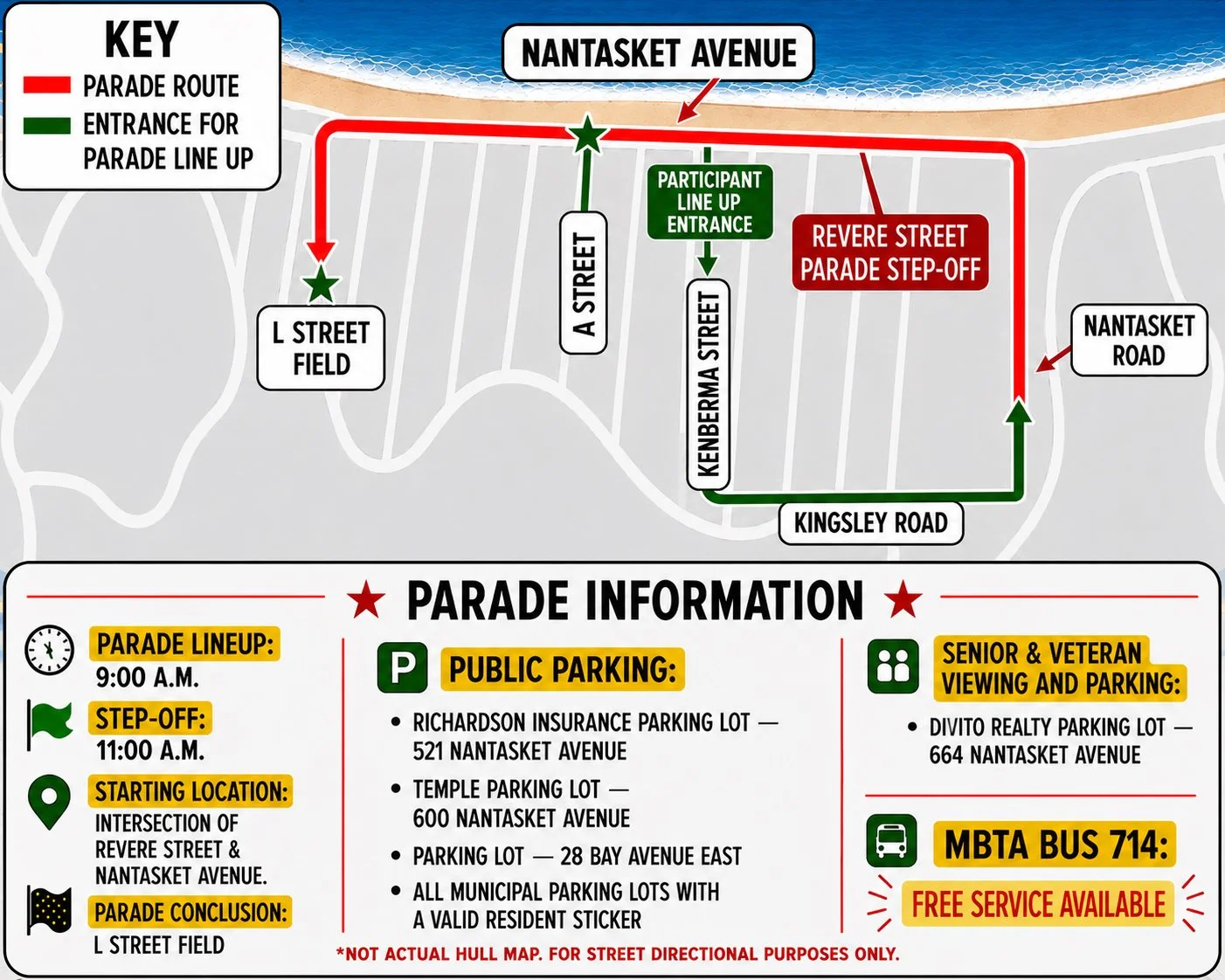
The grand finale of Hull’s commemoration of the nation’s 250th anniversary takes place this weekend, with festivities and fireworks on Friday night and a parade and field day on Saturday.

On Friday, August 14 at 5 p.m., the activities begin at the Hull Redevelopment Authority property, with live music, lawn games, and food trucks and a beer truck, leading up to a 30-minute fireworks display at 9 p.m. Entertainment will be by the Assisted Living band, and parking in the main area of the HRA land will be free for residents with restricted parking stickers. The other parking areas on the property will charge a fee.

On Saturday, August 15, the huge parade will step off from Revere Street at 11 a.m. and travel down Nantasket Avenue to L Street, where a field day is planned to bring together the community.

Hull’s Semiquincentennial Committee has selected four division grand marshals for the parade – Joseph A. DiVito Sr., Mary Jane Silva, Tim Dunn, and Herb Fleck.

Participants in the parade include Hull’s police and fire departments, veterans and military groups, community organizations, floats, patriotic-themed golf carts, classic cars, sports teams, marching bands, drum troupes, USS Constitution Color Guard, stilt walkers and wing dancers, performers and plenty of surprises.

At L Street, food, fun, live music, and games will be available all afternoon for the whole family. For more information, visit the town’s website at www.town.hull.ma.us.


Like what you’re reading? Stay informed and support our work with a Hull Times subscription by clicking here.

Do you have an opinion to share? Click here to write a Letter to the Editor.

© 2026 The Hull Times. All rights reserved.

Family to host penny-candy fundraiser for MS care in memory of ‘Our Sweet Sue’

For more than 100 years, gathering at the summerhouse on Beach Avenue has been a cherished ritual for the Freda-Vadala family, full of love and memories. On August 15, the family invites the community to join them in remembering Suzanne “Sue” Vadala, who passed away in October 2024 after living with multiple sclerosis for many years. August 15 would

have been Sue’s 71st birthday.

Sue Vadala spent every summer in Hull since her birth in 1955. Her birthday was always a

special family celebration at the “Beach House.” Hull’s iconic penny Candy store was one of Sue’s favorite places as a child and she loved sharing it with her own children until it closed its doors in the mid 1980s.

The Freda-Vadala family invites the community to stop by their one-day-only penny candy stand at their home on the corner of Revere Street and Beach Avenue to enjoy a few classic beach “sweets” in memory of Sue.

“Sue loved filling her small brown bag with candy and standing with eyes of wonder as the cashier emptied the bag and counted it for the final tally,” recalls Sue’s sister, Jeanne Shine. “If you know, you know!”

In 2014, Sue became a resident of The Boston Home, a community for adults with MS and other progressive neurological disorders.

“Sue taught our family the meaning of strength as she bravely faced her challenges with multiple sclerosis,” her sister said. “The care and love that Sue received at The Boston Home enabled her to experience the quality of life and respect that she so deserved. The work they do is truly remarkable.”

Even after Sue moved to The Boston Home in Dorchester for full-time care, her family ensured that she could make her annual birthday trip to Hull, bringing her wheelchair to the water’s edge so that she could still feel the healing ocean.

In honor of Sue’s birthday, her family hopes the community will take a moment to enjoy a sweet treat, to share precious memories of childhood summers in Hull, and to learn about Sue and The Boston Home.

“If our little candy stand can help one family who needs support the way that we did when Sue’s multiple sclerosis was progressing, that would mean the world to me!” Jeannie said.

Sue’s family invites anyone who would like to join them in remembering a “Our Sweet Sue” on August 15 at the corner of Revere Street and Beach Avenue. Donations are not required to enjoy the penny candy, but will be gratefully accepted in support of life-enhancing programs for The Boston Home’s residents and outpatients.

The Boston Home is a non-profit skilled nursing facility serving 96 residents who are full-time wheelchair users, as well as outpatients with similar neurological disorders. With on-site physical and occupational therapy, wheelchair enhancement center, assistive technology and adaptive arts and recreation programs, The Boston Home’s mission is to empower people with advanced neurological disorders to lead creative and purposeful lives.

For more information or to make a gift in memory of Sue, visit thebostonhome.org.


Like what you’re reading? Stay informed and support our work with a Hull Times subscription by clicking here.

Do you have an opinion to share? Click here to write a Letter to the Editor.

© 2026 The Hull Times. All rights reserved.

Board sets early-voting hours; hears updates on 250th events, personal rapid transit system

By Carol Britton Meyer

The select board this week approved early voting hours for the upcoming state primary, heard an update on the parade and fireworks sponsored by the 250th Anniversary Committee, approved an Agent Orange Day Ceremony at the veterans memorial, and considered a request to consider a demonstration of a personal rapid transport system.

The early-voting hours for the September 1 state primary election will take place at town hall to coincide with the public hours of the town clerk’s office:

• Saturday, August 22, 9 a.m. to 3 p.m.

• Monday, August 24, 8:30 a.m. to 4:30 p.m.

• Tuesday, August 25, 8:30 a.m. to 4:30 p.m.

• Wednesday, August 26, 8:30 a.m. to 4:30 p.m.

• Thursday, August 27, 8:30 a.m. to 4:30 p.m.

“We’ve already mailed out about 1,300 vote-by-mail ballots,” Town Clerk Lori West noted.

The board also approved signing the September 1 state primary warrant and the appointment of Elizabeth Murphy, Catherine Caloia, and Alice Bisbee as election workers.

At Hull US 250th Anniversary Committee Chair John Reilly’s request, N Street will be closed from 11 a.m. to 5 p.m. for the August 15 USA 250th parade. N Street is part of the parade route. There will also be food trucks along that stretch. The parade starts at 11 a.m., traveling from Revere Street to N Street, with field day activities at L Street.

Fireworks on the Hull Redevelopment Authority property are planned for Friday, August 14, with a rain date the following day. The event will feature the Assisted Living band, a Vitamin Sea Brewing beer garden, food and ice cream trucks, and games. The fireworks will begin at about 9 p.m.

“These events are something we can all be proud of,” Reilly said.

The board approved an Agent Orange Day ceremony at the Hull Veterans Memorial Agent Orange stone at Monument Square on Monday, August 10, at 7 p.m. at the request of War Memorial Commission members Edward Burke and Andrew Wohar. August 10 is Agent Orange Awareness Day nationally.

During select board member reports, Jerry Taverna asked Town Manager Jennifer Constable for an update in response to a question he emailed her earlier related to a comment she made at the July 22 joint select board/light board meeting.

At that time, Taverna made a motion to direct Constable – who also serves as light plant manager – to “separate the two facilities [light plant and Department of Public Works] from the Coastal Zone Management grant process based on the many, many light board meetings and the votes of the light board.” The board issued a resolution earlier opposing the proposed joint facility and related grant activity.

The motion passed 3-2, with board members Irwin Nesoff and Greg Grey voting no and Grey questioning whether such a vote had any validity.

“I heard your vote,” Constable said during the July 22 meeting, noting, “I have authority over grant applications and will consult with town counsel and get back to you.”

Taverna said he is seeking clarification about the status of that agenda item and related comment. He noted at this week’s board meeting that he spoke with town counsel earlier in the day, “provided him with some details, and suggested he watch the video of the meeting,’ he said. “[Town counsel] said he will watch it and get back to us.”

Grey then pointed out that this discussion was taking place during select board updates – rather than a regular agenda item for discussion – and that the conversation was “drifting.”

Taverna then asked that the word “drifting” be removed “from meetings moving forward.”

In other business

• Resident Judeth Van Hamm asked the board to consider the town’s participation in a pilot project, at no expense to Hull, of the JPod personal rapid transit system, extending along the George Washington Boulevard right-of-way from Jake’s to the Paragon Carousel.

JPods are overhead rail networks featuring ultralight vehicles that carry people in pods suspended from elevated rails, using a tenth of the energy of cars, passenger trains, and buses, according to the JPod website.

For more details, visit https://library.jpods.com/what.

While the select board was overall skeptical of such a project, they told JPod founder and CEO Bill James – whom Van Hamm called by cell phone during the discussion to answer questions from the board – that if he could submit a proposal in writing and a video (if available), the board will place the project on an upcoming agenda for further discussion.

“I love your passion, but I can’t see something like this moving forward or ever even happening in Hull, so I can’t support it,” Grey told Van Hamm.

“This is exactly what I was hoping to get out of this [overall discussion],” Van Hamm said.

• Constable reported that either the week of September 21 or 28, there will be a public forum with the Department of Conservation and Recreation that will provide information about the DCR’s climate adaptation and master plans, which she said “are in process.” The meeting will be held in a large space, with an expected high attendance and plans to have it recorded, if possible.

The next board meetings are August 19 and 26.

Following the regular meeting, the board went into executive session regarding the railroad bed.

A reply of this week’s select board meeting will be available on demand on Hull Community Television’s website, www.hulltv.net.


Like what you’re reading? Stay informed and support our work with a Hull Times subscription by clicking here.

Do you have an opinion to share? Click here to write a Letter to the Editor.

© 2026 The Hull Times. All rights reserved.